
Nepal Saves Nearly Rs. 9.87 Arba In Foreign Currency After Fuel Imports Drop
Nepal saved nearly Rs. 9.87 arba in foreign currency after petrol and diesel imports dropped by more than 6.9 crore liters following the two-day public holiday policy and the return of misused government vehicles.
· 5 min read
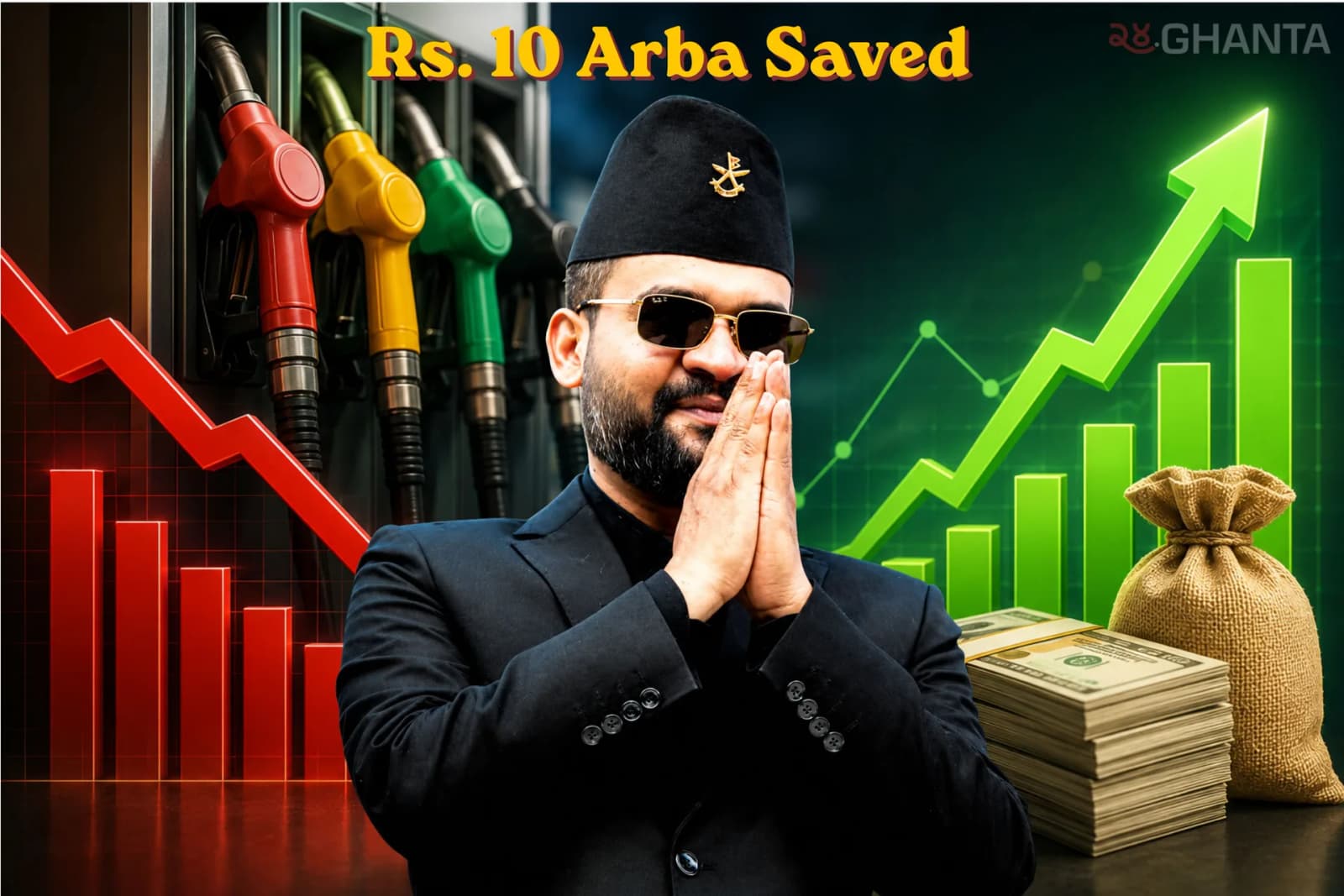
KATHMANDU — Nepal saved nearly Rs. 9.87 arba in foreign currency over three months after petrol and diesel imports dropped by more than 6.9 crore liters following the government’s two-day public holiday policy and a wider crackdown on the misuse of government vehicles.
Who made the decision?
The government introduced the fuel-saving policy by declaring two public holidays every week, on Saturday and Sunday. The decision was made on Chaitra 22 and came into effect from Chaitra 23.
At the same time, Prime Minister Balen Shah moved to take back nearly 700 government vehicles that were being used against rules or by officials and former high-ranking individuals receiving duplicate facilities.

What Changed?
After the decision came into effect, Nepal’s petrol and diesel imports fell sharply during Chaitra, Baisakh, and Jestha.
During the three-month period, total petrol and diesel imports dropped by 6 crore 90 lakh 24 thousand liters.
Petrol imports fell by 2 crore 62 lakh 72 thousand liters, while diesel imports dropped by 4 crore 27 lakh 52 thousand liters.
When Did The Savings Happen?
The fuel import decline was recorded in the three months after the two-day holiday system began: Chaitra, Baisakh, and Jestha.
The impact was especially visible in Baisakh, when the full effect of the two-day weekend and the return of misused government vehicles was seen. Additional public holidays in Baisakh and Jestha also contributed to lower fuel consumption.
Where Was The Impact Seen?
The impact was reflected in Nepal’s national fuel import figures.
Based on earlier import patterns, Nepal had been consuming an average of 6 crore 81 lakh 73 thousand liters of petrol and 13 crore 84 lakh 42 thousand liters of diesel per month during Magh and Falgun.
After the new measures began, fuel imports declined significantly, reducing both market-level fuel transactions and the amount of foreign currency leaving Nepal for fuel purchases.
Why Did Fuel Consumption Fall?
Government officials say there has been no separate study to measure exactly how much fuel was saved only because of the two-day holiday policy.
However, the decline is believed to have been driven by a combined effect of three factors: the two-day public holiday, the return of misused government vehicles, and additional public holidays during Baisakh and Jestha.
Some of the decline may also be linked to lower consumer demand caused by higher fuel prices.
According to reports, the strict move to bring back government vehicles and the two-day holiday policy naturally helped reduce fuel consumption and save state resources.
How Much Money Was Saved?
At current retail market prices, the fall in fuel imports reduced total fuel transactions by around Rs. 14.60 arba.
Based on the retail price of Rs. 219 per liter for petrol, the decline in petrol imports saved around Rs. 5.75 arba in market value.
Similarly, based on the retail price of Rs. 207 per liter for diesel, the decline in diesel imports saved around Rs. 8.45 arba in market value.
However, retail fuel prices include taxes, fees, transportation costs, dealer commissions, and other domestic expenses that remain inside Nepal.
After removing these internal taxes and local costs, the net fuel-cost saving is estimated at around Rs. 9.46 arba.
Using the actual purchase price paid by Nepal Oil Corporation to Indian Oil Corporation, the foreign currency saving is estimated at around Rs. 9.87 arba over the three-month period.
Monthly Breakdown
In Chaitra, petrol imports fell by 86 lakh 35 thousand liters, saving around Rs. 1.89 arba in retail market value. But diesel imports increased by 15 lakh 87 thousand liters that month, limiting the total market-level saving to around Rs. 1.56 arba.
In Baisakh, petrol imports fell by 94 lakh 93 thousand liters, saving around Rs. 2.07 arba in retail market value. Diesel imports dropped sharply by 3 crore 63 lakh 71 thousand liters, saving around Rs. 7.53 arba. Altogether, Baisakh alone saw around Rs. 9.60 arba in fuel transaction savings.
In Jestha, petrol imports fell by 81 lakh 44 thousand liters, saving around Rs. 1.78 arba in retail market value. Diesel imports fell by 79 lakh 68 thousand liters, saving around Rs. 1.64 arba. The total market-level saving in Jestha was around Rs. 3.43 arba.
Why The Figures Matter
Nepal spends a large amount of foreign currency on fuel imports every year. The three-month decline shows how even small policy changes, if combined with stricter control over government resources, can reduce pressure on the economy.
The figures also show the importance of separating market-level savings from real foreign currency savings. While the total fuel transaction value declined by around Rs. 14.60 arba, the actual foreign currency saved on fuel purchases was around Rs. 9.87 arba.
No Separate Study Yet
Officials have made clear that no separate government study has been conducted to calculate the exact fuel saving caused only by the two-day public holiday system.
Still, the combined impact of the public holiday policy, government vehicle recovery and reduced movement during additional holidays appears to have played a major role in lowering fuel imports.
The data has now become an example of how governance reforms and consumption-control measures can provide financial relief at a time when Nepal’s economy remains under pressure.
Published Jul 10 in Business