
Bolivia’s Mysterious Tilcayo Becomes First Newly Described Living Cat Species Since 1923
A small spotted wildcat first examined at a Bolivian sanctuary in 2016 has been formally described as Leopardus tilcayo, the first entirely new living cat species named in more than a century.
· 7 min read
KATHMANDU, September 20, 2026
A mysterious spotted cat that arrived at a wildlife sanctuary in Bolivia has been formally identified as an entirely new species, giving science its first newly described living member of the cat family in more than 100 years.

The animal has been named Leopardus tilcayo, using the traditional name “tilcayo,” which local communities already used for the small wildcat. The finding was published online in the scientific journal Current Biology on September 17, 2026. The peer-reviewed study carries the title “Phylogenomics and museomics reveal five distinct species of tiger cats in South America.”
A Strange Call From a Wildlife Sanctuary
The scientific journey began in 2016 when Bolivia’s Senda Verde Wildlife Sanctuary contacted biologist Paola Nogales-Ascarrunz about an unusual cat in its care.
According to accounts provided by the researchers, a local resident had found the animal as a kitten and initially believed it was a domestic cat. It reportedly lived with a family for about a year before its wild behavior became difficult to manage and it was taken to the sanctuary.
Nogales-Ascarrunz initially thought the animal was a member of Leopardus tigrinus, a small South American wildcat commonly known as the northern tiger cat or oncilla.
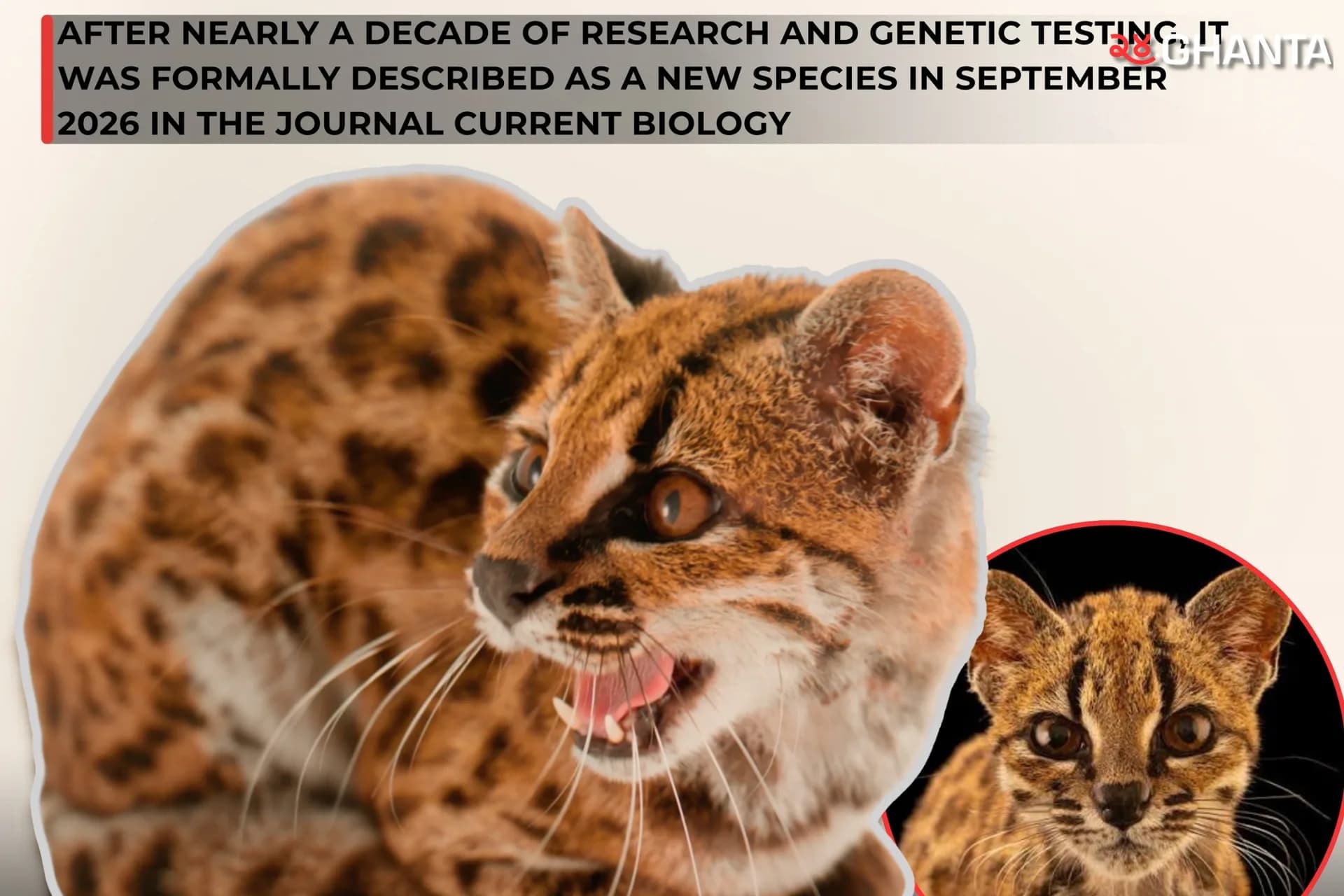
However, the animal looked unusual. It had a small face, short rounded ears, long whiskers, and large leopard-like markings known as rosettes.
While preparing educational material about Bolivia’s wildcats in 2019, Nogales-Ascarrunz compared its photographs with tiger cats from Brazil and noticed important differences in the size and pattern of its markings. That observation led to years of deeper investigation. National Geographic documented the research journey.
DNA Revealed a Separate Species
Appearance alone was not enough to prove that the animal represented a new species. Tiger cats are considered “cryptic species,” meaning separate species can look so similar that photographs and physical observations cannot reliably distinguish them.
An international team therefore studied complete genomes from 38 individual cats belonging to the South and Central American genus Leopardus. The material included DNA from living animals and eight museum specimens.
The genetic evidence placed the Bolivian cat on a separate branch of the tiger-cat family tree. Researchers estimated that its lineage separated from other tiger cats approximately 1.4 million years ago.
The study concluded that the animals previously grouped within the tiger-cat complex represented five genetically distinct species:
Leopardus guttulus
Leopardus emiliae
Leopardus pardinoides
Leopardus tigrinus
Leopardus tilcayo
Researchers also described a new Peruvian subspecies, Leopardus tigrinus antisuyo.
First Entirely New Living Cat Species Since 1923
Reports frequently describe Leopardus tilcayo as the first new cat discovered in more than 100 years. More precisely, researchers say it is the first living cat species in over a century to receive a completely new scientific name and formal description.
Some recent feline discoveries have involved restoring an older scientific name or raising a previously recognized subspecies to full species status. The tilcayo is different because scientists had never formally described it as a species or subspecies before.
The previous comparable description was the pampas cat in 1923, according to the researchers and subsequent scientific reporting.
This does not mean local people were unaware of the animal. Communities in the region already called it “tilcayo,” and researchers retained that name in its scientific identity.
What Does the Tilcayo Look Like?
The tilcayo is a small wildcat with a light-brown coat covered in irregular dark rosettes that give it the appearance of a miniature leopard.
Verified physical details include:
A body length of approximately 46 centimeters
A weight of around 1.4 kilograms
Light-brown fur
Large, irregular dark rosettes
Short, rounded ears
Long whiskers
A body smaller than that of an average domestic cat
The research team examined only two living individuals, along with a limited number of camera-trap records. One of those cats is a male living at the Senda Verde sanctuary.
Where Does It Live?
The species has been genetically confirmed in the Bolivian Yungas, a humid mountain-forest region along the eastern slopes of the Andes.
The Yungas forms an ecological transition between high mountain areas and the Amazon Basin. Its cloud forests contain high biodiversity, but many areas remain difficult to study.
Researchers currently do not know whether the tilcayo is limited to a small section of Bolivia or has a wider distribution. It has not yet been genetically confirmed in neighboring Peru or Argentina.
Much of Its Life Remains a Mystery
Scientists still lack enough evidence to provide a complete description of the tilcayo’s behavior and ecology.
Confirmed observations remain limited:
Small-rodent remains found in fecal samples suggest rodents form part of its diet.
Camera-trap records indicate it may be more active at night.
Its total population is unknown.
Its complete habitat range is unknown.
Its reproduction, lifespan, predators and wider diet have not been documented.
Researchers have therefore avoided making firm claims about its daily life in the wild.
Discovery Changes the Cat Family Tree
The study carries importance beyond the identification of one small wildcat. Scientists had once treated tiger cats across a large part of South and Central America as one broadly distributed species.
Genomic evidence now shows that this group contains several separate evolutionary lineages. Recognizing five species instead of one changes how researchers understand their development, movement, and isolation across the continent.
The work also demonstrates how complete-genome analysis and “museomics, the study of genetic material preserved in museum specimens, can reveal differences that photographs and conventional field observations miss.
Researchers believe similar methods could help identify other overlooked populations of small wildcats, although further research will be necessary before any additional species can be confirmed.
Why Separate Recognition Matters for Conservation
A population can appear relatively secure when it is counted as part of one species occupying a vast geographical range. Its situation may look very different when genetic evidence shows that the population is actually a separate species living in a much smaller area.
The International Union for Conservation of Nature currently recognizes two tiger-cat species as vulnerable. Researchers have shared their findings with the IUCN so the five newly clarified lineages can be evaluated separately.
The tilcayo has not yet received its own confirmed IUCN threat classification. Researchers have said it could face greater danger than earlier assessments suggested, but that possibility must not be reported as an official endangered classification.
The Yungas forests face pressure from:
Deforestation
Agricultural expansion
Human-caused fires
Mining
Separation of remaining forest habitats
Because scientists do not yet know the tilcayo’s population or complete range, they cannot accurately calculate its extinction risk.
A Scientific Discovery Built on Local Knowledge
Although the species is new to scientific classification, it was not unknown to the people living alongside it.
Researchers chose “tilcayo” because the name had been passed down through local communities for generations. Its exact linguistic origin remains uncertain, but using the community name recognizes that local knowledge existed long before genetic analysis placed the animal on its own scientific branch.
The discovery shows that remote ecosystems may still hold animals familiar to local residents but not formally recognized by science.
Key Points
Leopardus tilcayo was formally described in Current Biology on September 17, 2026.
The animal was first examined by biologist Paola Nogales-Ascarrunz at a Bolivian sanctuary in 2016.
It is the first entirely new living cat species formally named and described since 1923.
The wildcat is smaller than an average domestic cat and has irregular leopard-like rosettes.
Researchers analyzed complete genomes from 38 cats.
Genetic evidence indicates its lineage separated from related tiger cats about 1.4 million years ago.
It has been confirmed in Bolivia’s Yungas cloud forest.
Its population, complete range, reproduction, and wider behavior remain unknown.
It does not yet have a separate official IUCN conservation classification.
Published Yesterday in World