
From Eggs to Biscuits: How Nepal’s Football Crisis Is Reaching Young Players
More than 100 young footballers living in four ANFA-linked academies across Nepal are facing reduced meals, unpaid school expenses and growing financial uncertainty after FIFA’s suspension disrupted funding to the All Nepal Football Association. Academy officials say some centers are surviving through personal loans and unpaid bills, raising concerns that a football governance dispute is now affecting children who rely on the academies for much more than training.
· 7 min read
KATHMANDU, August 11, 2026
More than 100 young footballers living and training at academies in Lalitpur, Butwal, Rautahat and Dharan are being affected by a financial crisis after FIFA suspended the All Nepal Football Association (ANFA) on June 24 over unresolved third-party interference in football governance. With ANFA unable to provide its usual financial support for the past two to three months, academy officials say expenses covering food, schooling, medical care, training and staff salaries have become increasingly difficult to manage, forcing several centers to depend on loans and credit.
Young Players Feel The Impact
For the children inside Nepal’s football development system, the crisis is showing up in everyday routines.

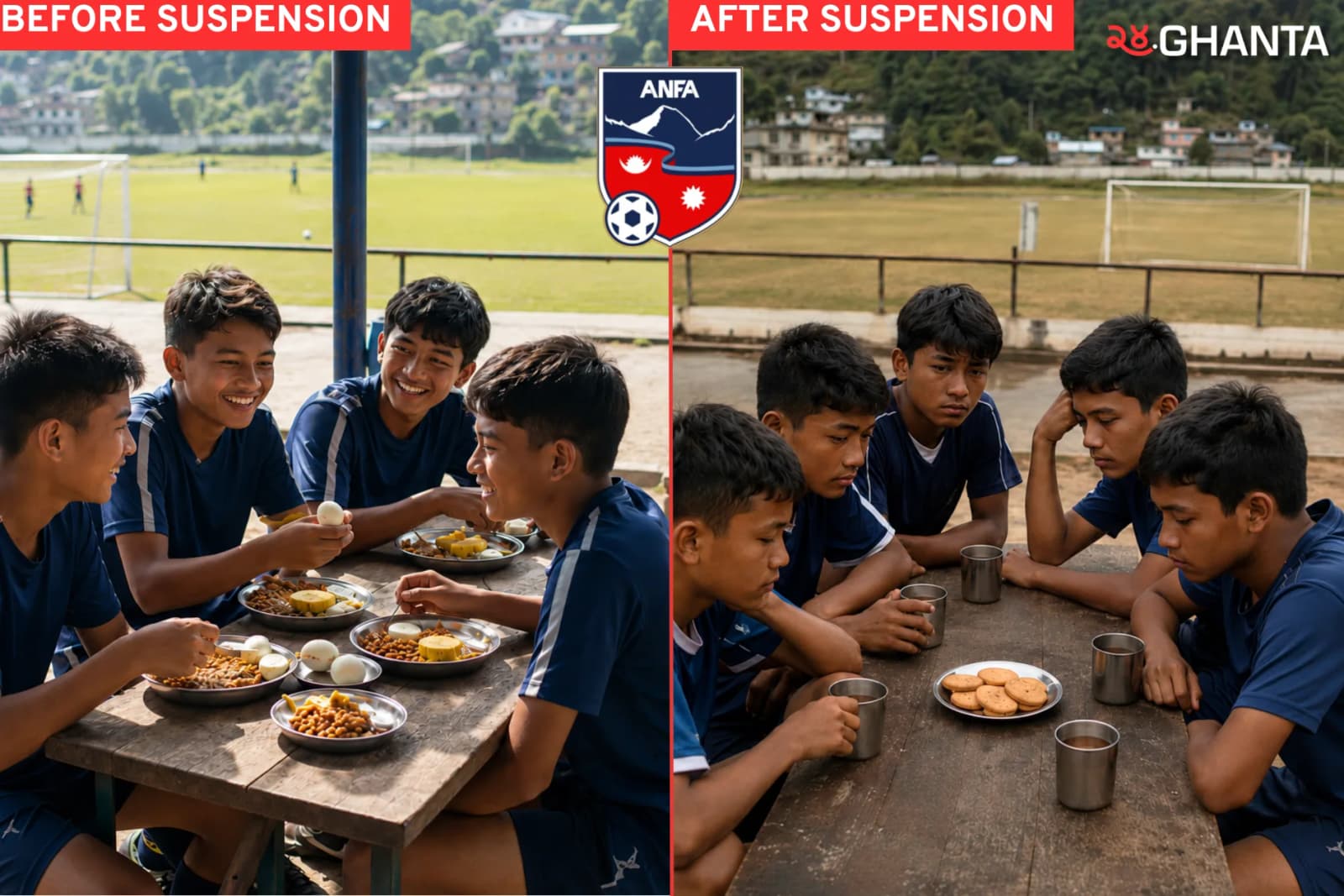
Players who once received more substantial food such as chickpeas and eggs before training are, at times, reportedly heading onto the field after having only tea and biscuits.
The change may sound small compared with the larger institutional dispute surrounding ANFA, but for growing athletes who train regularly, nutrition forms an important part of their development.
Academy officials say the challenge goes far beyond food. School fees, medical expenses, grocery bills and staff salaries are also becoming difficult to cover.
Four Academies Under Pressure
Four football academies connected with FIFA’s Goal Project are currently operating across Nepal.
Together, they accommodate more than 100 young players.
The academies are based at Satdobato in Lalitpur, Butwal, Rautahat and Dharan, although their financial situations are not identical.
Three of them are facing significant pressure because of the interruption in funds, while Dharan has been able to rely more heavily on support from local institutions and donors.
Satdobato Needs Around Rs 200,000 A Week
The academy currently operating from ANFA headquarters in Satdobato, Lalitpur, houses 21 young players.
ANFA spokesperson Suresh Shah has said operating the academy requires around Rs 200,000 every week.
The same children were previously housed at an academy in Sisneri, Makwanpur. They were later relocated following the devastating flood and landslide there two years ago in which six academy players lost their lives.
They eventually arrived at Satdobato, where they now continue their studies and football training.
The latest financial disruption has created another challenge for the group.
Butwal Running On Loans And Credit
The situation appears particularly difficult at the Butwal academy, which has 30 students, two coaches and several other employees.
Acting academy director Shankar Malla has said he has been borrowing money to keep operations running.
School payments are becoming due, while grocery bills have reportedly remained unpaid for more than three months.
Suppliers who previously allowed purchases on credit are becoming reluctant to continue doing so.
Staff members have also gone without regular salaries.
Despite those difficulties, the academy has continued sending children to school and conducting football training while administrators try to keep the financial problems away from the players as much as possible.
Concern Over Players’ Health
Academy officials have also raised concerns about the health of the young players.
At Butwal, officials say children have frequently been falling ill while financial pressure has made it more difficult to maintain the same level of food and care previously available.
The academy has so far continued providing basic services, but its management has warned that the situation may become much harder to sustain if funding does not resume.
Officials have particularly pointed toward the coming weeks as a critical period because schools, suppliers and employees cannot remain unpaid indefinitely.
Rautahat Also Depending On Personal Loans
The Rautahat academy, home to 29 young footballers, is facing a similar problem.
Academy coordinator Bhagwan Darlami has said the center is operating largely on credit, with people involved in its management personally assuring suppliers that outstanding bills will eventually be paid.
With regular ANFA funding unavailable, some expenses have reportedly been covered through loans taken in the names of those running the academy.
Administrators say their immediate priority is preventing the financial dispute outside the academy from disrupting the children’s education and football development.
Why Dharan Is Coping Better
The Dharan academy, which houses around 30 players, has managed the crisis better than the other three centers.
Its president, Kishor Rai, has said the academy receives funding from several sources rather than depending entirely on ANFA.
Support comes from the local municipality, provincial government and private donors, providing the academy with a financial cushion during the current disruption.
ANFA also previously contributed a smaller amount through its partnership with the academy.
The difference highlights how heavily academies that rely primarily on central football funding can be exposed when that support suddenly stops.
Why Did The Funding Stop?
The immediate problem goes back to June 24, 2026, when FIFA suspended ANFA with immediate effect over what it described as unresolved third-party interference in Nepali football administration.
The dispute followed months of tension involving ANFA, the National Sports Council, elections and questions over the independence of the football governing body.
Although the National Sports Council had earlier withdrawn its own suspension of ANFA, FIFA concluded that issues linked to its previous directives had not been fully resolved.
Under FIFA’s suspension, ANFA lost its membership rights and access to FIFA and AFC development programs and benefits.
That international-level decision has now had consequences far below the governing body itself.
ANFA Says Its Hands Are Tied
ANFA spokesperson Suresh Shah has acknowledged that academy players are no longer receiving the same level of food and facilities they were accustomed to before the crisis.
According to Shah, ANFA has been unable to send regular financial support to the academies for roughly two to three months.
He has also said ANFA was instructed by the government not to conduct activities, further limiting the association’s ability to release resources.
For academy managers, however, expenses have continued regardless of the dispute.
Children still have to eat, attend school, receive medical attention and train, while employees and suppliers continue waiting for payment.
A Governance Crisis Reaching The Next Generation
FIFA’s suspension was initially discussed mainly in terms of Nepal losing international matches, competitions and development opportunities.
The academy situation reveals another consequence.
The young footballers involved have no role in ANFA elections, government directives or disputes over football administration, yet they are among those now feeling the financial impact.
Many of these academies do more than develop football talent. They also provide children with accommodation, education, meals, training and structured daily care.
Interruptions therefore affect not only Nepal’s future football talent but also the children's everyday lives.
ANFA Official Calls On Government To Act
ANFA central committee member and Makwanpur District Football Association president Tika Lama has urged the government to treat the issue as a serious responsibility.
His argument is straightforward: whatever disagreements exist between football authorities, young players should not be the ones paying the price.
Lama has called on the country’s leadership, including the prime minister and sports authorities, to ensure that responsibility for the academies is fulfilled and that children are not left without proper meals or basic support.
What Happens If The Crisis Continues?
For now, all four academies remain operational.
Training has not completely stopped, children are continuing their education and managers are finding temporary ways to cover expenses.
But loans, unpaid salaries and credit from suppliers can only provide a short-term solution.
If the FIFA suspension remains unresolved and funding does not resume, academy administrators fear maintaining the existing system will become increasingly difficult.
What began as a dispute over who controls and governs Nepali football is therefore becoming something much more immediate.
For more than 100 young players dreaming of becoming Nepal’s next generation of footballers, the crisis is already being felt at the dining table, in the classroom and on the training ground.
Published Aug 11 in Sports