
Over Rs 200 Million in Student Fees Allegedly Embezzled at RRM Campus, TU Pledges Action
An Investigation Into Alleged Financial Irregularities at RRM Campus in Janakpurdham Has Uncovered a Student Fee Scam Involving an Estimated Rs 200 Million, While Thousands of Receipts Were Destroyed During the 2025 Gen Z Protests.
· 6 min read
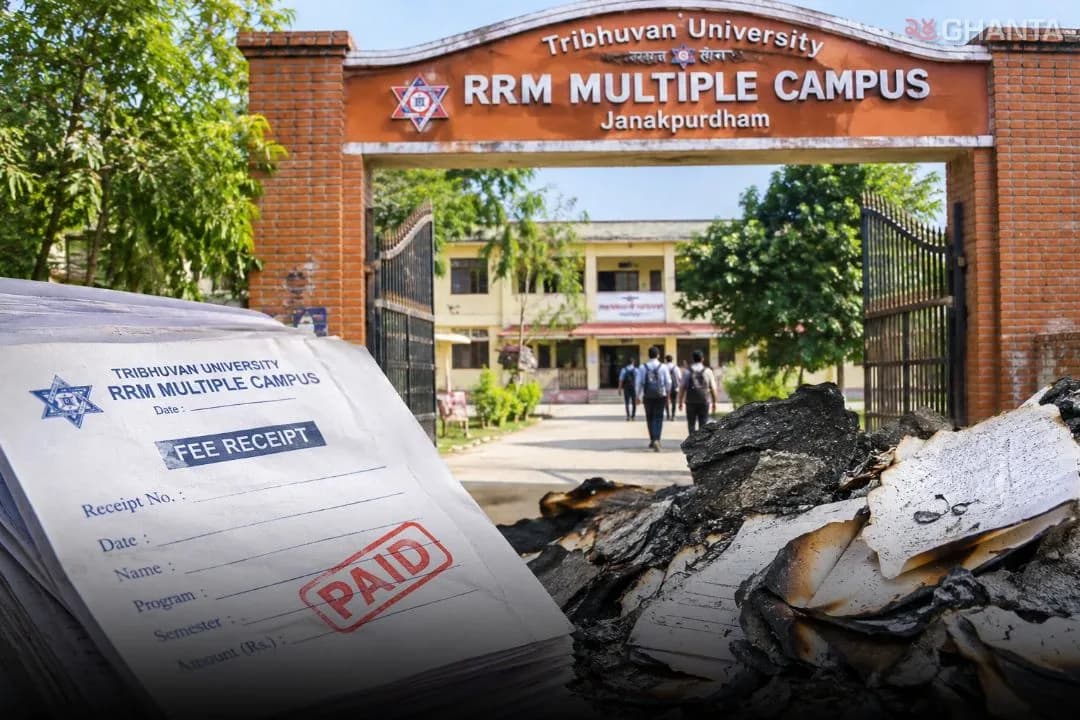
Kathmandu, November 26, 2026 — Tribhuvan University (TU) has pledged legal and disciplinary action against individuals involved in the alleged embezzlement of more than Rs 200 million (Rs 20 crore) in student fees at Ram Sagar Ram Swaroop (RRM) Multiple Campus in Janakpurdham, Dhanusha.
An investigation conducted by TU’s central office uncovered extensive financial irregularities involving manipulated receipts, unrecorded fee collections, and money that was never deposited into the campus’s bank account.
The investigation identified accounting assistant Sanjay Das as the principal suspect. However, the scale and duration of the alleged fraud have also raised serious questions about the campus administration, financial oversight, and auditing mechanisms.

The case is being described as the largest student fee-related financial scandal uncovered at Tribhuvan University.
How 36 Students Helped Expose the Alleged Scam
The financial irregularities began coming to light in late 2024 and early 2025 when students discovered that their previously paid semester fees were missing from the campus’s financial records.
When students attempted to fill out examination forms in January and February 2025, some were informed that their semester fees remained unpaid despite having official payment receipts.
Complaints from 36 students prompted Tribhuvan University’s central office to launch an investigation into the financial records of the campus, which serves approximately 20,000 students.
Students who presented their receipts were allowed to complete their examination forms without disrupting their academic activities.
However, the investigation revealed that the discrepancies extended far beyond the initial complaints.
Thousands of Receipts Destroyed During Gen Z Protests
Following the students’ complaints, TU dispatched an investigation team to Janakpurdham to examine financial records and collect receipts.
University officials reportedly found the initial investigation insufficient and decided to send a second team for a more comprehensive review.
Before the second team could arrive, the campus accounts section and the campus chief’s office were set on fire during the September 2025 Gen Z protests.
Thousands of financial receipts and documents were destroyed, including records that could have helped investigators establish the full extent of the alleged embezzlement.
According to Onlinekhabar, campus employees and teachers suspect that the fire was deliberately intended to destroy financial evidence. The investigation reportedly linked a group led by Das to the incident.
These allegations have not been established through a final court judgment.
Rs 62.4 Million Identified Through Surviving Records
Despite the destruction of financial documents, investigators identified approximately Rs 62.4 million in alleged embezzlement through the records that survived.
The investigation uncovered discrepancies between student receipts, internal financial records, and actual bank deposits.
Investigators also found that 22 additional receipt pads containing 2,200 receipts had been destroyed in the fire.
Based on average student fee collections, university officials estimate that these missing receipts could account for another Rs 130 million to Rs 140 million.
The combined figures suggest potential losses of approximately Rs 192.4 million to Rs 202.4 million. University officials believe the total recovery amount could exceed Rs 200 million when applicable penalties are included.
The precise amount remains uncertain because many original financial records are no longer available.
Financial Records Reveal Major Discrepancies Over Five Years
The investigation examined financial transactions between July 2020 and January 2026.
Campus financial records showed substantial differences between the expected revenue from student fees and the amounts deposited into the institution’s bank account.
Fiscal Year | Expected Deposits | Actual Deposits |
|---|---|---|
2020/21 | Rs 27.9 million | Rs 2.524 million |
2021/22 | Rs 41.5 million | Rs 6.549 million |
2022/23 | Rs 41.2 million | Rs 13.1 million |
2023/24 | Rs 35.9 million | Rs 14.7 million |
2024/25 | Rs 25.6 million | Rs 0 |
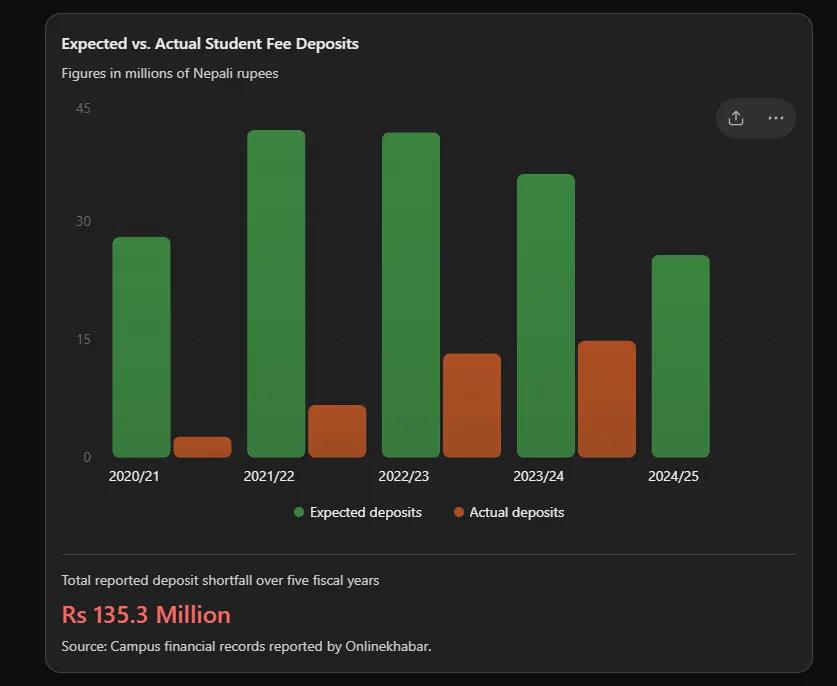
According to the investigation, the difference between expected and actual deposits amounted to approximately Rs 135.3 million over five fiscal years.
These recurring discrepancies have raised questions about why financial irregularities were not identified earlier through routine monitoring and annual audits.
The deposit shortfall represents a separate measure of financial discrepancies and should not be added to the estimated embezzlement total.
Questions Raised Over Campus Administration and Auditors
The investigation has raised concerns about the effectiveness of financial oversight at RRM Campus.
Former campus chief Pradeep Prasad and former accounts chief Devendra Shah have both denied having knowledge of the alleged embezzlement.
Prasad maintained that monitoring student fee collections and verifying bank deposits were the responsibilities of the accounts department.
Meanwhile, Shah said he had been serving as acting accounts chief with limited staff and was not directly responsible for issuing receipts.
Questions have also been raised about TU’s internal audit teams and the Office of the Auditor General, which reportedly conducted annual audits during the period under investigation.
Campus officials have expressed concerns about whether an alleged fraud of this scale could have occurred without being noticed by other employees or administrators.
However, the involvement of additional individuals has not been conclusively established.
Principal Suspect Was Arrested and Released on Bail
The campus administration filed a criminal complaint against Sanjay Das at the District Police Office, Dhanusha, on November 13, 2025.
He was subsequently arrested and released on bail of Rs 30,000 on November 26, 2025, in connection with a criminal mischief case.
Das, who joined the campus as a permanent employee in 2016, has reportedly not returned to work since the incident.
According to Onlinekhabar, attempts to contact him for his response to the allegations were unsuccessful.
The university’s investigation examined approximately five years of financial transactions, leaving uncertainty about whether similar irregularities occurred before July 2020.
TU Vice-Chancellor Pledges Action and Recovery of Funds
Tribhuvan University Vice-Chancellor Professor Dr. Bhola Thapa has confirmed that the investigation committee has submitted its report and that the university is reviewing its findings.
Speaking on November 26, Thapa said individuals found responsible would face action under TU regulations and prevailing laws.
He also pledged to recover the misappropriated funds and investigate similar financial irregularities at other campuses.
Tribhuvan University’s regulations allow disciplinary measures, including dismissal, against employees found responsible for corruption or financial misconduct.
The investigation committee has reportedly recommended the immediate recovery of Rs 62.4 million identified through surviving records, along with further action concerning the missing receipts and individuals responsible.
Accountability Remains Pending
Although the investigation has been completed, the campus administration is still awaiting a formal decision from TU’s central office.
As of November 26, 2026, the supplied reports indicate that formal disciplinary proceedings against Das had not yet been initiated.
The case has exposed significant concerns regarding student fee management, institutional accountability, financial transparency, and the effectiveness of auditing systems within Nepal’s largest university.
For thousands of students who pay semester fees, the investigation raises questions about the security of their payments and the reliability of institutional financial records.
TU now faces the responsibility of establishing individual accountability, recovering the missing funds, and strengthening financial oversight to prevent similar incidents in the future.
Published 20 hours ago in Crime