
“The Himalayas Are Warning The World”: Balen Shah’s Powerful Message At The UN
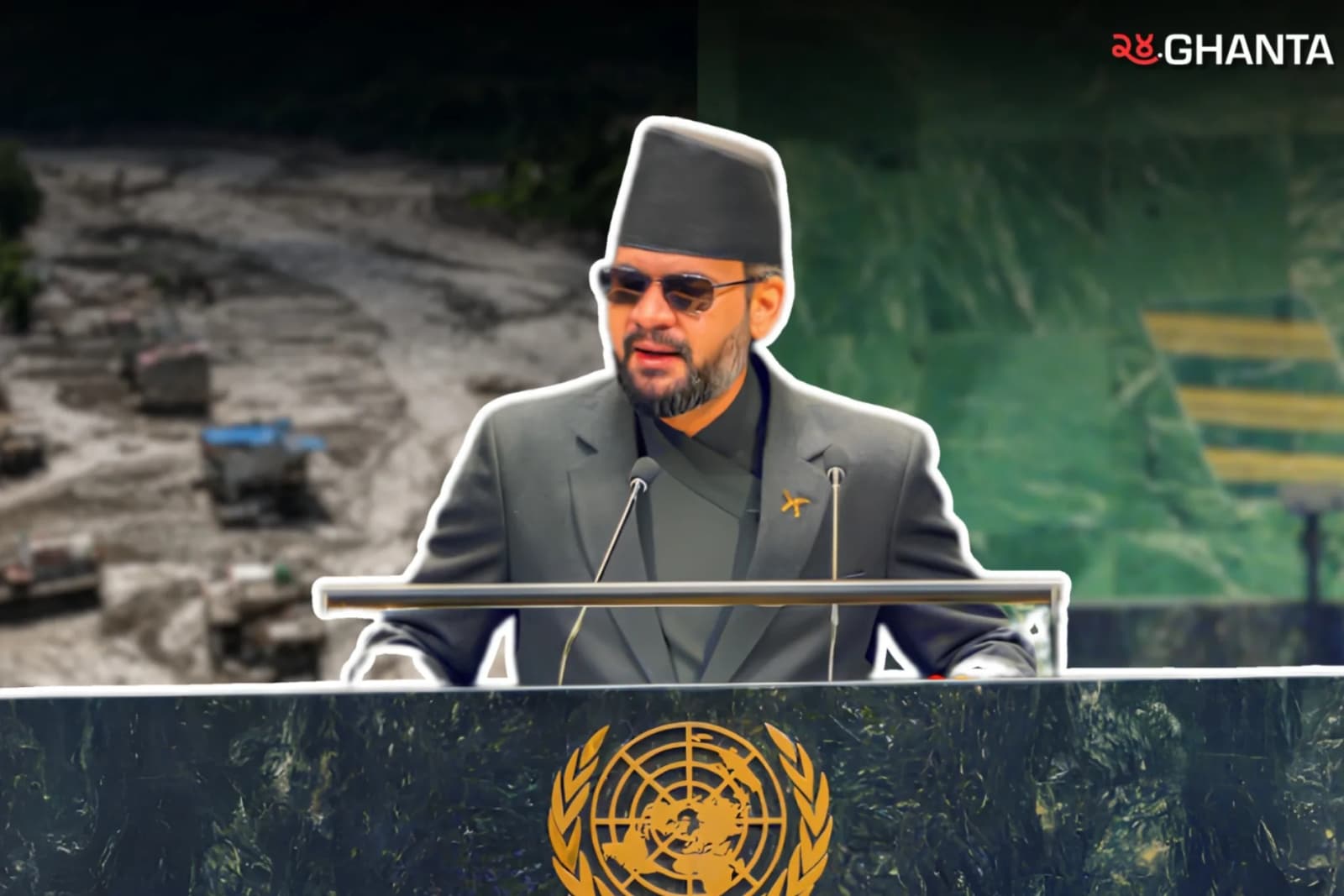
Prime Minister Balendra Shah used his address at the 81st United Nations General Assembly to present Nepal’s Bhotekoshi–Trishuli disaster as a warning about the growing impact of climate change on Himalayan communities. He called for stronger global climate cooperation, a Nepal–India–China Himalayan Climate Resilience Mechanism, fair climate finance and a global system where vulnerable countries have a stronger voice.
· 4 min read
Kathmandu, September 25, 2026
Balen Shah Brings Nepal’s Himalayan Warning To The World
Prime Minister Balendra Shah addressed the 81st United Nations General Assembly in New York, where he spoke about Nepal’s devastating Bhotekoshi–Trishuli floods, the growing threat of climate change and the need for stronger global cooperation. Shah said he came from Nepal, a Himalayan country, carrying a warning for humanity about the dangers facing vulnerable communities because of climate change.

A Disaster That Became A Global Warning
Shah began his speech by describing the destruction caused by the Bhotekoshi–Trishuli disaster.
He spoke about families waiting for missing loved ones, communities searching through mud and water, and the destruction of bridges, roads, schools, homes, and livelihoods.
He said the disaster was not only Nepal’s tragedy but a warning for the entire world.
“The Bhotekoshi-Trishuli disaster was not just a local tragedy; it was a warning to the world,” Shah said, questioning whether global leaders had truly understood the message coming from the Himalayas.
Climate Change Is Putting The Himalayas At Risk
Shah said rising global temperatures are destabilizing the fragile Himalayan ecosystem.
He highlighted growing risks including:
Melting glaciers
Unstable mountain slopes
Ice-rock avalanches
Floods and landslides
Unpredictable rivers
He said climate change does not respect borders, explaining that glaciers and floods do not need passports to move from one country to another.
Nepal Pays The Price For A Crisis It Did Not Create
During his speech, Shah highlighted Nepal’s low contribution to global emissions while facing serious climate impacts.
He said Nepal contributes less than 0.1% of global greenhouse gas emissions, yet the country is suffering major consequences from climate change.
According to Shah, climate disasters are not only humanitarian crises but also development emergencies because they destroy:
Roads and bridges
Schools and homes
Farms and livelihoods
Clean energy infrastructure
He said disasters force vulnerable countries to spend money rebuilding damage they did not cause.
A New Himalayan Climate Cooperation Plan
One of Shah’s major proposals at the UN was the creation of a Himalayan Climate Resilience Mechanism led by Nepal, India and China.
The proposed mechanism would focus on:
Sharing satellite data and scientific expertise
Monitoring dangerous glacial lakes
Strengthening early-warning systems
Coordinating disaster response across borders
Shah said the Himalayas should become a place of international cooperation instead of fragmented action.
From Relief To Resilience: Shah’s Six-Word Climate Message
Shah said the world must move beyond only responding after disasters.
He highlighted six important words:
Relief
Immediate support after a disaster.
Rehabilitation
Helping affected communities recover.
Reconstruction
Rebuilding damaged infrastructure.
But he said long-term solutions require:
Responsibility
Accepting the causes and impacts of climate change.
Reparation
Providing meaningful support to affected countries.
Resilience
Building systems that can withstand future disasters.
He said disaster-hit countries cannot continue depending only on loans and limited support to rebuild after climate events.
Climate Finance Should Not Be A Difficult Process
Shah criticized the current climate finance system, saying vulnerable countries often spend years trying to access support.
He said climate finance should not become a complicated process where countries must complete endless procedures before receiving help.
“When the house is burning, we do not ask the family to complete fifty forms. We act,” Shah said while calling for stronger climate justice.
The Himalayas Are A Global Lifeline
Shah highlighted that the Hindu Kush Himalaya region supports nearly two billion people through water resources, agriculture, ecosystems and livelihoods.
He said the Himalayas are not only important for Nepal but are part of the planet’s life-support system.
Questioning The World’s Priorities
Shah also raised concerns about global supply systems and inequality.
He questioned why military equipment can move quickly across borders while essential supplies for ordinary people often face delays.
He mentioned challenges faced by farmers and communities, including shortages of fertilizer, fuel, and other necessary materials.
He said the world has developed efficient systems for war but weaker systems for meeting basic human needs.
A Call For A Fairer Global System
Shah said the current international system needs reform.
He argued that global decisions should not depend only on military and economic power, and smaller countries should have a stronger voice in international affairs.
He said climate justice is not only about money but also about:
Who carries the cost
Who gets a voice
Whether vulnerable countries and future generations are treated fairly
Message From Nepal’s Young Generation
Shah also spoke about Nepal’s younger generation and their demand for accountability, integrity and opportunities.
He said this change is part of a wider global movement where young people are seeking a stronger role in shaping the future.
Nepal’s Final Message At The UN
Ending his speech, Shah called for the world to move from reaction to preparation.
He urged countries to:
Invest in climate resilience
Build stronger infrastructure
Improve warning systems
Reduce fossil fuel dependence
Create systems that protect lives
He said the next warning from the Himalayas should not be ignored.
Nepal’s message at the UN was clear: climate change is not only an environmental challenge, but a test of global responsibility, cooperation and fairness.
Published 1 hour ago in World