
Western Sydney Unemployment Hits Highest Level Since Pandemic
Why Has Western Sydney’s Unemployment Reached Its Highest Level Since the COVID-19 Pandemic, and With Rising Living Costs and Interest Rates Putting Pressure on Australia’s Economy, What Does It Mean for Nepali Students and Workers in Australia?
· 4 min read

Kathmandu, November 27, 2026 — Unemployment across Western Sydney has climbed to its highest level since the COVID-19 pandemic, as rising interest rates, persistent inflation, and increasing living costs continue to weaken Australia’s labor market and put financial pressure on households.
According to figures from the Australian Bureau of Statistics (ABS), unemployment in the Merrylands-Guildford area reached 7.8% in October 2026, the highest rate recorded across Sydney.
The increase comes as Australia's national unemployment rate reached 4.9% in October, with nearly 80,000 jobs lost nationwide over the previous two months.

Western Sydney Experiences Rising Unemployment
Several suburbs across Western Sydney have recorded significant increases in unemployment compared with the same period last year.
In Merrylands-Guildford, the unemployment rate increased from 6.5% in October 2025 to 7.8% in October 2026. The number of unemployed individuals increased by approximately 1,300, representing a rise of nearly 25%.
Fairfield and Mount Druitt have also experienced deteriorating employment conditions.
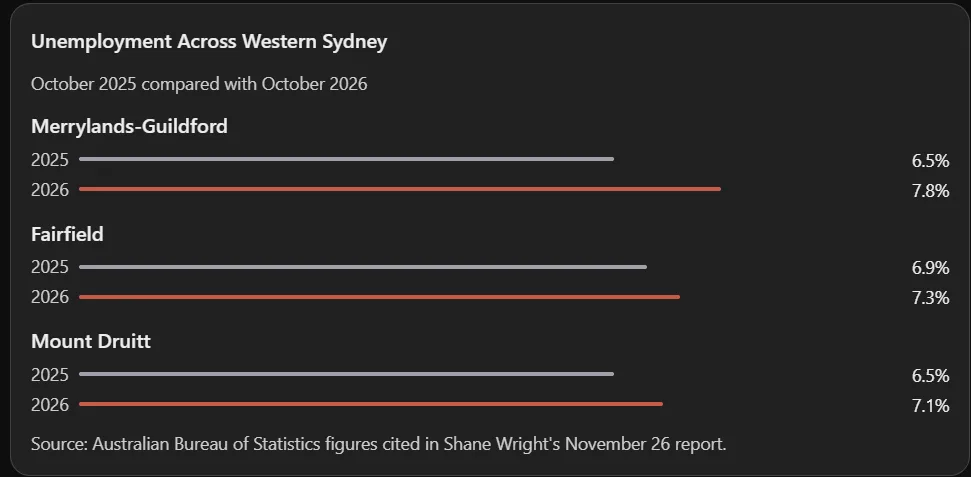
Much of the deterioration in Western Sydney's employment market has occurred since the Reserve Bank of Australia (RBA) began increasing interest rates in February 2026.
Higher borrowing costs and rising household expenses have placed additional pressure on businesses and consumers.
Australia Loses Nearly 80,000 Jobs in Two Months
Australia's employment market is experiencing increasing pressure nationwide, with unemployment and inflation both reaching 4.9% in October.
Australian Treasurer Jim Chalmers said the upcoming mid-year budget update would reveal that Treasury expects unemployment to rise above 5% in 2027.
Financial markets reportedly anticipate that the Reserve Bank could begin reducing interest rates from August 2027 to support the weakening employment market. However, this remains a market expectation rather than a confirmed central bank decision.
Women Face Greater Employment Challenges
The increase in unemployment has disproportionately affected women in several parts of Australia.
Across Melbourne's western suburbs, female unemployment increased from 5.8% to 7.8% over the past year, while male unemployment rose from 6% to 6.6%.
A similar pattern has emerged in Sydney's Parramatta area, where female unemployment increased from 5.7% to 6.9%. Male unemployment in the area stood at 6%.
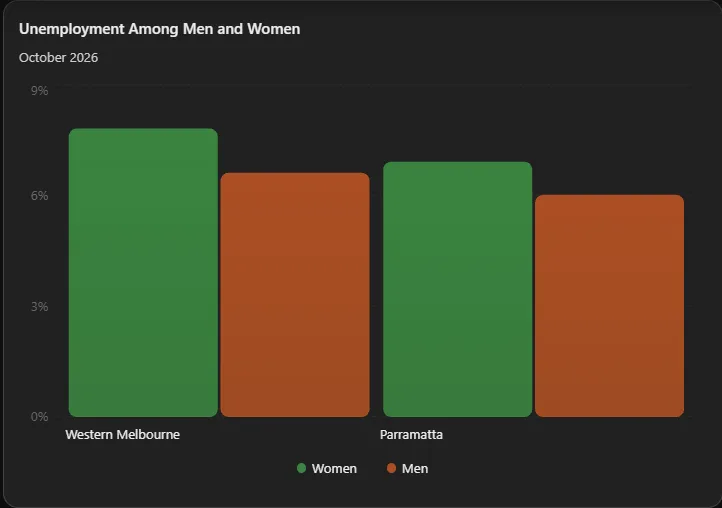
The figures indicate that women in these areas are experiencing greater employment difficulties as Australia's labor market weakens.
Unemployment Also Rising Across Queensland and Regional Australia
The employment slowdown is not limited to Sydney and Melbourne.
In Queensland, unemployment reached 8.7% in Springwood and Kingston, up from 7% a year earlier.
Other areas, including Ipswich, Caboolture, Maryborough, and parts of western Queensland, have also experienced rising unemployment.
In regional New South Wales, unemployment has exceeded 6% in locations including Bourke, Inverell, and Moree.
Rising fuel prices have added to household financial pressures, particularly in suburban communities where residents depend heavily on private vehicles for transportation.
AI Investment Booms Despite Rising Unemployment
Australia's weakening employment market comes despite a significant increase in private-sector investment, particularly in artificial intelligence infrastructure and data centers.
According to ABS figures cited in the report, private investment in new buildings and equipment increased by 18.6% over the past year, reaching AUD 59.7 billion in the September quarter — its highest level since 2014.
Quarterly capital expenditure increased by 12.2%, driven largely by a 23.1% rise in spending on equipment and machinery, including computer servers used in data centers.
Businesses have also increased their expected capital expenditure for the 2026/27 financial year by 11.8% to a record AUD 223 billion.
New South Wales and Victoria are attracting substantial AI-related investment, with spending in both states increasing by more than one-third over the past year.
However, the investment boom has coincided with rising unemployment across several regions.
What Could This Mean for Nepali Students and Workers in Australia?
The weakening employment market could create additional challenges for international students, migrant workers, and recent graduates seeking employment in Australia.
For Nepali students and workers living in Western Sydney and other affected regions, increased competition for available jobs could make securing employment more difficult.
Persistent inflation and higher living expenses may also increase financial pressure on individuals who depend on employment income to cover accommodation, tuition fees, transportation, and daily expenses.
However, the reported unemployment figures cover the general population and do not specifically measure unemployment among Nepali nationals or international students.
Australia's Employment Outlook Remains Uncertain
Australia continues to face the combined challenge of rising unemployment, persistent inflation, and higher borrowing costs.
Although investment in artificial intelligence and technology infrastructure remains strong, economists have warned that higher interest rates and financing costs could make future business investment more difficult.
The country's employment outlook will depend on inflation trends, monetary policy decisions, business investment, and broader economic conditions.
With Treasury expecting unemployment to exceed 5% in 2027, households and businesses could face continued financial pressure in the coming months.
Published 20 hours ago in World