
Apple's First Touchscreen MacBook Pro Is Here, but Its Cheaper Model Has a Newer Chip
Apple has introduced its first touchscreen MacBook Pro with a tandem OLED display, Dynamic Island, and M5 Pro or M5 Max processors, alongside a separate 14-inch MacBook Pro powered by the newer M6 chip. The new laptops start at $1,999 for the M6 model and $2,899 for the touchscreen version, with pre-orders opening on October 28 and retail availability beginning November 6, 2026.
· 8 min read
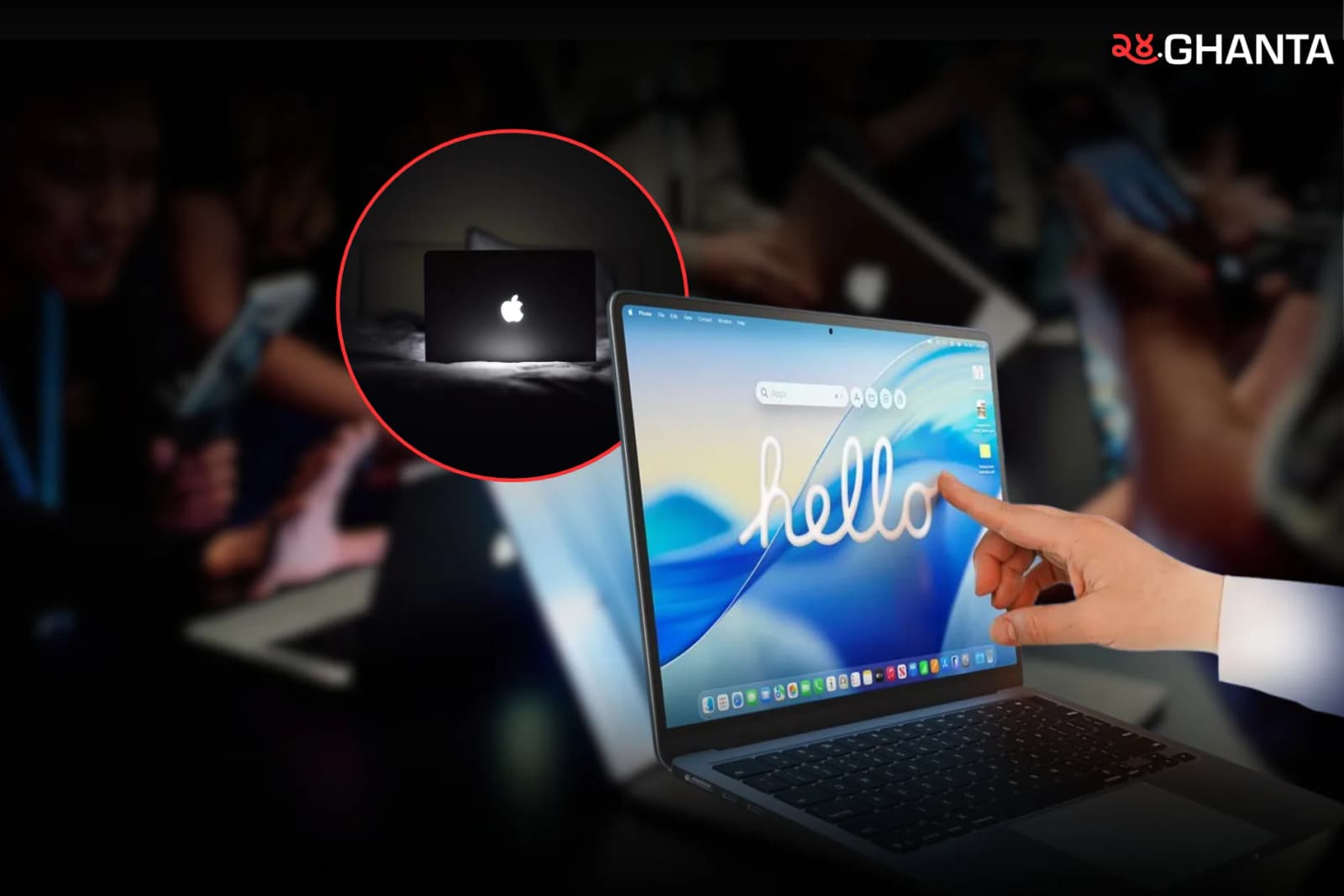
Kathmandu, October 29, 2026
Apple has introduced two new MacBook Pro laptop lines through announcements made on October 27 and 28, 2026, in California, United States, bringing major changes to its premium computers. The company unveiled a 14-inch MacBook Pro powered by its next-generation M6 chip on October 27, followed by its first touchscreen MacBook Pro with a PROLED XDR display on October 28. The new laptops are designed to improve performance, artificial intelligence processing, display quality, and professional workflows. Both became available for pre-order on October 28 and are scheduled to reach customers and stores in supported markets beginning November 6.
Touchscreen Revolution: Apple Changes Its MacBook Approach
For years, Apple's MacBook computers relied primarily on keyboards and trackpads, while touchscreen interaction remained a defining feature of the iPhone and iPad.

That distinction has now changed.
The newly introduced MacBook Pro with PROLED XDR Display allows users to interact directly with the screen through familiar gestures, including tapping, swiping, scrolling, and pinching to zoom.
Users can move objects between applications, enlarge photographs, navigate websites, and manipulate creative content without relying entirely on the trackpad.
Apple has also developed a more stable hinge to reduce screen movement during touch interactions. An upgraded camera stabilization system helps keep video calls steady even when users are touching the display.
The touchscreen is an additional way to control the laptop rather than a replacement for its traditional keyboard and trackpad.
PROLED XDR: A Major Upgrade in Display Technology
The premium MacBook Pro introduces Apple's PROLED XDR display, which uses tandem OLED technology instead of the Mini-LED technology found in the standard MacBook Pro.
OLED pixels produce their own light, allowing individual pixels to switch off completely and create deeper black levels. This also helps eliminate the blooming effect that can appear around bright objects on conventional backlit displays.
According to Apple's published specifications, the new screen supports up to 2,000 nits of peak HDR and SDR brightness, a 10,000,000:1 contrast ratio, and ProMotion refresh rates of up to 120Hz.
It also supports P3 and Adobe RGB color spaces, making it suitable for professional photography, video production, graphic design, and other color-sensitive work.
The display includes an antireflective coating, with a nano-texture option available for customers working in challenging lighting conditions.
M6 vs. M5 Pro: Why Does the Cheaper Laptop Have the Newer Processor?
One of the most interesting differences in Apple's latest lineup is its processor selection.
The standard 14-inch MacBook Pro uses the newer M6 chip, while the more expensive touchscreen models use the M5 Pro and M5 Max processors.
Although the M6 belongs to a newer generation, the M5 Pro and M5 Max are higher-tier chips designed for more demanding professional tasks.
The M6 features a 12-core CPU, a 12-core GPU, and a Dual 16-core Neural Engine. Apple claims it delivers up to 30% faster graphics performance and up to 25% faster performance in certain AI workloads compared with the previous M5 chip.
These figures are based on Apple's testing and should not be interpreted as a direct comparison with the M5 Pro or M5 Max.
Meanwhile, the premium touchscreen models offer greater memory and graphics capabilities for tasks such as high-resolution video editing, advanced 3D rendering, software development, and complex creative projects.
This means the more expensive MacBook is not necessarily using a weaker processor simply because its chip belongs to an earlier generation.
Dynamic Island: Another iPhone Feature Reaches Mac
Apple has also introduced Dynamic Island to the premium MacBook Pro, replacing the traditional notch found on earlier models.
The interactive area at the top of the screen provides access to Spotlight, Live Activities, and Siri AI.
It can display relevant information and provide convenient access to supported activities without requiring users to constantly switch between applications.
The redesigned MacBook Pro also features slimmer screen borders, a thinner enclosure, and a glowing Apple logo on the back.
The 14-inch touchscreen model weighs approximately 3 pounds, while the 16-inch model weighs approximately 4 pounds, making both lighter than their previous counterparts.
Professional Upgrades: More Memory, Storage, and Connectivity
Beyond its touchscreen, the premium MacBook Pro introduces hardware improvements intended for demanding professional workflows.
The new models support up to 128GB of unified memory and 16TB of SSD storage, allowing users to work with large video files, complex software projects, and extensive creative libraries.
They include three Thunderbolt 5 ports, HDMI, an SDXC card slot, MagSafe charging, and a headphone jack.
Depending on the processor configuration, the laptops can support multiple external displays, with M5 Max configurations supporting up to four.
Apple has also upgraded the six-speaker audio system, claiming 50% deeper bass, and included a 12MP Center Stage camera and studio-quality microphones.
Wi-Fi 7 and Bluetooth 6 support provide updated wireless connectivity.
macOS 27: How Will Touch Work on a Mac?
The new MacBook Pro models run macOS 27, known as Golden Gate, which includes software improvements designed to support Apple's latest hardware.
On the touchscreen models, users can perform gestures such as swiping through content, pinching to zoom, and moving objects directly with their fingers.
Apple says macOS can translate touch interactions into conventional clicks, allowing many existing applications to respond to basic touch input without requiring a complete redesign.
Developers can also introduce more specialized touch controls for applications that would benefit from direct manipulation.
The operating system includes improvements to Siri AI, Apple Intelligence, Spotlight, and other productivity features.
However, advanced touchscreen interactions may vary depending on individual applications and developer support.
Battery Life: Up to 24 Hours on Both Models
Despite the differences in design and processing hardware, Apple advertises up to 24 hours of battery life for both the standard M6 MacBook Pro and the new premium touchscreen lineup.
The M6 model focuses on delivering improved performance and power efficiency while retaining the established 14-inch MacBook Pro design.
The premium models combine their thinner construction and OLED technology with Apple's power-management features.
Actual battery life will depend on screen brightness, applications, workload, and usage conditions. The 24-hour figure represents Apple's stated maximum under specific testing conditions.
Price Comparison: How Much Do the New MacBooks Cost?
Apple's new MacBook Pro lineup introduces a significant difference in starting prices.
The standard 14-inch MacBook Pro with M6 starts at $1,999, while eligible education customers in the United States can purchase it starting at $1,899.
The 14-inch MacBook Pro with PROLED XDR Display starts at $2,899, and the larger 16-inch touchscreen version begins at $3,399.
That creates a $900 difference between the starting prices of the two 14-inch models.
However, the difference is not solely the cost of adding a touchscreen. The premium models also offer higher-tier processors, tandem OLED displays, redesigned enclosures, Thunderbolt 5 connectivity, and expanded professional configuration options.
For buyers in Nepal, these figures represent official U.S. starting prices rather than confirmed local retail prices. Final costs may differ because of import duties, taxes, currency exchange rates, and retailer pricing.
Launch Schedule: When Will the New MacBooks Be Available?
Apple announced the M6-powered 14-inch MacBook Pro on October 27, followed by the touchscreen MacBook Pro with PROLED XDR Display on October 28.
Pre-orders for both product lines opened on October 28, 2026.
Apple has confirmed that deliveries and retail availability in supported markets will begin on Friday, November 6, 2026.
The laptops will be available through Apple's official sales channels and participating authorized resellers.
However, Apple has not established a Nepal-specific retail launch date or official local pricing in these announcements.
Buying Decision: Is the $900 Premium Worth It?
The new lineup gives customers two different approaches to purchasing a professional Apple laptop.
The M6-powered MacBook Pro offers newer-generation processing technology, strong battery life, a Mini-LED Liquid Retina XDR display, and a lower starting price.
For students, office workers, programmers, and creators who do not require touchscreen functionality or extremely high memory configurations, it may offer better value.
The PROLED XDR models are aimed at users who need advanced display quality, direct touchscreen interaction, more powerful professional chip configurations, and greater memory and storage capacity.
Photographers, video editors, designers, and other creative professionals may find these additional capabilities particularly useful.
However, the higher price does not automatically make the touchscreen version the better purchase for every user.
The Bigger Picture: A New Direction for Apple's Laptops
Apple's latest announcements represent a significant shift in how the company separates its premium laptops.
Instead of introducing the same processor generation across every model, Apple is offering a newer standard processor in one laptop and more specialized professional hardware in another.
The arrival of touchscreen controls also marks a change in Apple's longstanding approach to Mac interaction, bringing the laptop closer to some of the direct-touch experiences already familiar to iPhone and iPad users.
Whether the touchscreen becomes an essential part of future MacBooks will depend on software support, user adoption, and the practical benefits it provides.
For now, Apple's latest MacBook Pro lineup presents buyers with an unusual choice: a newer chip at a lower price or a more advanced display and professional hardware at a significantly higher cost.
Published 1 hour ago in Technology