
Are Students Actually Getting Their 45% Public Transport Fare Discount?
Nepal’s Department of Transport Management has reiterated that students with valid student identity cards are entitled to a 45% discount on public transport fares, reviving attention around a concession first agreed between the government and transport operators in 2009. Despite the directive, implementation remains disputed, with students complaining that they do not always receive the full concession while transport entrepreneurs say the government has stopped providing the tax benefits originally promised in return.
· 6 min read
KATHMANDU | AUGUST 19, 2026
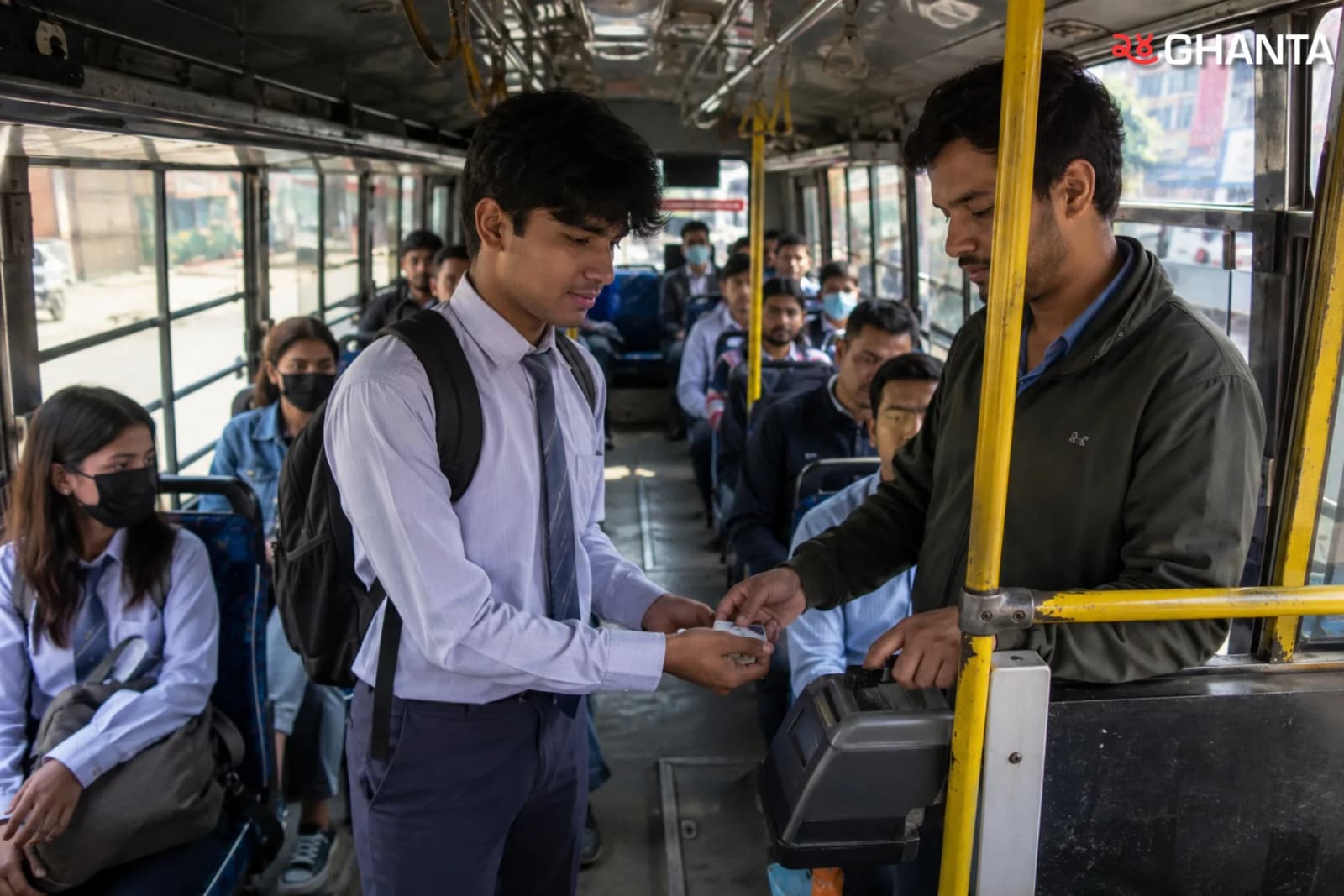
Students travelling on public transport with valid student identity cards are entitled to a 45% fare concession under a long-standing government-transport operator arrangement that the Department of Transport Management again directed operators to implement in April 2026.
However, more than 17 years after the original agreement, implementation remains disputed. One major complication is Nepal's shift to a federal system, under which many transport-related responsibilities, including vehicle taxes, permits and fare management, moved to provincial governments. Transport operators argue that while they are still expected to provide the 45% student concession, benefits promised to them under the original agreement have not been consistently continued by the provinces.

The Discount Is 45%, Not 40%
One of the biggest points of confusion surrounding student fares is the actual percentage.
The prescribed student concession is 45% of the applicable public transport fare.
That means an eligible student should generally pay 55% of the regular applicable fare after the concession is calculated.
For example:
Regular fare of Rs. 20 → 45% discount is Rs. 9 → student portion is Rs. 11
Regular fare of Rs. 30 → 45% discount is Rs. 13.50 → student portion is Rs. 16.50
Regular fare of Rs. 40 → 45% discount is Rs. 18 → student portion is Rs. 22
Regular fare of Rs. 50 → 45% discount is Rs. 22.50 → student portion is Rs. 27.50
These are mathematical examples. The actual amount payable depends on the official fare applicable to the particular route or distance and any officially prescribed fare-calculation or rounding practice.
Where Did the 45% Rule Come From?
The student concession is not a new policy introduced in 2026.
It dates back to an arrangement reached between the government and transport entrepreneurs on Falgun 20, 2065 BS, corresponding to March 3, 2009.
Under that arrangement, students were to receive a 45% concession on public transport fares.
But Nepal's system of government has changed significantly since then. After the country adopted federalism, many transport-related responsibilities shifted from the central government to provincial governments.
That shift is now at the centre of the dispute over how the original arrangement should be implemented.
Government Reissued Instructions in 2026
In April 2026, the Department of Transport Management again instructed public transport operators to implement the 45% student concession.
The direction was sent to major transport organisations, including the Federation of Nepalese National Transport Entrepreneurs, Central Federation of Public Transport and Sajha Yatayat.
The Department said it had received complaints through Hello Sarkar and its own grievance system regarding public vehicles failing to provide students with the prescribed concession.
Authorities warned that public vehicles failing to implement the government decision could face action.
Why Are Students Still Confused About Fares?
One major problem is that passengers do not always have an easy way to check the official fare for their exact journey.
Knowing that the discount is 45% is only useful when a student also knows the correct regular fare on which the discount should be calculated.
Different fare amounts, unclear or missing fare charts and difficulty finding updated official information can leave students unsure about how much they should actually pay.
Without clear official fare information, different prices can create confusion and make it difficult for students to know whether the full 45% discount is actually being applied.
Why Isn't the Rule Consistently Implemented?
Transport entrepreneurs say there is another side to the issue.
According to the Federation of Nepalese National Transport Entrepreneurs, the original 2009 arrangement did not only require operators to provide students with a 45% discount.
The Federation says operators were also provided a 60% concession on certain annual vehicle taxes, route permit fees and vehicle inspection-related fees.
But after Nepal moved to a federal system, responsibility for many of these transport-related taxes and fees shifted to provincial governments.
The Federation argues that most provinces did not continue the concessions operators had received under the original arrangement.
Their argument is simple: if operators are still required to provide students with the 45% concession, the benefits promised to operators under the original deal should also continue.
Federalism Complicated the Original Deal
When the agreement was reached in 2009, Nepal's current provincial government structure was not operating as it does today.
After federalism, transport responsibilities became divided among different levels of government, with provinces taking responsibility for several areas related to vehicle registration, taxation, permits and transport management.
This means the federal government can reiterate the student concession, while some of the concessions transport operators are asking to have restored now fall within areas handled by provincial governments.
According to the Federation, most provinces discontinued the earlier tax and fee relief, while Koshi Province continues to provide some concession.
This has created a complicated situation:
Government: Students should receive the 45% concession.
Students: We want the discount we're entitled to.
Transport operators: If the original deal still applies to us, the government's side of the deal should also be honoured.
Why 45% Matters to Students
For one journey, the difference may appear to be only a few rupees. But for students who use public transport every day, those small amounts add up.
A student whose regular one-way fare is Rs. 40 would mathematically receive an Rs. 18 concession each way.
Across two journeys a day for 25 days, that represents Rs. 900 in fare concessions in a month.
For students living away from home for education, transportation is a recurring expense alongside rent, food, tuition and educational materials.
The 45% concession therefore matters much more when viewed as a monthly saving rather than the saving from a single bus journey.
Recent Disputes Show Why Clarity Matters
Complaints about students not receiving the concession have continued despite the long-standing arrangement.
A recent passenger allegation involving a journey from Gwarko to Jay Bageshwori is one example of how disagreements over student fares can escalate. But the broader issue is not about blaming every conductor.
Conductors may also face unclear fare information, different instructions and uncertainty surrounding the continuing dispute between transport operators and government authorities.
What should be clear for everyone is the official fare, who qualifies for the concession and how much an eligible student should pay.
Students and Conductors Need the Same Fare Information
One practical solution would be to make official fares much easier to check.
Updated fare charts could be displayed clearly inside public vehicles, while provincial transport authorities could make updated fare information easily accessible online.
Passengers and conductors would then be working from the same information:
Regular Fare → 45% Student Concession → Final Student Fare
This could reduce arguments caused by unclear, different or outdated fare information.
A 17-Year-Old Deal Caught Between Two Systems
The issue is no longer simply about whether students should receive a discount.
The 45% student concession dates back to 2009, when Nepal's transport system operated under a different government structure.
Today, many transport responsibilities are handled by provincial governments. Meanwhile, the Department of Transport Management has continued to call for implementation of the student concession, while transport entrepreneurs argue that concessions promised to them under the original arrangement have not been consistently continued after federalism.
That leaves students caught in the middle of a dispute between what the original agreement promised, what the government currently requires and how transport is now managed under the federal system.
Making official fares transparent and clearly defining how the 2009 arrangement should work under today's federal structure could help resolve much of the confusion.
Until then, students may officially have a 45% concession, but many are still left asking how much they should actually be paying.
Published Aug 19 in Society