
China Rejects Claims It Withheld Weather And River Data From Nepal After Rasuwa Disaster
The Chinese Embassy in Nepal has rejected claims that China lacked transparency in sharing hydrological and weather information following the August 26 disaster along the Gyirong-Rasuwa border, saying it continues to provide key data to Nepal every day despite damage to monitoring and communication systems. China says cooperation on warnings and disaster response remains active, although the catastrophe has also raised wider questions in Nepal about whether the two countries need a stronger formal system for sharing real-time cross-border hazard information.
· 6 min read
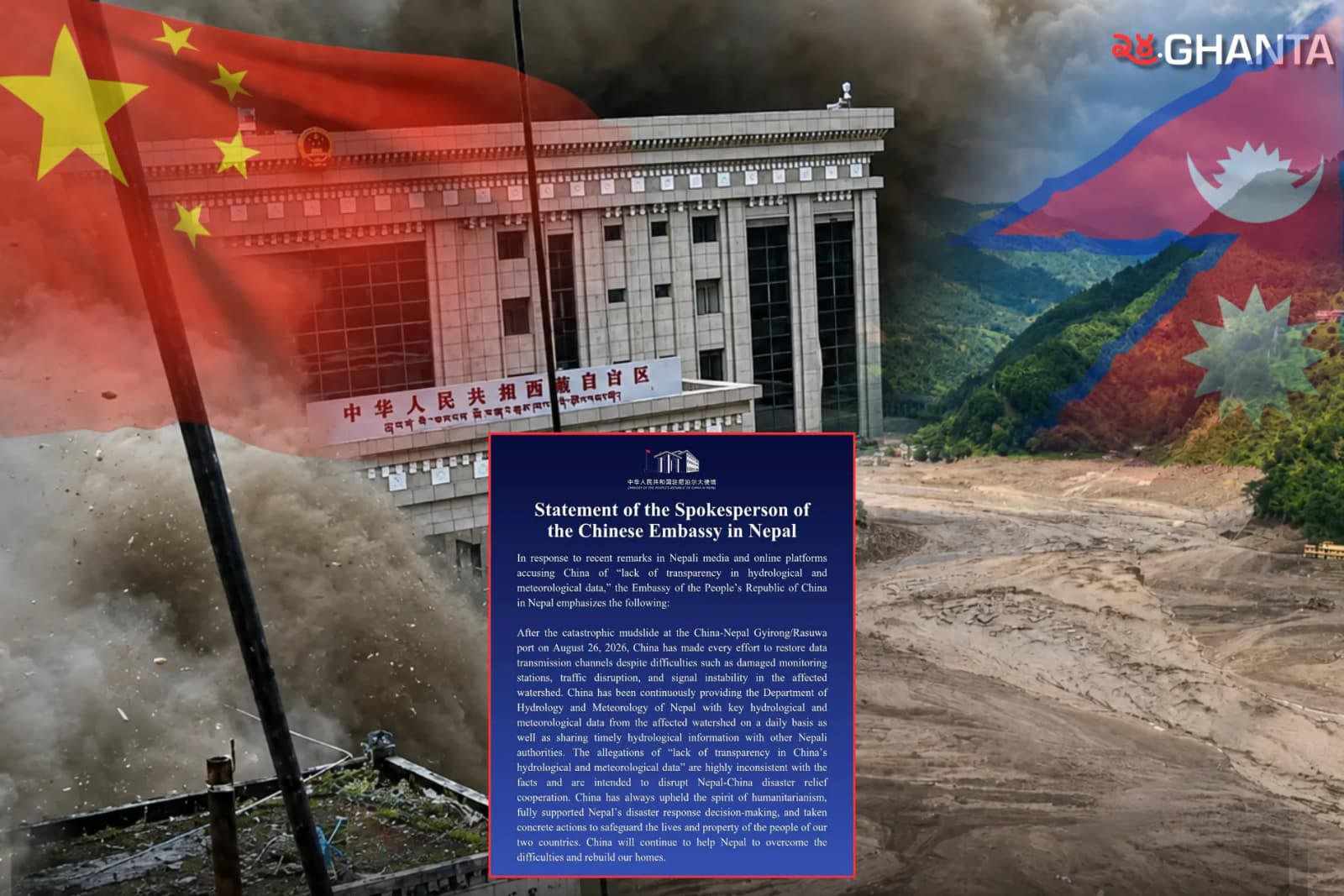
KATHMANDU, NEPAL — September 2, 2026: The Chinese Embassy in Nepal has rejected recent media reports and online allegations questioning China's transparency in sharing weather and river information following the devastating August 26 disaster around the China-Nepal Gyirong-Rasuwa border. The Embassy says monitoring equipment, transportation and communication systems were damaged by the disaster, but Chinese authorities have been working to restore data transmission and are now providing important hydrological and meteorological information from the affected watershed to Nepal's Department of Hydrology and Meteorology on a daily basis to support safety and disaster-response efforts.
China Rejects The Accusations
The latest clarification follows growing public discussion in Nepal about how much information was available from across the border before and after the disaster.
Some Nepali media reports and online posts questioned whether China had been sufficiently transparent with hydrological and meteorological information.

The Chinese Embassy rejected that claim, saying accusations of a lack of transparency do not match the facts.
According to the Embassy, China has continued providing information needed by Nepal as both countries respond to the enormous destruction caused by the disaster.
Monitoring Stations Were Damaged
China says the disaster itself created major difficulties in gathering and transmitting information.
According to the Embassy, monitoring stations in the affected watershed were damaged, while transportation routes and communication signals were also disrupted.
These problems affected the normal transmission of data from the disaster area.
The Embassy says Chinese authorities have since been working to restore those channels and recover monitoring capabilities.
China Says Data Is Being Sent Every Day
One of the most important points in the latest statement concerns what is happening now.
The Embassy says China is continuously providing key hydrological and meteorological information from the affected watershed to Nepal's Department of Hydrology and Meteorology on a daily basis.
It also says relevant hydrological information is being provided to other Nepali authorities when needed.
The data is particularly important because the disaster has dramatically changed conditions around rivers and mountain slopes, while concerns about secondary floods, landslides and other hazards remain.
Foreign Ministry Says Communication Has Continued
China's Foreign Ministry has separately addressed questions about information sharing between the two countries.
At an August 31 press briefing, spokesperson Guo Jiakun said Nepal and China have remained in communication regarding search and rescue, information sharing and prevention of secondary disasters.
China says it has provided Nepal with weather and river data, arranged consultations between experts and shared warning information following the disaster.
The Foreign Ministry also said cooperation in disaster prevention and control would be strengthened.
But Questions About The Warning System Remain
China's latest statement addresses accusations about transparency, but the disaster has also exposed a broader issue:
Did Nepal and China have a strong enough cross-border early-warning system before August 26?
That question is different from asking whether China is sharing information now.
Nepali officials have said Nepal previously discussed obtaining weather, rainfall and river-monitoring information from China, but a formal mechanism for the type of real-time information exchange needed during an extreme event had not been finalised before the disaster.
That gap has received renewed attention after the catastrophe.
Nepal's Own Sensors Were Also Destroyed
Nepal also faced serious problems with its domestic monitoring network.
Automatic flood-monitoring stations along the upper Bhotekoshi were destroyed as the disaster moved downstream.
According to Nepal's Department of Hydrology and Meteorology, the Rasuwagadhi station was still showing relatively normal conditions at 8:40 am on August 26.
Its next scheduled reading never arrived.
The flood was so sudden that the monitoring equipment itself was destroyed before the system could provide the kind of warning normally expected from a rapidly rising river.
Information Reached Nepal Through Other Channels
Nepal's Flood Forecasting Division has said information about the disaster reached it at approximately 8:56 am through the Rasuwa District Administration Office and the National Disaster Risk Reduction and Management Authority.
The division then began sending warnings downstream.
By around 9:15 am, mass alerts were being distributed, eventually reaching hundreds of thousands of mobile phones in potentially affected districts.
The episode demonstrated both the value of emergency communication and the limitations of relying on monitoring stations that can themselves be destroyed by an extreme event.
This Was Not An Ordinary Flood
Another important part of the discussion is the extraordinary nature of the August 26 event.
The disaster developed extremely rapidly and was not simply the result of a normal gradual rise in river levels following monsoon rainfall.
Scientific assessments have linked the catastrophe to a massive rock-and-ice avalanche and resulting flood in the high Himalayan catchment.
That type of event can send an enormous volume of water, ice, rock and sediment downstream with very little warning.
It also creates a different challenge for monitoring systems originally designed primarily to detect changing river levels.
Two Different Questions Need Clear Answers
Public discussion following the disaster has sometimes mixed two separate issues.
The first question is:
Did China deliberately withhold important information from Nepal?
China strongly rejects that accusation and says it has been providing Nepal with disaster-related weather and river information.
The second question is:
Did Nepal and China have a sufficiently strong, formal and rapid cross-border warning mechanism capable of handling an extreme Himalayan disaster?
Available reporting indicates there were weaknesses in that system before August 26, and the catastrophe has renewed calls for stronger cooperation.
These two questions should not be treated as the same claim.
China Says Cooperation Will Continue
The Chinese Embassy says China has supported Nepal's disaster-response decisions and taken measures aimed at protecting people on both sides of the border.
It has also pledged continued assistance during relief and reconstruction.
China's Foreign Ministry similarly says the two countries intend to strengthen cooperation on disaster prevention and control.
Why Better Data Sharing Matters
The debate goes beyond determining who was responsible for what happened on August 26.
Nepal and China's Himalayan border contains glaciers, steep valleys, unstable slopes and river systems that cross national boundaries.
A dangerous event beginning high in the mountains can quickly become a disaster for communities many kilometres downstream.
That means information collected on one side of the border can potentially become life-saving information on the other.
The Bigger Lesson After The Disaster
For families who have lost loved ones, arguments over information sharing cannot undo what happened.
But understanding what worked and what failed could help prevent another disaster from producing the same level of destruction.
China says it is now sharing key weather and river information with Nepal every day and will continue supporting relief and reconstruction.
The larger challenge for both countries is turning that cooperation into a reliable, rapid and formal cross-border warning system capable of giving communities as much time as possible when the next extreme Himalayan hazard develops.
Published Sep 2 in World