
Illegal To Protest? Around 6,000 Detained As Delhi Police Block Mass Demonstrations In India
Around 6,000 People Including Four Former Chief Ministers, Journalists And Protesters Detained Across Delhi As Police Try To Stop Mass Demonstrations Demanding Chief Election Commissioner Gyanesh Kumar's Resignation
· 10 min read
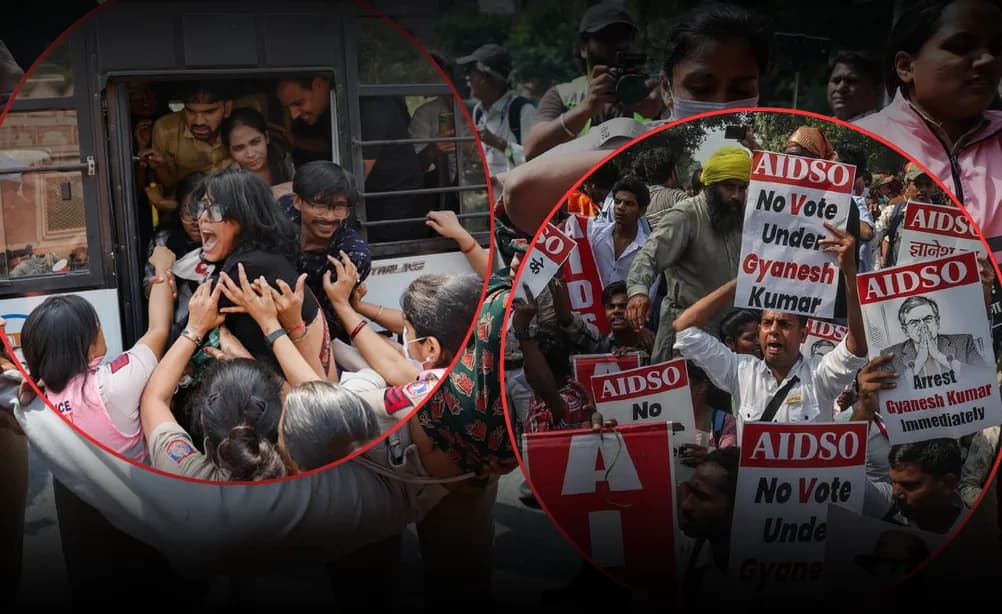
India's capital witnessed one of its largest, arguably historic, police operations against a planned demonstration on Saturday, October 10, with an estimated 6,000 people detained across Delhi as authorities attempted to prevent protesters from gathering at Jantar Mantar.
Those detained included four former Chief Ministers, student leaders, lawyers, journalists, social activists, YouTubers and supporters of the Cockroach Janta Party (CJP), the youth movement that organised the demonstration demanding the resignation of Chief Election Commissioner Gyanesh Kumar.
According to The Indian Express, groups of protesters were stopped on roads, taken into police buses and vans, and transported to stadiums and temporary detention centres. Several journalists covering the demonstrations and people who said they were simply passing through the areas were also reportedly detained.

The police operation began even before the scheduled demonstration. Around 1,200 people were reportedly detained overnight, followed by approximately 500 more during the morning. By around 3 PM, the reported figure had crossed 2,000, before later estimates suggested that around 6,000 people had been detained.
The detentions took place across Delhi and nearby areas, including outside political leaders' residences, at airports, and along roads leading towards the planned protest venue.
Despite these measures, protesters continued to gather at different locations throughout the day, showing resistance to Police's crackdown.
Metro Stations Closed, 254 Trains Cancelled And Internet Restricted
Authorities introduced extensive restrictions on public transport, roads and communication services before the demonstration.
Delhi Police requested restrictions at 57 metro stations across the capital, while reports indicated that access to several stations was closed. Indian Railways cancelled 254 train services, including services connected to New Delhi and Hazrat Nizamuddin railway stations.
Mobile internet services were also restricted within a four kilometre area around Jantar Mantar, the planned centre of the protest.
More than 25,000 police and security personnel were reportedly deployed across the capital, with heavy security concentrated in central Delhi. Roads leading towards Jantar Mantar were blocked with barricades, while authorities increased vehicle checks and restricted movement in sensitive areas.
Police also imposed restrictions under Section 163 of the Bharatiya Nagarik Suraksha Sanhita, a law that allows authorities to restrict certain gatherings and activities when they believe there is a risk to public safety.
The authorities had already refused permission for the October 10 demonstration, saying the organisers submitted their request on October 7 instead of providing the required 10 days' notice. Police also raised concerns about earlier protest violations.
The restrictions affected not only protesters but also ordinary commuters, with metro access, railway services and movement across several parts of Delhi disrupted.
Protest Leaders Detained Inside Aircraft, Opposition Figures Taken Into Custody
Among the most notable developments of the day was the detention of three senior CJP leaders shortly after they arrived in Delhi from Mumbai.
CJP founder Abhijeet Dipke, along with Saurav Das and Ashutosh Ranka, was detained at approximately 10:20 AM after police entered the aircraft in which they had travelled. The three were later taken to separate locations.
Following his detention, Dipke announced through a video that Ajinkya Shinde, the organisation's national in-charge, would lead the movement in his absence.
Popular YouTuber Dhruv Rathee was also detained early Saturday morning from his residence in Gurugram's Sector 56 and taken to a Crime Branch office, according to police sources cited by The Indian Express.
Several prominent political leaders were also detained during the day.
Former West Bengal Chief Minister Mamata Banerjee was taken into custody outside her Delhi residence alongside other Trinamool Congress leaders.
Former Delhi Chief Minister Arvind Kejriwal was detained outside his Lodhi Estate residence with Aam Aadmi Party leaders Sanjay Singh and Saurabh Bharadwaj. Police officers were seen physically carrying Kejriwal towards a police bus.
Former Kerala Chief Minister Pinarayi Vijayan was detained and taken to Chhatrasal Stadium, while former Tripura Chief Minister Manik Sarkar was also among the opposition leaders taken into custody.
Student leader Neha Bora, activist Yogendra Yadav and lawyer Prashant Bhushan were detained near Dilli Haat. Neha later announced on social media that she had been released at around 7 PM.
The widespread detentions drew strong criticism from opposition parties, which accused the government of using police powers to prevent peaceful political demonstrations.
Protesters Gather Across Delhi Despite Police Restrictions
Although police successfully prevented a major gathering at Jantar Mantar, the demonstration continued in smaller groups across the capital.
During the afternoon, protesters gathered in groups of roughly 100 to 150 at locations including Dilli Haat, Connaught Place, Rajghat, the Safdarjung Airport flyover and other parts of central Delhi.
Some demonstrators raised slogans against the government and Chief Election Commissioner Gyanesh Kumar, while others called for greater transparency in India's election system.
Police moved to disperse these gatherings and detained protesters at several locations. Reports also described police using batons against some student demonstrators near Sansad Marg.
Unlike the larger violent incidents reported during previous CJP demonstrations in July, Saturday's protests saw relatively limited violence. However, several incidents were reported, including stones being thrown at a bus carrying detained protesters near Jhandewalan.
Delhi Police said six of its personnel, including a woman officer from the Pink Force, were injured during the day's operations.
The protests continued despite the absence of several senior organisers, showing that the demonstrations had spread beyond a single venue or a leadership group.
UN Human Rights Office Raises Concern Over Mass Detentions
The United Nations Human Rights Office publicly expressed concern over the police action in Delhi, bringing international attention to the treatment of protesters and the right to peaceful assembly.
In a statement posted on its official X account on October 10, the UN Human Rights Office said:
"#India: We are concerned by reports of mass detentions of demonstrators, protest leaders, members of civil society organisations, lawyers and journalists, before and during today’s large-scale demonstrations in Delhi.
We call on the authorities to ensure that the right to peaceful assembly is fully respected and fulfilled."
The statement was accompanied by a graphic calling for the immediate and unconditional release of people who had been detained without legal justification.
Under India's Constitution, citizens have the right to assemble peacefully without weapons, although that right is subject to reasonable restrictions under the law.
The Delhi Police have maintained that restrictions were necessary for security and public order, while protest organisers and opposition leaders have questioned whether the measures were proportionate to the situation.
Why Were Thousands Protesting Against India's Election Commission?
The October 10 demonstration was organised by the Cockroach Janta Party, a youth-led movement, with support from student organisations, political groups and civil society activists.
The main demand was the resignation of India's Chief Election Commissioner, Gyanesh Kumar, following accusations of irregularities in the Special Intensive Revision (SIR) of electoral rolls.
The SIR process is intended to review and verify voter records, including removing duplicate, outdated or otherwise ineligible entries. However, opposition parties and protest organisers have accused the Election Commission of improperly removing large numbers of legitimate voters from electoral lists.
The controversy involves approximately 13 crore voter entries that critics say have been removed through the revision process. Protesters argue that these removals could prevent eligible citizens from voting, particularly people from disadvantaged communities and minority groups.
They have also accused the Election Commission of failing to properly address concerns about the handling of voter registration forms and the transparency of the revision process. These questions were repeatedly being raised before as well by the opposition, but heavy criticism against Election Commission Chief Election Commissioner (CEC) Gyanesh Kumar came after Ritika Chopra from The Indian Express published a ground breaking investigative exposé. The report, along with well documented proofs, claimed that the CEC was repeatedly ignoring official letters against the decisions made from the election commissioners when, according to the Indian Constitution, three election commissioners have an equal say, i.e. majority of the commissioners must be in agreement with a decision. The investigative report had other major allegations as well regarding the SIR process and control of the CEC over the commission.
The Election Commission has rejected allegations of political manipulation and defended the revisions as part of its responsibility to maintain accurate voter lists. Prime Minister Narendra Modi's Bharatiya Janata Party has also denied claims that the exercise was designed to benefit the ruling party.
The disputed voter list changes have become a major political issue ahead of important state elections scheduled for 2027.
From Youth Movement To Nationwide Political Protests
The Cockroach Janta Party began as a youth-driven protest movement rather than a traditional political party.
Its rise has been linked to growing frustration among young Indians over unemployment, examination irregularities, education issues and government accountability.
Abhijeet Dipke, one of the movement's leading figures, gained attention through social media activism, helping the group build support among students and younger citizens.
Earlier demonstrations organised by the movement focused on examination paper leaks and problems within India's education system. The group later expanded its activities to include wider political issues, particularly election transparency and democratic rights.
In recent weeks, the movement has repeatedly organised protests against Gyanesh Kumar and the Election Commission.
A previous demonstration on October 2 also faced police restrictions, with protesters detained near Jantar Mantar.
The October 10 rally was intended to bring together a much larger number of supporters in the capital, but police restrictions prevented the organisers from holding the planned central gathering.
Opposition Criticises Police Action As BJP Defends Restrictions
Opposition leaders strongly criticised the government's response to Saturday's protests, accusing authorities of restricting democratic freedoms.
Congress leader Rahul Gandhi said the demonstrations would continue despite police action and challenged Prime Minister Narendra Modi's government to respond to the protesters' demands.
Mamata Banerjee described the situation as more serious than India's Emergency period and suggested that she could join the opposition INDIA bloc's planned march to the Supreme Court on Monday.
Pinarayi Vijayan also criticised the detentions, saying that concerns over the integrity of elections could not be answered by preventing people from demonstrating.
However, the ruling BJP and Delhi government defended the security measures.
Delhi Chief Minister Rekha Gupta said Delhi could not be held hostage by protests and argued that public order needed to be protected.
BJP president Nitin Nabin accused opposition parties of attempting to destabilise the country and alleged that some political forces were working with foreign interests.
The government and protesters have offered sharply different explanations for Saturday's events, with authorities focusing on security and public order and the opposition focusing on the right to demonstrate peacefully.
What Happens Next? CJP Announces Another Protest For October 11
Despite the detention of its senior leaders and thousands of supporters, the Cockroach Janta Party has announced plans to continue its movement.
Ajinkya Shinde, who took responsibility for coordinating the protests after Abhijeet Dipke's detention, said the group would continue demonstrating until Chief Election Commissioner Gyanesh Kumar resigned.
The movement has called for another gathering at Jantar Mantar at 10 AM on Sunday, October 11.
Organisers have urged supporters to continue peaceful demonstrations even if access to the main protest venue remains restricted.
Meanwhile, climate activist Sonam Wangchuk has warned that he may begin a hunger strike or walking protest if detained student leaders and activists are not released by Sunday.
Opposition leaders are also considering further demonstrations, including a planned INDIA bloc march towards the Supreme Court on Monday.
The legal questions surrounding the restrictions could also receive further attention. A petition has already been filed in the Supreme Court challenging aspects of the measures imposed to restrict movement during the demonstration.
It remains uncertain whether authorities will allow the next planned gathering or continue the transport and security restrictions imposed during Saturday's protests.
Published 1 hour ago in World