
He Came to See Nepal. Then Millions Saw Nepal Through Him, How Harry Jackson Became an Unexpected Voice Carrying Nepal’s Story to the World
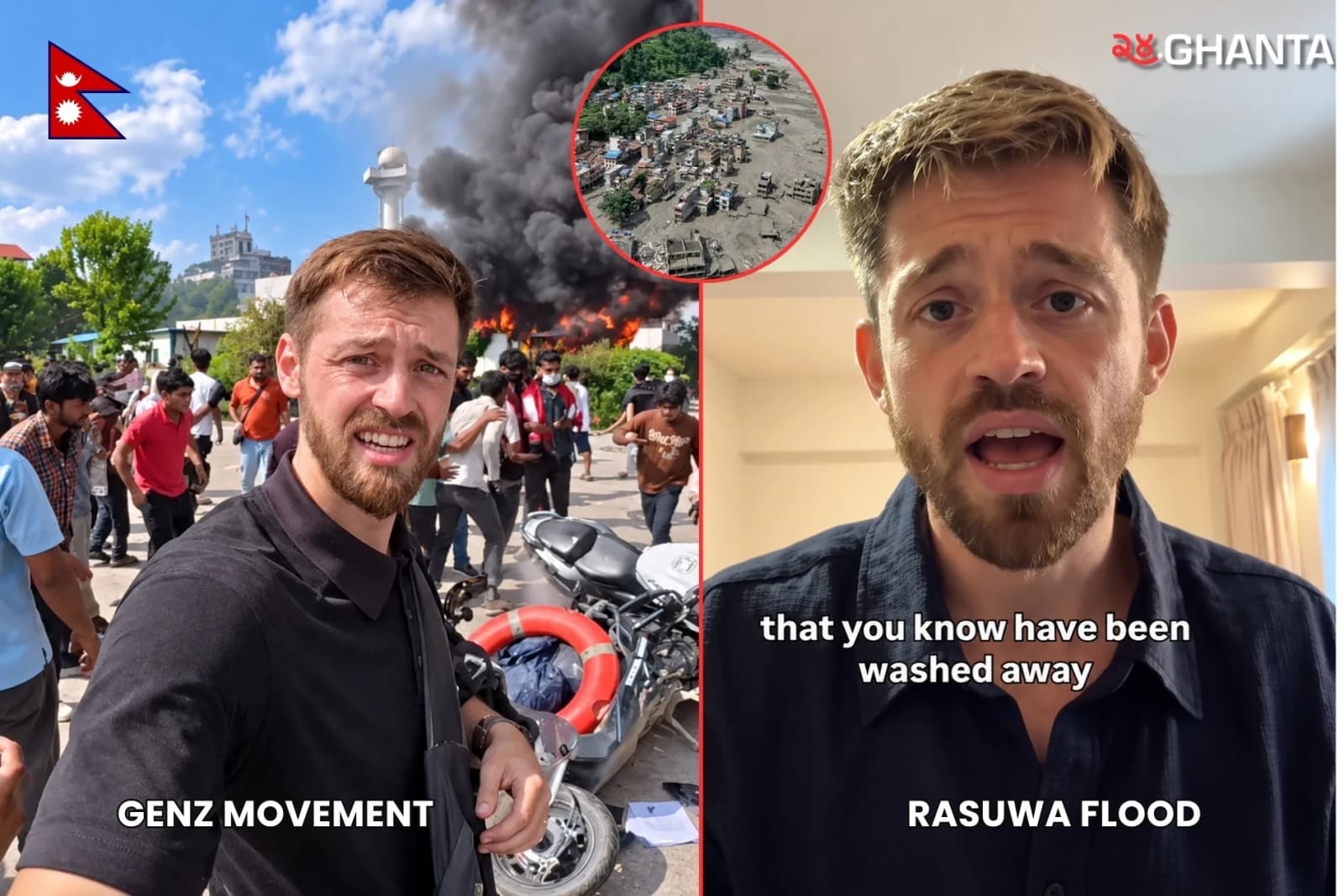
British travel creator Harry Jackson came to Nepal while riding a small motorcycle from Thailand toward the United Kingdom, but his unexpected arrival during the 2025 Gen Z uprising turned his travel camera into one of the international windows on a defining moment in Nepal’s recent history. A year later, as Nepal struggles with the devastation of the Rasuwa flood, Jackson has again used his international platform to acknowledge the disaster and help keep global attention on a country he once planned to simply pass through.
· 6 min read
KATHMANDU, NEPAL, SEPTEMBER 8, 2026
A Traveller Who Accidentally Recorded History
British travel vlogger Harry Jackson, known online as We Hate The Cold, arrived in Kathmandu in September 2025 while travelling overland from Thailand to the United Kingdom, not to report on Nepalese politics but as part of his long motorcycle journey. Instead, he found himself in the middle of Nepal’s historic Gen Z movement, where his street-level videos of protesters, security forces and the turmoil around Parliament reached millions internationally, giving audiences far beyond Nepal an unusually close look at what young Nepalis were experiencing and why they were demanding change.
He Was Never Supposed to Be a Journalist
Jackson had already spent months travelling and documenting his journey when circumstances brought him back to Nepal. According to international reporting, he had been trying to continue from India into Pakistan, but after the border route became unavailable, he returned north to Nepal. Kathmandu was supposed to be a relatively short stop where he could arrange the next stage of his motorcycle journey.

Then September 8 happened.
Jackson entered Kathmandu on his Honda CT125 without initially realizing the scale of what was unfolding. By the following day, he was walking alongside crowds, speaking with people and recording scenes around the demonstrations as Nepal went through extraordinary political upheaval.
He had arrived as a tourist.
His camera was suddenly recording history.
Millions Watched Nepal Through His Camera
The footage travelled far beyond Kathmandu.
Nepali Times reported that one of Jackson’s September 9 videos had reached around 29 million views by September 25, while WIRED reported days later that the video had surpassed 30 million views on YouTube alone. Jackson later became widely recognized in Nepal, with people stopping him in the streets for photographs and thanking him for showing what was happening.
The significance was not simply the number of views.
His videos placed viewers at street level. They showed frightened crowds running, tear gas, violence and the destruction around Parliament, but they also captured people helping one another, handing out water and checking on those affected.
For millions watching from abroad, Nepal’s crisis was no longer only a headline.
They were seeing the people inside it.
He Tried to Explain What Gen Z Was Really Saying
Jackson also pushed back against the idea that Nepal’s uprising could be explained only by the government’s social-media restrictions.
After speaking with Nepalis, he said the anger he encountered was connected to deeper and longer-running frustration over corruption and the political system. He also stressed that he was not trying to appoint himself as a voice for Nepalis; instead, his role was largely to record what he saw and listen to people who were actually living through it.
That distinction mattered.
An outsider had unexpectedly gained an enormous international audience, but much of the power of his coverage came from allowing the streets and the people around him to tell the story.
He Stayed to Show Nepal Beyond the Flames
What happened afterward is an equally important part of Jackson’s connection with Nepal.
Once the most dramatic images of the uprising had travelled around the world, he did not immediately stop filming the country.
He remained longer than originally planned and documented Kathmandu as ordinary life started returning, shops reopening, people meeting again and communities moving forward after days of extraordinary unrest. Jackson told WIRED that he felt a responsibility to continue showing Nepal after Nepalis had helped him so much.
Later reports also described plans for Jackson to promote Nepal’s Himalayan tourism through further motorcycle content, extending his connection with the country beyond the protests themselves.
A Year Later, Nepal Needed the World to Look Again
Now Nepal is facing a very different tragedy.
After the devastating Rasuwa flood, the images emerging from affected communities are no longer of political demonstrations but of destroyed homes, missing loved ones, damaged infrastructure and families trying to rebuild their lives.
On August 27, 2026, a post attributed to Jackson’s We Hate The Cold account expressed sympathy for people affected by the disaster. Comments beneath the post included Nepalis thanking him for using his large platform to raise awareness. Separate online discussions about donating from abroad also directed potential donors toward information shared by We Hate The Cold about supporting Nepal.
It shows how the audience built during one of Nepal’s most difficult political moments can still bring international eyes back to Nepal during another crisis.
Attention Can Become a Form of Support
It would be inaccurate to claim that Jackson’s posts themselves directly produced a specific amount of flood donations. There is currently no reliable public evidence establishing such a direct connection.
But international visibility still matters.
A person cannot support a disaster they know nothing about. When creators with audiences across different countries share verified information, show affected communities and explain legitimate ways to help, Nepal’s crisis can reach people who otherwise might never encounter the story.
Jackson’s experience demonstrates how unexpectedly powerful that bridge can become.
From Gen Z's Streets to Rasuwa's Pain
In 2025, Jackson helped international audiences see young Nepalis demanding political change.
In 2026, the opportunity is different: helping those same audiences see a Nepal facing immense loss and trying once again to recover.
His role should not be exaggerated. He did not create Nepal’s Gen Z movement, he did not speak on behalf of an entire generation, and there is no evidence that he alone is driving international flood assistance.
What he has is something simpler but still valuable: an audience willing to look when he points his camera toward Nepal.
The Country Behind the Headlines
Perhaps that is the bigger story of Harry Jackson and Nepal.
He originally came looking for another country to cross on an extraordinary motorcycle journey. Instead, Nepal became one of the defining chapters of that journey. His footage of the uprising accumulated tens of millions of views, he stayed to document what came afterward, and the experience became prominent enough that later accounts of his cross-continental adventure continued to highlight Nepal.
Millions who had never stood on a Kathmandu street suddenly watched Nepal through the camera of a traveller who happened to arrive at an extraordinary moment.
And now, after the Rasuwa flood, Nepal needs the world to look beyond the destruction once again.
Not only at what the country has lost, but at the people searching for loved ones, helping strangers, rebuilding communities and finding ways to continue.
Harry Jackson came to Nepal expecting another stop on the road home.
Instead, his camera became one small window through which millions discovered something much bigger:
a Nepal that can be wounded deeply, but continues finding the strength to stand again.
Published Sep 8 in World