
Nagdhunga Tunnel: Is Slow Driving Creating an Overtaking Problem?
The Nagdhunga Tunnel has a 40 km/h maximum speed limit and a strict no-overtaking rule. But with no fixed minimum speed, could very slow vehicles be creating queues and encouraging risky overtaking?
· 5 min read
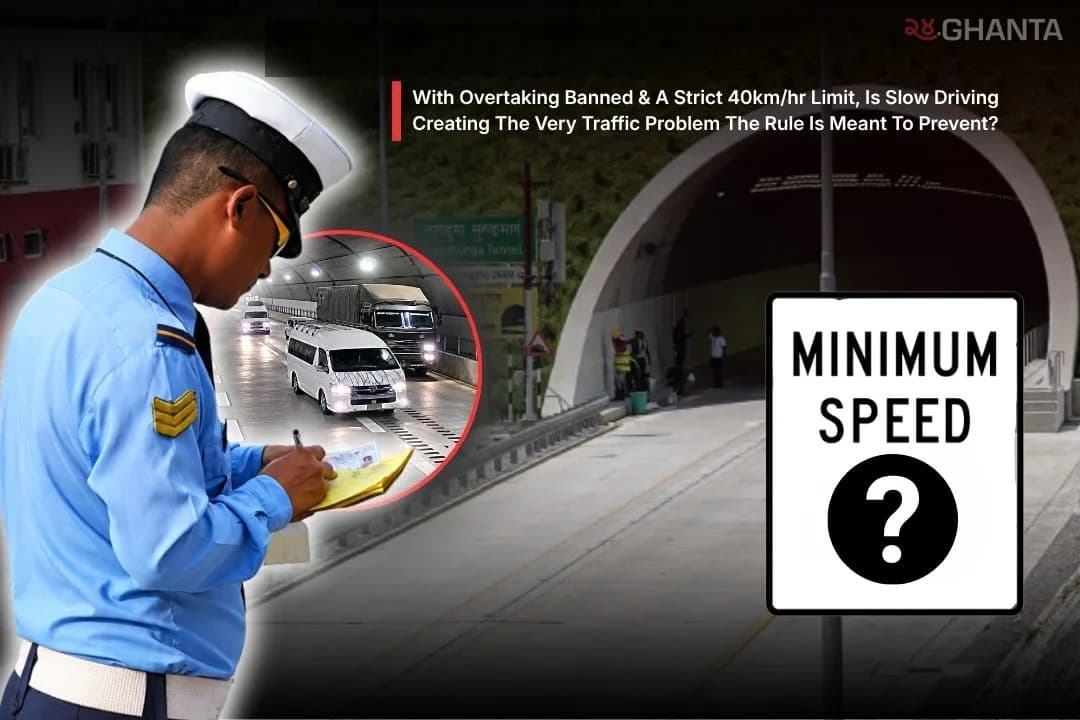
KATHMANDU: The Nagdhunga–Sisnekhola Tunnel has a 40 km/h maximum speed limit and a strict ban on overtaking. But recent enforcement against drivers who overtook inside the tunnel has raised another question: if drivers are moving well below the maximum speed, could slow traffic itself be contributing to the overtaking problem?
The tunnel is designed to make travel through the Nagdhunga section significantly faster. However, the current rules specify a maximum speed rather than a target or minimum operating speed.
40 km/h Is a Maximum, Not a Target
The most important distinction is that 40 km/h is the maximum permitted speed, not a speed that every vehicle must maintain at all times.

Drivers can legally travel below 40 km/h when traffic, road conditions, vehicle performance or safety requires it.
There is currently no specific minimum speed publicly stated in the tunnel's operating rules.
That means a vehicle traveling at 20 or 25 km/h is not automatically violating a minimum-speed rule simply because it is below 40 km/h.
But What Happens When Overtaking Is Also Banned?
This creates an important traffic-flow question.
Inside the tunnel, drivers cannot simply move around a slower vehicle. If one vehicle travels significantly below the normal traffic flow, every vehicle behind it may have to maintain the same slower pace.
This can create a queue, particularly during busy periods.
At the same time, drivers who become frustrated by a slow-moving vehicle may be tempted to break the no-overtaking rule, creating the very safety risk the restriction is intended to prevent.
Recent reports have documented action against two microbus drivers for overtaking inside the Nagdhunga Tunnel.
The Tunnel Was Built to Save Time
The question becomes more important because the tunnel was designed to significantly reduce travel time through the Nagdhunga section.
The existing road between Sisnekhola and Balambhu takes roughly 23 to 33 minutes, depending on the direction and traffic conditions. The tunnel route is expected to take around seven minutes.
That does not mean every vehicle will complete the tunnel section in exactly seven minutes. Traffic, vehicle type and operating conditions can affect travel time.
But if vehicles routinely move far below a reasonable operating speed, the tunnel could lose part of the time-saving advantage it was designed to provide.
Could a Minimum Speed Help?
A minimum normal operating speed could potentially improve traffic flow, especially because overtaking is prohibited.
It could:
Reduce unnecessary slow-moving traffic.
Prevent long queues behind vehicles traveling far below the normal flow.
Make traffic speeds more consistent.
Reduce the temptation to overtake illegally.
Help the tunnel deliver more consistent travel times.
But setting a fixed minimum speed would also have risks.
Why a Fixed Minimum Speed Could Be Difficult
Not every vehicle can safely maintain the same speed in every situation.
A vehicle may need to slow down because of:
Traffic congestion
A mechanical problem
An obstacle inside the tunnel
An emergency
Poor visibility or other road conditions
The performance of a heavily loaded vehicle
A rigid minimum speed could therefore penalize a driver who is slowing down for a legitimate safety reason.
What Could Be More Practical?
Instead of requiring every vehicle to maintain a fixed minimum speed, authorities could consider a reasonable normal operating speed.
For example, authorities could monitor whether a vehicle is moving unnecessarily slowly when there is no traffic, emergency or mechanical reason.
Such a system could maintain the benefits of controlled traffic flow while allowing drivers to slow down when safety requires it.
The key issue would not simply be “How slow is too slow?” but whether the vehicle is creating an unnecessary obstruction.
The 102-Fine Figure Needs Context
A figure of 102 drivers has circulated in discussions about tunnel traffic violations. However, this should not be presented as 102 drivers being fined for overtaking inside the Nagdhunga Tunnel.
The figure refers to broader traffic enforcement and does not establish that 102 people were penalized specifically for tunnel overtaking.
The documented tunnel case involving overtaking concerned two microbus drivers.
So, Is Slow Driving the Problem?
There is not enough evidence to conclude that slow driving is currently the cause of overtaking violations inside the tunnel.
However, the traffic design raises a legitimate question.
With no overtaking allowed, a vehicle traveling substantially slower than the surrounding traffic can affect every vehicle behind it. If that creates long queues, some drivers may be more likely to attempt illegal overtaking.
That makes speed management and the no-overtaking rule closely connected.
The solution would not necessarily be to force every driver to maintain 40 km/h. Instead, authorities could study actual traffic speeds, queue formation and overtaking violations before deciding whether a minimum normal operating speed or another traffic-flow measure is needed.
The Bigger Question for Nagdhunga
The tunnel is intended to make the Nagdhunga section safer and faster.
So the debate is not simply about whether drivers should be allowed to go faster.
It is about finding the right balance between speed, safety and traffic flow.
A strict 40 km/h maximum can prevent dangerous high-speed driving. A strict no-overtaking rule can reduce collision risks. But if vehicles are allowed to travel unnecessarily slowly without any traffic-flow mechanism, queues could develop.
Should authorities consider a reasonable minimum operating speed, with exceptions for emergencies, congestion and vehicle problems?
That is a question that could become increasingly relevant as more vehicles use the tunnel.
Published 1 hour ago in Society