
Nepal Cannot Confirm Original Sugauli Treaty Copy As Questions Grow Over Historic Border Document
Nepal’s government says it cannot confirm whether the country possesses the official signed copy of the historic Sugauli Treaty, the 1816 agreement that reshaped Nepal’s borders after the Anglo Nepal War.
· 7 min read
Kathmandu, August 11, 2026
Nepal’s government has said it cannot confirm whether the country possesses an official signed copy of the historic Sugauli Treaty, the agreement that ended the Anglo Nepal War and became one of the main foundations for defining Nepal’s boundary with British India.
Foreign Minister Shisir Khanal told the House of Representatives that the government has documents related to the Sugauli Treaty, but there is no clear information confirming whether any of them are the original official treaty documents.

Responding to a question from lawmaker Nishkal Rai, Khanal said records show that documents connected to some treaties are stored at the National Archives. However, authorities have not been able to establish whether those records include the actual signed originals.
The issue has gained new attention at a time when questions over Nepal’s border history remain politically sensitive, including continuing disagreements with India over areas such as Kalapani, Lipulekh and Limpiyadhura. The Sugauli Treaty remains important because it provided the historical basis for much of the boundary between Nepal and what was then British controlled India.
Parliamentary Inquiry Could Not Find Original
Questions surrounding the whereabouts of the treaty are not new.
On July 22, 2026, the Delegated Legislation and Governance Committee of the National Assembly concluded that original copies of both the Sugauli Treaty and the 1950 Nepal India Treaty of Peace and Friendship could not be located in Nepal.
According to the committee, searches were carried out in locations where important historical documents would normally be expected to remain. These included national archives and libraries, the Department of Archaeology, Narayanhiti Palace Museum, the Ministry of Law and the Ministry of Foreign Affairs.
Despite those searches, the original documents were not found.
A similar issue emerged in 2016 when the Eminent Persons’ Group on Nepal India Relations began reviewing relations between the two countries. The Nepali side attempted to locate the original 1950 Treaty of Peace and Friendship but was unable to find it. The government later provided the group with another copy of the treaty.
The matter was again raised in Parliament in 2019. Then Foreign Minister Pradeep Gyawali said the government possessed copies of both the Sugauli Treaty and the 1950 treaty but could not confirm whether those documents were the originals without forensic verification. He also said Nepal was attempting to locate historical documents and maps in India and the United Kingdom.
What Is The Sugauli Treaty?
The Sugauli Treaty is one of the most important agreements in Nepal’s modern history.
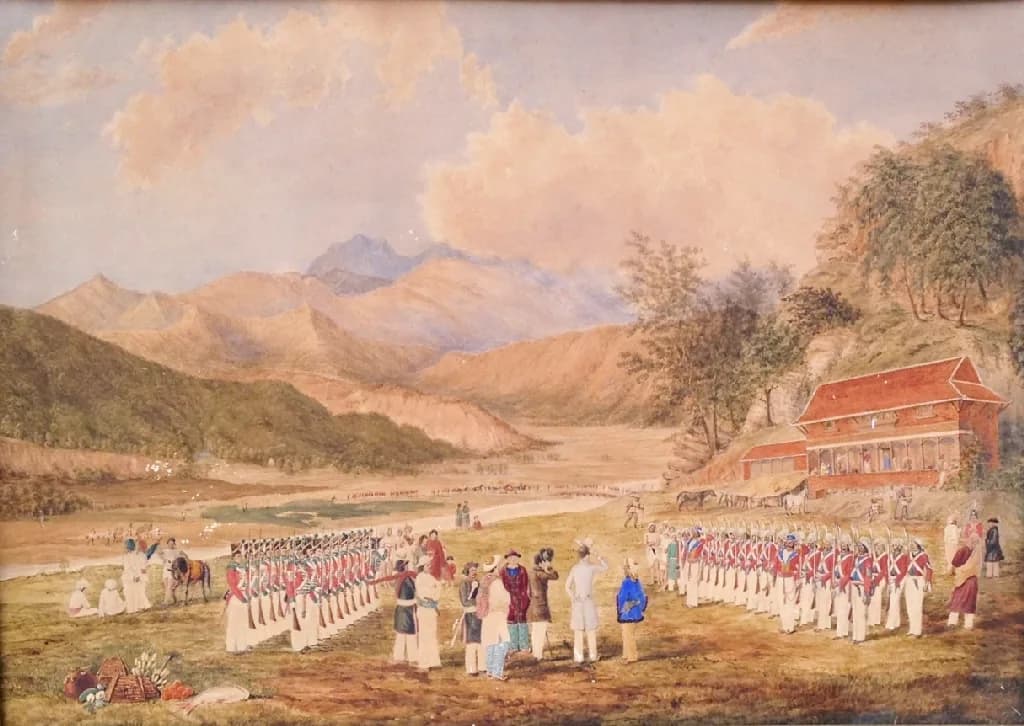
It followed the Anglo Nepal War of 1814 to 1816, fought between the Kingdom of Nepal and the British East India Company. In the decades before the war, the expanding Gorkha state had brought many smaller kingdoms and territories under its control and had extended its influence both east and west.
As Nepal expanded, territorial disagreements increased between Nepal and areas controlled or influenced by the East India Company. These disputes eventually developed into a full war in 1814.
Nepali forces initially put up strong resistance in difficult mountainous terrain. Several commanders and soldiers from the conflict later became important figures in Nepal’s military history. However, the British East India Company had greater financial resources, a larger military structure and the ability to continue operations on several fronts.
By 1815, Nepal was facing increasing military pressure. Peace negotiations followed, producing the document that became known as the Treaty of Sugauli. The agreement was prepared in December 1815 and was formally ratified on March 4, 1816.
The treaty was agreed between representatives of Nepal and the East India Company. It ended the Anglo Nepal War and reshaped Nepal’s political and territorial relationship with British India.
Nepal Lost Large Areas Of Territory
One of the most important consequences of the treaty was the reduction of territory controlled by Nepal.
Under the settlement, Nepal gave up its claims to Kumaon and Garhwal in the west and territories connected to Sikkim in the east. Changes were also made to Nepal’s control of areas in the southern plains.
The Kali River became an important reference for Nepal’s western boundary, while the Mechi River became a major reference in the east. These boundary descriptions later became particularly significant because different interpretations of the source of the Kali River are connected to the modern dispute over Kalapani, Lipulekh and Limpiyadhura.
Some areas of the southern plains were later returned to Nepal. Additional territory was also restored decades later following Nepal’s support for the British during the Indian uprising of 1857. However, the basic territorial structure created after the Anglo Nepal War remained central to Nepal’s modern boundaries.
The treaty also allowed for a British representative in Kathmandu and marked the beginning of a new period in formal relations between Nepal and British India.
Why The Treaty Still Matters Today
More than two centuries after it was concluded, the Sugauli Treaty continues to carry major historical, diplomatic and political importance.
Its wording is still discussed when examining sections of Nepal’s present border with India. This is particularly important in Nepal’s far western region, where Nepal and India have different positions over Kalapani, Lipulekh and Limpiyadhura.
Nepal maintains that the areas belong to Nepal based partly on its interpretation of the Kali River mentioned in the Sugauli Treaty. India has rejected Nepal’s territorial claim and maintains a different interpretation of the border. The disagreement remains unresolved through bilateral negotiations.
The issue has again become sensitive following developments involving the Lipulekh route and its use for trade and pilgrimage. The historical origin of the border therefore remains directly connected to modern diplomacy between Nepal and India.
Because the treaty is such an important historical document, the government’s inability to clearly identify an original signed copy raises questions about how Nepal has preserved records that continue to have diplomatic significance more than 200 years later.
The absence of an easily verifiable original does not automatically mean Nepal lacks documentary or historical evidence related to the treaty. Copies, archival records, correspondence, maps and documents held in other countries can also provide evidence. However, identifying and authenticating original documents can be especially important when historical agreements are connected to continuing territorial questions.
The 1950 Treaty Is Also Missing
The Sugauli Treaty is not the only major agreement whose original document has become the subject of concern.
The original Nepal India Treaty of Peace and Friendship of 1950 has also not been located by recent parliamentary inquiries.
Signed between Nepal’s Rana government and independent India, the 1950 agreement became a major foundation of modern relations between the two countries. It included provisions concerning security, economic relations and reciprocal treatment of citizens in certain areas.
The treaty has remained politically debated in Nepal for decades. Some political leaders have called for its review or replacement, arguing that aspects of the agreement no longer reflect the relationship that Nepal and India should have today.
The inability to locate the original copies of both the 1816 and 1950 agreements has therefore created broader concerns about the preservation and management of Nepal’s important diplomatic records.
Government Plans Wider Treaty Review
Foreign Minister Khanal has also announced that Nepal intends to review hundreds of treaties and agreements based on their present relevance and the country’s national interest.
According to the foreign minister, Nepal has 655 treaties and agreements. Of those, 412 are bilateral agreements involving neighbouring countries, friendly nations, regional organisations and other parties, while 243 are multilateral agreements.
He said 55 agreements have already been concluded or amended, while the government plans to review, amend or renew the remaining 600 depending on their necessity and relevance.
Khanal stressed that Nepal cannot change bilateral or multilateral agreements on its own. Any amendment, renewal or review requiring changes to an agreement must be carried out with the consent of the other countries or international organisations involved, in line with established international treaty practice.
For Nepal, the Sugauli Treaty is more than a historical document about a nineteenth century war. It represents a major turning point in the country’s territorial history and remains closely connected to discussions about sovereignty and boundaries today.
Whether an authenticated original is eventually found in Nepal, India, the United Kingdom or another historical archive could become an important question for researchers and government officials.
For now, Nepal’s foreign minister has acknowledged what several investigations have already suggested: the government has treaty related documents, but it still cannot say with certainty that Nepal holds its official signed copy of one of the most consequential agreements in the country’s history.
Published Aug 11 in Nepal