
Nepal Moves to Revive Udayapur Cement and Gorkharkali Rubber Industries
Nepal has renewed Udayapur Cement’s limestone licence and begun preparations for full-capacity operations, while experts assess options to revive Gorkharkali Rubber Industry.
· 3 min read
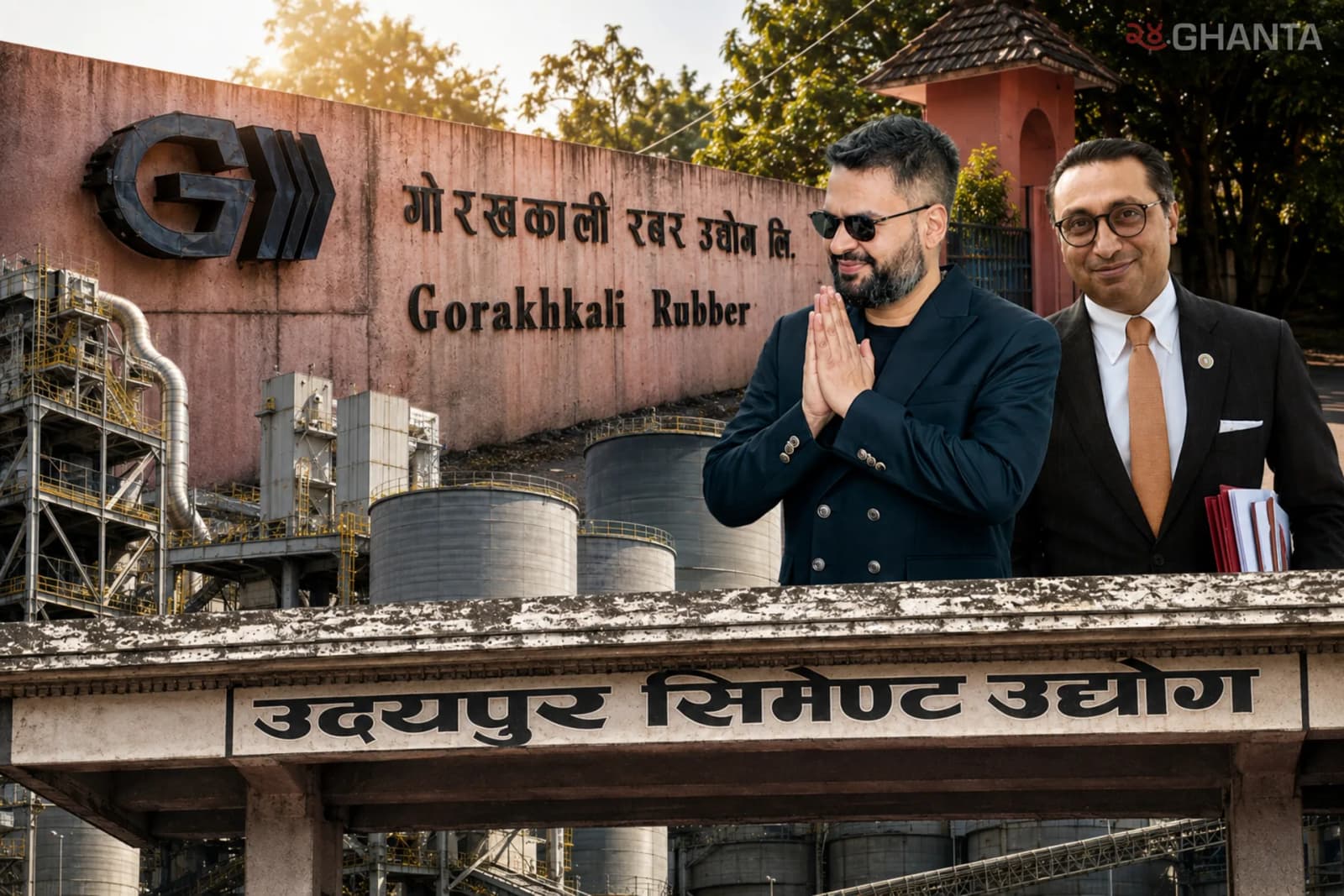
Kathmandu, August 17, 2026: The government has intensified efforts to bring long-shut state-owned industries back into operation, with Udayapur Cement Industry moving toward a full-capacity restart and Gorkharkali Rubber Industry undergoing a fresh feasibility assessment.
The two industries once played important roles in Nepal's domestic manufacturing sector but have remained largely inactive for years.
Udayapur Cement Industry Moves Toward Revival
The government has begun preparations to resume operations at Udayapur Cement Industry, one of Nepal's major state-owned cement factories.

As part of the revival process, the Cabinet has renewed the company's licence to extract limestone and red soil, essential raw materials for cement production.
The licence had previously been cancelled in 2024.
The Cabinet decided on July 2 to allow the Department of Mines and Geology to reissue the cancelled extraction licence under the Mines and Minerals Act.
Government Clears Outstanding Dues
The revival plan also involves settling outstanding payments owed by Udayapur Cement Industry to the Department of Mines and Geology.
The Ministry of Finance has provided Rs 7,497,331.95 to settle the outstanding amount, following the Cabinet's decision.
According to reports, the payment has already been made to the Department of Mines and Geology.
The government is now preparing to appoint a general manager and resume the factory's operations at full capacity.
Udayapur Cement at a Glance
Established in 1987 with Japanese financial and technical assistance.
Located in Jaljale, Triyuga Municipality-11, Udayapur.
Current production capacity: 800 metric tonnes per day.
Limestone was designed to be transported from northern Udayapur through a ropeway system.
The industry became Nepal's largest cement company in fiscal year 2016/17.
The government is now looking to restore the industry to its full production potential.
Gorkharkali Rubber Industry Also Under Study
While Udayapur Cement is moving toward operational revival, a separate effort is underway to determine whether the Gorkharkali Rubber Industry can also be restarted.
A team of experts led by Gorkha-2 lawmaker Kabindra Burlakoti visited and studied the long-shut factory in Mabhuwā, Gorkha Municipality-13.
Representatives from the Ministry of Finance, Ministry of Industry and Ministry of Law were also part of the assessment team.
Legal and Financial Feasibility Being Examined
Burlakoti said the visit was aimed at assessing whether the factory could realistically be brought back into operation.
The team is examining:
The legal feasibility of restarting the industry.
Its financial viability.
The condition and potential use of existing infrastructure.
Possible investment and operating models.
The requirements for bringing the factory back into production.
Burlakoti said a financial proposal for restarting the industry would also be prepared soon.
Once a Major Tyre Producer
Gorkharkali Rubber Industry was established on May 30, 1984, with assistance from the Chinese government. Its foundation stone was laid by then-King Birendra Shah in 1985.
Commercial production began in 1993.
At its peak, the industry was capable of producing around 88,000 tyres annually for trucks, jeeps, vans and cars.
The company once supplied a significant share of Nepal's domestic tyre and tube market and also exported products to countries including India, Bangladesh and Sri Lanka.
Factory Has Been Shut Since 2015
Gorkharkali Rubber Industry was completely shut down on March 23, 2015.
The factory covers around 670 ropanis of land, with substantial state investment and infrastructure now lying unused.
Years of closure have left its buildings and machinery idle, raising questions over whether existing facilities can be economically restored or whether significant new investment would be required.
A Broader Push for Domestic Manufacturing
The renewed attention on both industries comes as the government looks to make greater use of existing industrial infrastructure and strengthen domestic production.
Reviving Udayapur Cement could reduce dependence on imported cement products and raw materials, while restarting Gorkharkali Rubber could potentially restore domestic tyre production.
However, both projects face different challenges, including the condition of old machinery, financing, management, market competitiveness and the legal framework surrounding state-owned enterprises.
Published Aug 17 in Politics