
Who Is Manoj KC, Nepal’s New Police Chief? A Look at His 28-Year Career and Major Investigations
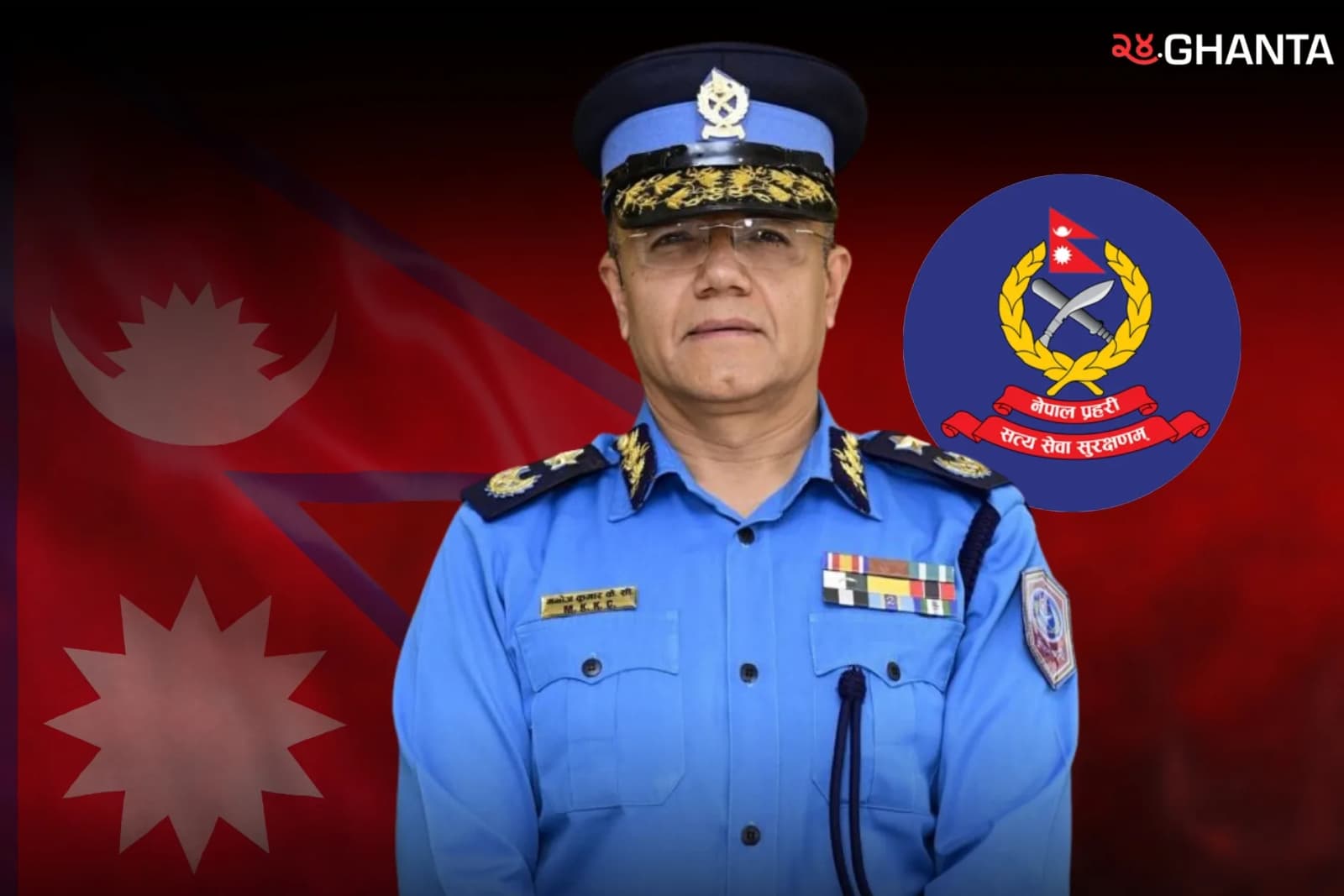
Dr. Manoj Kumar KC has been appointed Nepal’s new Inspector General of Police, replacing Dan Bahadur Karki after nearly 28 years of service. Known for his role in the fake Bhutanese refugee scam investigation, KC brings extensive experience in criminal investigations, police leadership, and international peacekeeping.
· 8 min read
Kathmandu, November 4, 2026
Dr. Manoj Kumar KC has been appointed as the new Inspector General of Nepal Police (IGP) following a Cabinet decision on Wednesday. The government appointed KC, who was serving as an Additional Inspector General (AIG) and head of the Crime Investigation Department at Police Headquarters, to replace Dan Bahadur Karki. The outgoing police chief has been assigned the newly created role of special security adviser to the Prime Minister.
Government spokesperson Sasmit Pokharel said the decision was a reassignment of responsibilities rather than disciplinary action against Karki. KC was appointed under Rule 41 of the Police Regulations, 2071 BS, effective November 4.

KC and Karki belong to the same batch of police officers, having entered Nepal Police as inspectors in March 1998. The leadership change comes before Karki's expected retirement under the existing 30-year service provision.
But who is Manoj KC, and what has his nearly three-decade career in Nepal Police looked like?
Nearly 28 Years in Nepal Police
Manoj Kumar KC began his policing career as an inspector in March 1998. Over nearly 28 years, he served in district police leadership, criminal investigation, specialized security units, police training, and senior administrative positions before becoming Nepal's Inspector General of Police.
He served as district police chief in Morang and Rupandehi and later held major responsibilities at the Kathmandu Valley Crime Investigation Office, Special Bureau, National Police Academy, and Central Investigation Bureau (CIB).
KC was promoted to Additional Inspector General on April 24, 2025, one of the highest ranks in Nepal Police.
On September 21, 2025, he was transferred to the Central Investigation Bureau, the specialized police unit responsible for investigating serious and complex crimes. On July 6, 2026, he became head of the Crime Investigation Department at Police Headquarters, the position he held immediately before his appointment as IGP.
The Fake Bhutanese Refugee Scam Investigation
One of the most widely discussed investigations associated with KC's career is the fake Bhutanese refugee scam.
The case involved allegations that an organized group collected large sums of money from individuals by promising to send them to the United States by falsely identifying them as Bhutanese refugees.
While serving as chief of the Kathmandu Valley Crime Investigation Office, KC helped advance the investigation, which had previously made limited progress.
On Chaitra 12, 2079 BS, his team arrested three key suspects: Keshav Dulal, Tank Gurung, and Sanu Bhandari.
As the investigation expanded, several senior political and administrative figures were implicated, including former Home Minister Balkrishna Khand, former Deputy Prime Minister Top Bahadur Rayamajhi, and former Home Secretary Teknarayan Pandey. All three were subsequently arrested in connection with the case.
The investigation became one of Nepal's most prominent criminal cases because of the alleged involvement of influential political figures.
KC was transferred from the Kathmandu Valley Crime Investigation Office in August 2023 while further investigation was underway. Some media reports linked the transfer to dissatisfaction within the political leadership over the investigation, although that explanation has not been independently established as the official reason.
His involvement in the case continued after he was promoted to Deputy Inspector General and assigned to the Special Bureau in 2024.
During that period, police arrested Bechan Jha and Pratik Thapa, the son of former Home Minister Ram Bahadur Thapa, in connection with the refugee scam investigation.
These developments brought KC considerable public attention for his involvement in investigations that reached senior political and administrative circles.
After his promotion to Deputy Inspector General in 2024, KC served in the Special Bureau, which coordinated operations connected to the June 28 arrests of Bechan Jha and Pratik Thapa in the fake Bhutanese refugee case. Contemporary reports linked KC to the operations but noted that he was not directly involved in the subsequent investigation.
Leadership of the Central Investigation Bureau
KC's appointment as chief of the Central Investigation Bureau in September 2025 marked another important stage in his career.
According to his official profile published by Nepal Police, the bureau conducted investigations into several major financial and organized crime cases during his leadership.
These included alleged fraudulent helicopter rescue operations, suspected fraud connected to Smart Telecom, organized financial fraud involving banking institutions, securities and insurance-related offenses, cryptocurrency crimes, and allegations involving the illegal occupation and misuse of government land.
His experience at the CIB expanded his responsibilities beyond individual criminal investigations to complex cases involving financial institutions, organized networks, and public assets.
However, the fact that an investigation was conducted under his leadership does not necessarily mean that every allegation was proven or that all cases resulted in convictions.
Money-Laundering Investigation Involving Former Prime Ministers and Ministers
In March 2026, the Department of Money Laundering Investigation (DMLI), with assistance from the Central Investigation Bureau under Manoj KC, intensified investigations involving former prime ministers Sher Bahadur Deuba, KP Sharma Oli and Pushpa Kamal Dahal, along with former ministers Arzu Rana Deuba and Deepak Khadka.
The investigations concerned suspected money laundering and discrepancies in financial records and declared assets. On March 29, the CIB arrested former Energy Minister Deepak Khadka at the DMLI's request. KC confirmed that his bureau was assisting the department rather than independently leading the entire investigation.
In April 2026, the Kathmandu District Court authorized the arrests of former Prime Minister Sher Bahadur Deuba and former Foreign Minister Arzu Rana Deuba in connection with the investigation. However, on May 25, the Supreme Court invalidated those arrest warrants and directed authorities not to arrest the couple on their basis, citing legal and procedural deficiencies.
Interpol had also declined Nepal's request to issue Red Notices against the couple. The allegations remained matters for investigation and did not establish criminal guilt.
KC, who was leading the CIB at the time, confirmed that his bureau was cooperating with the investigation following instructions received through Police Headquarters.
On March 29, 2026, the CIB arrested former Energy Minister Deepak Khadka in connection with the money-laundering investigation, following a request from the DMLI.
KC confirmed that the arrest was carried out on the department's instructions.
The investigation also extended to former Prime Minister Sher Bahadur Deuba and his wife, former Foreign Minister Arzu Rana Deuba.
On April 7, 2026, the Kathmandu District Court authorized the arrest of the Deuba couple in connection with the money-laundering investigation. The development was reported the following day.
The broader investigation also examined allegations concerning former prime ministers KP Sharma Oli and Pushpa Kamal Dahal.
At the time, KC said the investigation would proceed according to legal procedures, including the possible use of diplomatic channels and Interpol mechanisms when suspects were abroad.
However, the DMLI was the lead investigating authority, while the CIB provided assistance under KC's leadership. It would therefore be inaccurate to describe KC as personally leading every aspect of the investigation.
The allegations against the political figures also remain distinct from any finding of criminal guilt. Arrests, warrants, and investigations do not establish that the individuals concerned committed the alleged offenses.
Academic Background and Research
Apart from his policing career, KC has pursued higher education and academic research.
According to Nepal Police's official biography, he holds a PhD in Conflict Transformation from Paññāsāstra University of Cambodia.
He also holds postgraduate qualifications in sociology and anthropology and public administration from Tribhuvan University, along with a master's degree in applied conflict transformation studies from Cambodia.
His academic interests include human security, organized crime, policing in post-conflict societies, and improving the effectiveness of law enforcement institutions.
His official biography lists research publications, including Identify Effective Measures to Combat Organized Crime in Post-Conflict Kathmandu (2013) and Enhancing Policing in Nepal (2023).
KC served as the founding director of Nepal Police Staff College in Maharajgunj, where he contributed to developing the Master of Police Science curriculum. He has also been involved in police training and academic teaching.
International Experience and Recognition
KC has served in United Nations peacekeeping missions in Kosovo and Haiti, gaining experience in security management and strengthening policing capabilities in post-conflict environments.
His official police biography also lists proficiency in Nepali, English, French, and Spanish.
According to Nepal Police, KC has received national decorations, including the Suprabal Jana Sewa Shree and Prabal Gorkha Dakshin Bahu, along with recognition for his work in criminal investigation and district police leadership.
A New Role at the Top of Nepal Police
KC's appointment comes through a government decision to replace an incumbent police chief rather than through a routine retirement-based leadership transition.
The Cabinet assigned Dan Bahadur Karki a newly created special security advisory position under the Prime Minister while appointing KC to lead Nepal Police.
With nearly 28 years of service, experience in major criminal investigations, academic qualifications, and international assignments, KC now assumes responsibility for one of Nepal's most important security institutions.
His career includes involvement in the fake Bhutanese refugee scam investigation, major financial and organized crime cases, and the CIB's assistance in money-laundering investigations involving former prime ministers and ministers.
However, leading the entire police organization will require responsibilities extending beyond criminal investigation, including maintaining public security, managing personnel, strengthening accountability, and improving public trust.
As KC begins his tenure as Inspector General, attention will turn to how his investigative experience translates into leadership of Nepal Police and whether his administration can strengthen the institution's professionalism, independence, and accountability.
Published 2 hours ago in Politics