
Nepal Proposes Compensation For Passengers If Airlines Delay Or Cancel Flights Due To Their Own Fault
Domestic airline passengers in Nepal could gain stronger compensation rights under a proposed law requiring airlines to pay when delays or cancellations result from the company’s own negligence.
· 4 min read
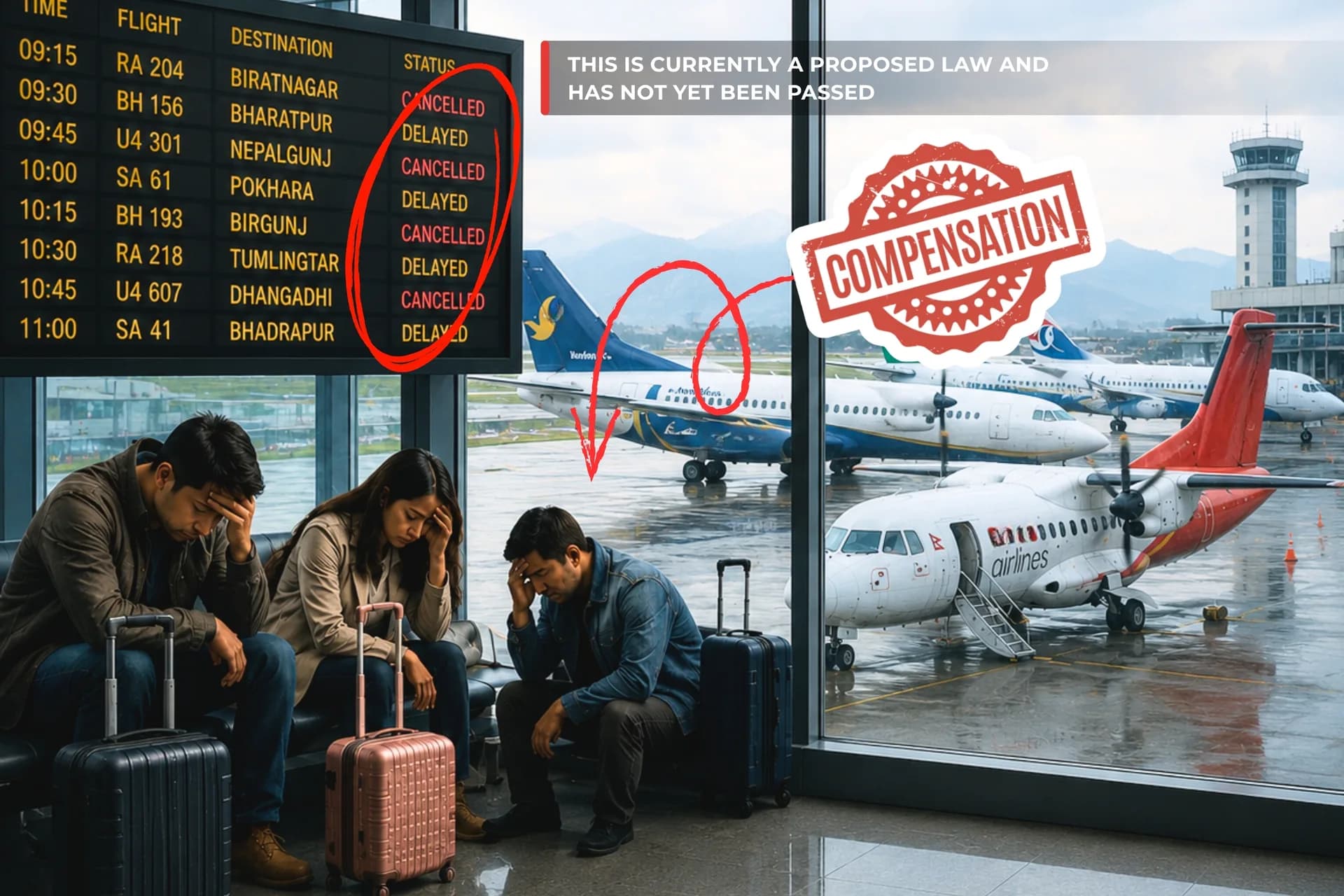
Domestic airline passengers in Nepal could soon have the right to claim financial compensation when a flight is delayed or cancelled because of an airline company’s own negligence.
The provision is included in the proposed Domestic Air Service Liability Act, 2083, prepared by the Ministry of Culture, Tourism and Civil Aviation.

Under the proposal, an airline would be financially responsible when its own actions or negligence cause a passenger’s flight to be delayed or cancelled.
The measure is intended to strengthen passenger protection and make domestic airlines more accountable for disruption caused by circumstances within their control.
When Could Passengers Claim Compensation?
The proposed law distinguishes between disruption caused by an airline and delays resulting from other circumstances.
If a flight is delayed or cancelled because of the airline company’s own negligence, passengers would be allowed to claim compensation from the carrier.
This could potentially cover situations where the airline itself is responsible for failing to operate the scheduled service.
However, the proposal does not mean that passengers would automatically receive compensation for every delay or cancellation.
Factors outside an airline’s control—such as extreme weather, airport closures or other operational restrictions—could be treated differently.
Airlines May Have To Give Three Hours’ Notice
Another important proposal deals with passenger notification.
If an airline expects a flight to be delayed or suspended because of other circumstances, it would have to inform affected passengers at least three hours in advance.
The measure is aimed at reducing situations where passengers reach airports only to discover that their flights have been significantly delayed or cancelled.
Advance notification could allow passengers to change travel plans, avoid unnecessary waiting at airports and make alternative arrangements.
Compensation Goes Beyond Flight Delays
The proposed law is not limited to delays and cancellations.
It also seeks to establish airline liability in situations involving:
Aviation accidents
Lost baggage
Damaged baggage
Flight delays
Flight cancellations
Other passenger losses covered by the proposed liability framework
This would create a broader domestic passenger compensation system rather than addressing each problem separately.
Lost Or Damaged Baggage Could Also Be Covered
Passengers who lose baggage or receive damaged luggage could also become eligible for compensation under the proposed framework.
Airline baggage disputes are currently a common source of frustration for travelers, particularly when responsibility and compensation procedures are unclear.
The proposed legislation aims to create clearer financial responsibility for airlines when baggage is lost or damaged while under their control.
Why Is The Government Proposing The Law?
The proposed legislation is designed to increase accountability within Nepal’s domestic aviation sector.
Passengers regularly face delays caused by weather, airport congestion, technical problems and operational issues.
While not every disruption is caused by an airline, the government wants passengers to have a clearer legal remedy when the company itself is responsible.
The Tourism Ministry had previously published a draft bill specifically dealing with domestic air service liability and insurance, showing that the government has been working toward a formal passenger-liability framework.
Not Every Delayed Flight Would Mean Compensation
One important distinction for passengers is that the proposal does not appear to guarantee compensation simply because a flight is late.
Compensation would depend on the reason behind the disruption.
If the airline is responsible, passengers could claim compensation.
If the delay results from circumstances outside the airline’s control, the airline could instead be required to provide advance information where possible.
The final rules would depend on the wording approved by Parliament and any regulations introduced after the law takes effect.
How Much Compensation Would Passengers Receive?
The report describing the proposal does not specify a single fixed compensation amount for every flight delay or cancellation.
The eventual amount could depend on the type of loss, length of delay, nature of the incident or limits established under the final law and regulations.
Passengers should therefore not assume that a particular compensation amount has already been guaranteed.
Further details could emerge as the bill moves through the legislative process.
What Happens Next?
Because these provisions are part of a proposed law, they do not automatically apply to passengers yet.
The legislation must complete the required parliamentary process before becoming legally enforceable.
Lawmakers could also amend parts of the proposal before its final approval.
Until then, existing aviation rules and individual airline policies continue to apply.
What Could Change For Passengers?
If passed in its current form, the law could significantly change the relationship between domestic airlines and passengers in Nepal.
Passengers could gain clearer rights when an airline causes disruption, while airlines could face stronger legal and financial pressure to maintain schedules, communicate delays quickly and handle baggage responsibly.
For frequent domestic travelers, the biggest change would be having a clearer legal basis to seek compensation rather than relying only on airline goodwill or internal company policies.
Published Aug 2 in Nepal