
Nepal’s Section 12B Explained: How Disaster Relief Donations Can Reduce Your Taxable Income
Nepal’s Section 12B allows eligible donations to specified government disaster and reconstruction funds to be deducted from taxable income. The full qualifying donation amount may reduce taxable income, but the actual tax savings depend on the taxpayer’s income and applicable tax rate.
· 7 min read
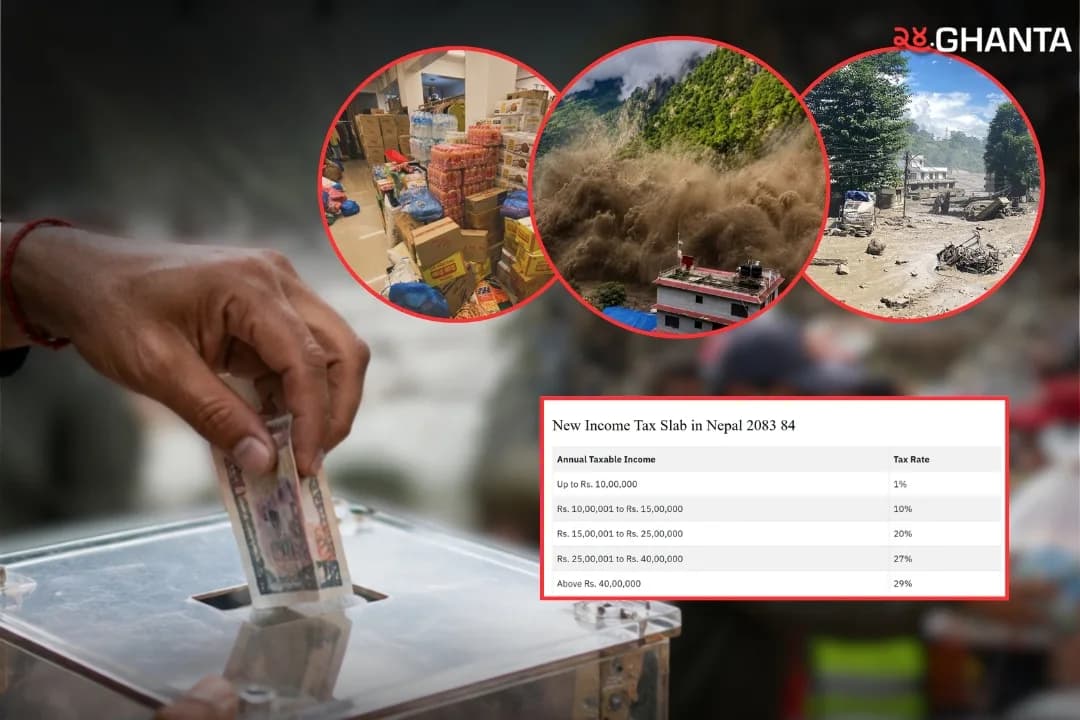
Kathmandu, September 4, 2026: As people and businesses contribute to disaster relief following the recent flooding in Nepal, questions have emerged about whether such donations can also provide an income tax benefit.
Nepal’s Income Tax Act contains a specific provision for certain government disaster funds. Section 12B of the Income Tax Act, 2058 allows a person contributing to the Prime Minister Natural Calamities Fund and a reconstruction fund established by the Government of Nepal to deduct the qualifying contribution when calculating taxable income for that income year.
The provision can be valuable for taxpayers, but its meaning is easy to misunderstand. A tax deduction does not mean the government returns the money you donated. It reduces taxable income, and the actual amount of tax saved depends on the tax rules and rates that apply to the taxpayer.

What Does Section 12B Say?
Section 12B provides that a person contributing an amount during an income year to the specified Prime Minister Natural Calamities Fund and government-established reconstruction fund may deduct that contribution when computing taxable income for that year.
The important words are “deduct” and “taxable income.”
In simple terms, if a taxpayer has taxable income of Rs. 6,00,000 and makes a qualifying contribution of Rs. 50,000, the basic calculation would be:
Rs. 6,00,000 − Rs. 50,000 = Rs. 5,50,000 taxable income
The Rs. 50,000 is therefore deducted from income before the applicable income tax calculation. It is not Rs. 50,000 taken directly off the final tax bill.
What Is An “Eligible Donation”?
Not every donation made during a disaster automatically qualifies under Section 12B.
The provision specifically refers to contributions to the Prime Minister Natural Calamities Fund and a reconstruction fund established by the Government of Nepal.
This distinction matters. Giving money directly to an affected family, a private fundraiser, an NGO, a community campaign, or another relief collection may be valuable humanitarian support, but that does not automatically make the payment deductible under Section 12B.
The Inland Revenue Department has also recently published an appeal for financial assistance to the Prime Minister disaster and relief funds following the Rasuwa disaster.
Does The Donation Have To Be Rs. 1 Lakh?
No fixed Rs. 1 lakh requirement appears in the wording of Section 12B.
The provision refers to a person contributing “any amount.” Therefore, the basic Section 12B rule is not limited to people who donate Rs. 1,00,000 or more.
For example, depending on qualification under the provision:
Rs. 5,000 donated → Rs. 5,000 deduction
Rs. 50,000 donated → Rs. 50,000 deduction
Rs. 1,00,000 donated → Rs. 1,00,000 deduction
The amount donated and the amount of actual tax saved, however, are two completely different figures.
What Does “100% Deductible” Actually Mean?
This is where taxpayers need to be particularly careful.
If a qualifying Rs. 50,000 contribution is fully deductible, it means Rs. 50,000 can be removed from taxable income when computing taxable income.
It does not mean:
Donate Rs. 50,000 → Receive Rs. 50,000 back
Instead, it means:
Taxable income − qualifying donation = reduced taxable income
Tax is then determined using the tax rules applicable to that reduced amount.
A Simple Example
Suppose a taxpayer has:
Taxable income before donation: Rs. 6,00,000
Eligible Section 12B donation: Rs. 50,000
The calculation is:
Rs. 6,00,000 − Rs. 50,000 = Rs. 5,50,000
The taxpayer's taxable income has therefore fallen by Rs. 50,000.
If, purely for illustration, the entire relevant amount were taxed at 1 percent:
Before donation:
Rs. 6,00,000 × 1% = Rs. 6,000
After donation:
Rs. 550,000 × 1% = Rs. 5,500
Difference:
Rs. 6,000 − Rs. 5,500 = Rs. 500
So, in this simplified illustration, donating Rs. 50,000 does not create a Rs. 50,000 tax refund. The tax difference is Rs. 500.
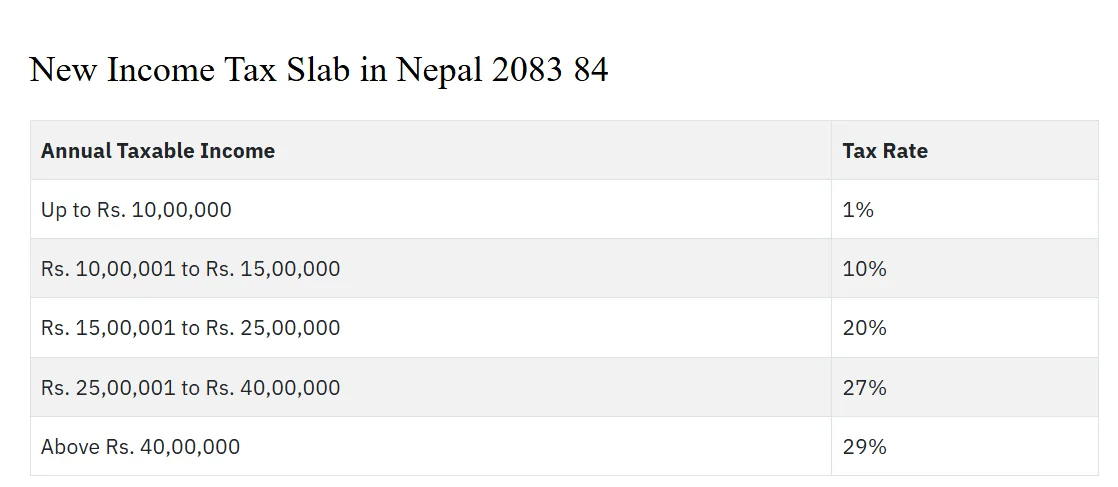
Actual Nepal income tax calculations can involve progressive slabs, taxpayer status, and other rules, so this simplified example should not be treated as a universal tax calculation. The Inland Revenue Department notes that applicable income tax rates are contained in Schedule 1 of the Income Tax Act and can be changed by the Finance Act for the relevant fiscal year.
Why Higher Income Taxpayers May See A Different Benefit
A deduction becomes more financially significant when it removes income that would otherwise fall within a higher applicable tax bracket.
Consider a simplified example where part of a person's taxable income falls within a 10 percent bracket. If a qualifying deduction removes Rs. 50,000 that would otherwise have been taxed at 10 percent, the tax effect on that portion could be:
Rs. 50,000 × 10% = Rs. 5,000
This is why two people making exactly the same donation may not necessarily receive exactly the same tax benefit.
The donation determines the potential deduction from taxable income. The taxpayer's income, applicable tax rates, and individual circumstances determine the actual tax effect.
What About Low Income Employees?
For workers with relatively low annual taxable income, the financial benefit can be small or, depending on their circumstances, there may be no additional income tax savings to realize.
This does not necessarily mean that a qualifying contribution stops being a Section 12B deduction. Rather, a deduction can only reduce tax to the extent there is relevant taxable income and tax liability to reduce.
This is an important point for people earning Rs. 20,000 or Rs. 25,000 per month. They should not assume that donating will automatically produce a cash payment or refund from the government.
The rule is a tax deduction, not a donation reward programme.
But Salaried Employees Already Pay Tax Monthly
Yes. Employers commonly deduct applicable tax when paying employment income. The Inland Revenue Department explains that advance tax on remuneration is deducted when salary is paid and deposited with the tax authority according to the prescribed process.
However, Section 12B itself refers to contributions and taxable income within an income year.
Therefore, monthly salary withholding should not be confused with the final concept of annual taxable income. How an employee's qualifying deduction is reflected or reconciled can depend on the taxpayer's filing and employment circumstances.
Section 12B Is Different From The General Donation Rule
Another important detail is that Nepal's Income Tax Act contains other provisions dealing with gifts and donations.
The English translation published by the Inland Revenue Department shows a general limitation in the preceding donation provision of Rs. 1,00,000 or 5 percent of adjusted taxable income, whichever is lower. But Section 12B is separately written specifically for contributions to the specified disaster and reconstruction funds and says a person contributing “any amount” may deduct that amount when computing taxable income.
Taxpayers should therefore avoid assuming that every charitable donation receives the same treatment as a contribution covered specifically by Section 12B.
Why Documentation Matters
Anyone intending to claim a tax deduction should maintain clear evidence of the qualifying contribution.
At minimum, taxpayers should retain the official receipt, bank or digital payment evidence, and information identifying the fund that received the money. The purpose is to be able to establish that the payment was actually made to a fund covered by the relevant provision.
For significant contributions or complicated tax situations, taxpayers should confirm the treatment with the Inland Revenue Department or a qualified Nepal tax professional before filing.
The Bottom Line
Section 12B provides a tax incentive for qualifying contributions to specified government disaster and reconstruction funds, but it should not be presented as the government “paying people back” for donating.
The simplest way to understand the provision is:
You donate Rs X to an eligible fund → Rs X may be deducted from taxable income → tax is calculated on the reduced taxable income → your actual tax saving depends on the tax rules applicable to you.
For taxpayers who already have little or no relevant tax liability, the immediate financial benefit may be small or nonexistent. For taxpayers whose income is subject to higher marginal rates, the same qualifying deduction may have a larger tax effect.
The humanitarian decision to donate and the financial tax benefit are therefore separate considerations. Section 12B can reduce the tax burden for qualifying taxpayers, but a 100 percent deduction from taxable income is not a 100 percent refund of the donation.
Tags
Published Sep 3 in Business