
"Sayaun Thunga Phool Ka: The Song Nepal Sings But Rarely Understands"
Nepal’s national anthem is more than a patriotic song it marks the country’s shift from praising a king to celebrating its people, diversity, sacrifice, and shared identity. This article explores what its 46 words really mean, how the anthem was chosen, and the legal rules most Nepalis still do not know.
· 8 min read
What Is a National Anthem?
Most people have stood for one. Many have sung one. But few have stopped to ask what a national anthem actually is, and why it matters. A national anthem is a patriotic song or musical composition that is either officially recognized by a nation's government and constitution, or accepted through popular use by its people. It reflects the history, struggles, and traditions of a nation and serves as an expression of national identity.
The concept was first popularized in 19th-century Europe. As nations gained independence from colonial powers, they began composing their own anthems. Today, virtually every sovereign nation in the world has one.

When Is It Used?
National anthems are played during national holidays, cultural festivals, and international sporting events. In the Olympic Games, the anthem of the winning team plays during the medal ceremony, a moment that gives athletes the feeling of having made their country proud. In some countries, the anthem is part of a school's daily routine. In countries like China and Colombia, it plays at specific times of the day on radio and television channels.
Why Does It Matter?
The national anthem represents the tradition, history, and beliefs of a nation and its people. It evokes patriotism, reminds citizens of their nation's heritage, and unites people across ethnic and regional differences. During its performance, citizens, despite their differences, rise together in unison. Students who listen to the national anthem in school learn to respect their nation and develop a sense of unity among themselves.
The Song Nepal Was Embarrassed By, And The One That Replaced It
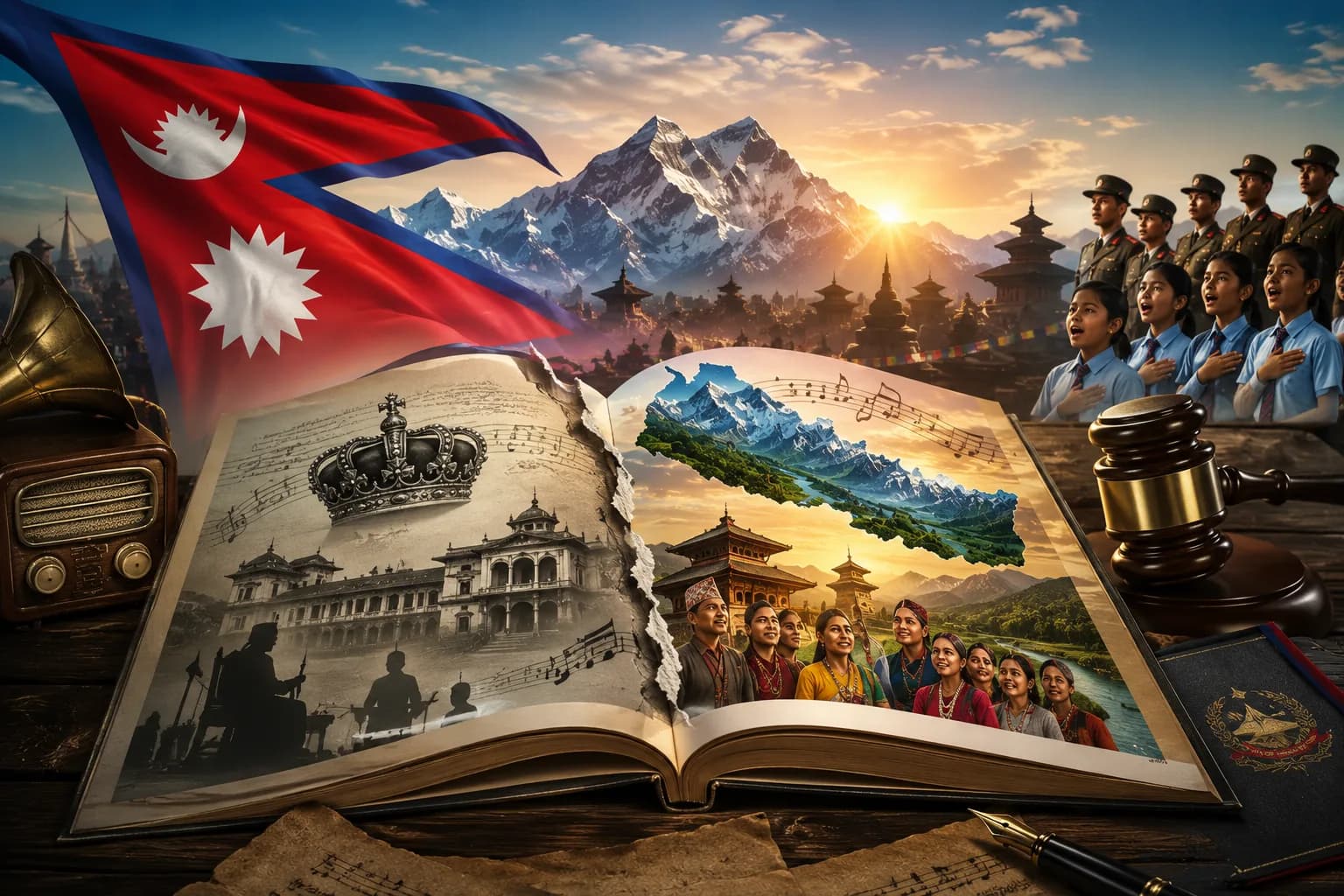
For decades, Nepal had a national anthem that, by many accounts, made its own citizens cringe.
"Shreeman Gambhir Nepal…" sung to a Western martial tune that had nothing in common with South Asian folk or classical traditions. It sang praises of the incumbent king, wished him eternal enhancement of status, and hoped that the population would expand. It was, by most accounts, an embarrassing and uninspiring tune that had been a burden throughout Nepal's modern era.
Then everything changed.
The Fall of the King
King Gyanendra was Nepal's last king. He was the 12th king in a royal line that began with Prithvi Narayan Shah, the ruler who unified Nepal into one nation almost 250 years ago. But the political turbulence that defined his reign irrevocably changed how the people of Nepal viewed the monarchy. As public confidence in the monarchy faded, the anthem that once celebrated it gradually faded with it.
A Competition, Not a Committee
Amidst the political turbulence following the People's Movement of April 2006, while the country was adjusting to major political shifts, a competition was held to draft a new national anthem.
The king was gone. The palace was empty. And Nepal asked its people what we should sing now?
The lyrics eventually selected were those of Pradeep Kumar Rai, aka Byakul Maila, a man of hill ethnicity of the Rai community, notable in a society where acts of literary creativity had tended to be the monopoly of caste groups.
The Music
The music was composed by Amber Gurung, described as a living icon and great musical impresario who came to Kathmandu from Darjeeling during the early 1960s at the invitation of King Mahendra. Gurung possessed a unique command of Western classical, Hindustani classical, and Nepali folk traditions, blending harmony and melody to create a sound that was quintessentially Nepali.
What The New Anthem Said
"Sayaun Thunga Phoolka Haami" is made up of a hundred varieties of flowers.
The lyrics of the new Nepali national anthem speak of the country as a bouquet of a hundred varieties of flowers across plains, hills, and mountains with multiple cultures, tongues, and faiths, an advancing nation made possible by the blood of ancestors.
It was a welcome release from the lyrics of the old anthem. The old song belonged to a king. The new one belonged to everyone.
What Have We Actually Been Singing?
Most Nepalis have sung it hundreds of times. But if you asked them to explain what it actually says, most would struggle.
Here is what "Sayaun Thunga Phool Ka" is actually saying.
The anthem has two stanzas, four lines each. Just 46 words. But those 46 words carry the entire identity of a nation.
Unity
Hundreds of flowers and one garland. The flowers represent Nepal's people of different castes, tribes, and backgrounds compiled into one identity.
Geography
The nation stretches sovereign from Mechi to Mahakali, Terai, hills, and Himalayas, named and celebrated as one indivisible motherland.
Natural Wealth
Nepal is described as a playground for millions of nature's gifts: mountains, rivers, and an extraordinary natural landscape.
Bravery
The country stands free and immovable on the blood of heroes who sacrificed their lives so Nepal would never be ruled by a foreign power.
Peace
Nepal is declared a land of knowledge and peace across its plains, hills, and mountains.
Diversity
Multi-racial, multi-lingual, multi-religious, and with a significant culture. The anthem does not just acknowledge Nepal's diversity; it celebrates it.
What Changed
Before this anthem, Nepal sang "Shreeman Gambhir Nepali," written in 1924. That anthem praised the king and wished him eternal status.
The new anthem mentions no king. No palace. No single identity.
About 1,272 people entered the competition to write it. Byakul Maila won. Late Amber Gurung composed the music.
1,272 entries. 46 words. One nation finally singing about itself.
The Rules Most Nepalis Have Never Read
You have sung it at school. You have stood for it at events. But did anyone ever tell you there are actual legal rules about how to do it?
Most Nepalis would say no.
The Constitutional Status
"Sayaun Thunga Phool Ka" is not just a song; it is a constitutional document. It has been officially declared the national anthem of Nepal in Schedule 2 of the country's Constitution, under clause 1 of Article 9.
The 2012 Procedure Rules That Already Existed
Long before the National Dignity Bill of 2023, Nepal already had a legal framework governing the anthem. The Procedure Related to the Use of the National Flag and National Anthem came into effect in 2069 BS (2012 AD), with its first amendment on August 19, 2019.
Under this procedure, the national anthem must be played mandatorily during:
National festivals and formal programs
Military gatherings and military honors
School prayers and sports events
The beginning and end of all radio and television programs
During these occasions, everyone, including the President, Vice President, Prime Minister, Chief Justice, and all other officials, must stand in a dignified and respectful manner, heads held high, and sing the anthem in a loud and enthusiastic voice.
Private listening at home or while traveling in public places? No rules apply.
The National Dignity Bill 2079 Is Now Law
Rules existed. But breaking them had no formal legal consequence until 2023.
On March 26, 2023, Nepal's National Assembly gave unanimous approval to the National Dignity Bill 2079. Not a single member objected.
The bill's rules for honoring the anthem, outlined in Section 5, are clear:
Stand at attention, feet forming a V shape
Head up, chest lifted
Sing aloud and joyfully
Every citizen follows the same rules, including those in positions of authority, with no exceptions.
Individuals with disabilities are exempt based on their physical condition
The bill also formally defined the National Tune, the original musical sound of the anthem, and directed that it be played before federal parliament and state assembly meetings, and accorded the same level of respect as the anthem itself.
Most importantly, disrespecting the national anthem is now formally prohibited by law. What was once just a rule is now a legal obligation.
The Gap
The 2012 procedure existed for over a decade. Most Nepalis never knew it. Nepal had to pass an entirely new law in 2023 just to remind its citizens that the anthem deserves respect.
That gap between law and awareness is perhaps the most important thing this article is trying to close.
More Than a Song
Most of us learned the anthem in school. We stood for it every morning, sang it at every assembly, and heard it at every national event. But somewhere between graduation and adulthood, we stopped listening.
Not just to the tune. To the words.
"Sayaun Thunga Phool Ka" is not just a song Nepal sings. It is a document of what Nepal chose to become. It replaced an anthem written for a king with one written for the people. It took 1,272 entries, one poet, and one composer to put into 46 words what Nepal stands for: unity, geography, natural wealth, bravery, peace, and diversity.
It was declared a constitutional symbol under Schedule 2 of Nepal's Constitution. A legal procedure governing how to sing it has existed since 2012. And in 2023, Nepal's National Assembly unanimously passed the National Dignity Bill, making disrespect of the anthem a formal legal offence.
The rules exist. The law exists. History exists.
What is missing is awareness.
Nepal did not just change its anthem in 2006. It changed its identity. And that identity, multi-racial, multi-lingual, multi-religious, stretching from Mechi to Mahakali, is written into every single line of the song most Nepalis sing without thinking.
So the next time the anthem plays, stand a little straighter, lift your chest, and actually listen. Because those 46 words were never just a formality. They were a declaration.
"Agragami Rastra Hamro Jaya Jaya Nepal."
Progressive nation, ours, oh great Nepal.
Source:
Oishimaya Sen Nag, "What Is the Purpose of a National Anthem?" World Atlas, February 5, 2019.
"The Newest National Anthem," Himal Southasian, Volume 21, Number 3, March 2008.
"The Newest National Anthem," Himal Southasian, Volume 21, Number 3, March 2008.
"National Anthem of Nepal," Above the Himalaya.
Shraddha Pant, "Nepal's National Anthem (Rules and Regulations)," April 6, 2023.
Constitution of Nepal 2072, Schedule 2, Article 9 Clause 1.
Published Jul 12 in Researched Article