
Smart Telecom Scandal Explained: How Rs 30 Arba Liability Turned Into A Major Political And Financial Controversy
Smart Telecom’s collapse has become one of Nepal’s biggest telecom controversies, raising questions over Rs 30 arba in dues, licence cancellation, asset control, bank loans and political decisions.
· 6 min read
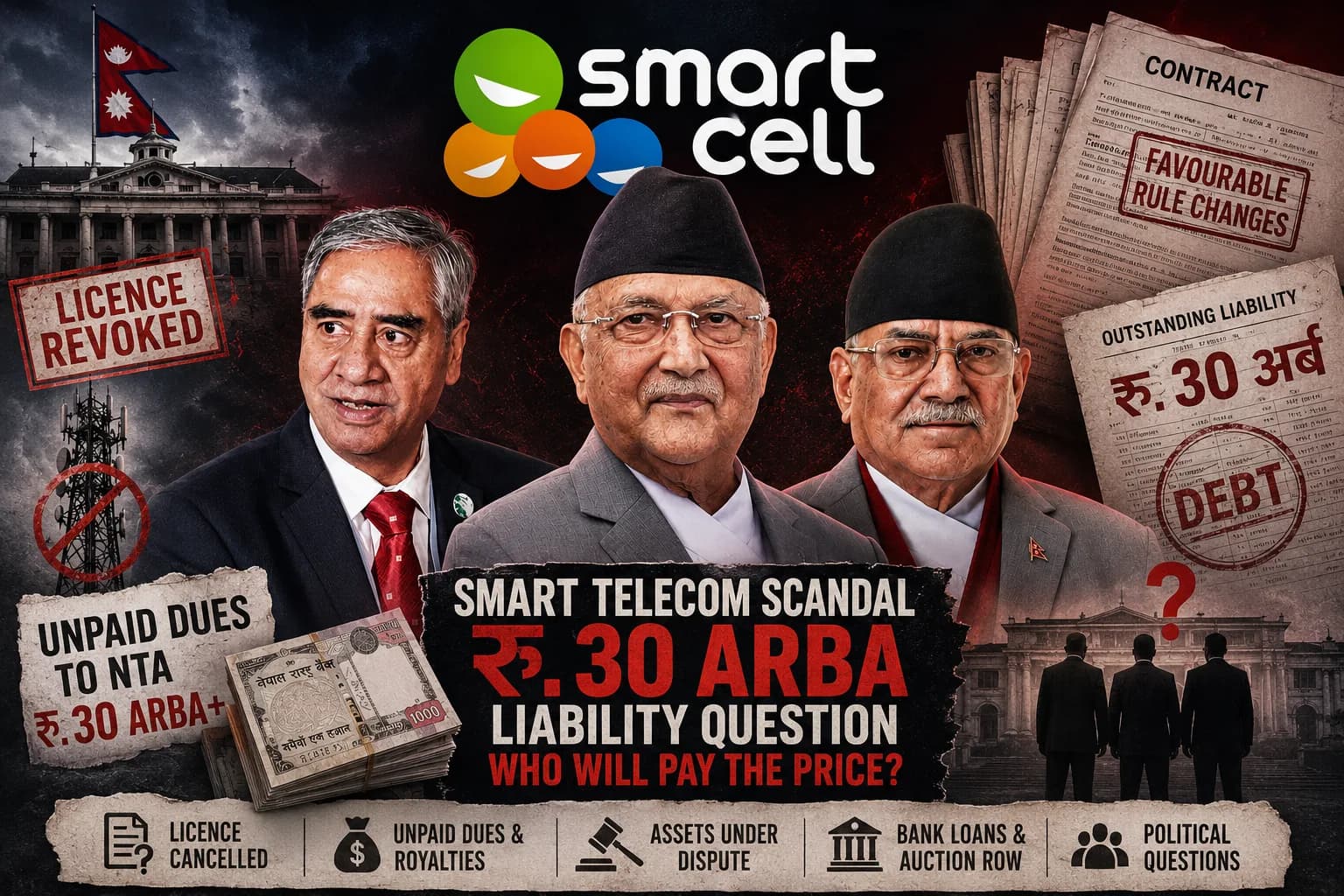
The Smart Telecom case has become one of Nepal’s biggest telecom-sector controversies, with questions now rising over unpaid dues, licence cancellation, asset control and political accountability. According to reports, Smart Telecom failed to clear huge payments linked to licence renewal, frequency fees, royalties and other regulatory dues. TechPana has reported the case as a major financial loss issue, saying the collapse of Smart Telecom could cost the state around Rs 30 arba.
Smart Telecom, also known by its brand name Smart Cell, was once one of Nepal’s private telecom operators. But the company repeatedly struggled to pay its government dues. The Nepal Telecommunications Authority had earlier moved to cancel its licence in 2019 after non-payment, but the decision was later rolled back after the company sought review from the government. Reports say the company was then allowed to pay dues in instalments, but it still failed to clear the required amount.
How Did The Smart Telecom Problem Start?
The main problem started with unpaid dues and licence renewal fees. Smart Telecom had to pay large sums to renew its telecom licence and clear pending payments to the Nepal Telecommunications Authority. According to Annapurna Express, the company was required to pay Rs 23 billion for licence renewal and Rs 5 billion as dues, bringing the total to around Rs 28 billion at the time of its licence issue in 2023.

The Kathmandu Post reported that the government seized control of Smart Telecom after the company failed to pay permit and service operation dues. The NTA board decided to move ahead with asset management after the company’s licence was revoked for failing to clear its payments. The report also noted that Smart Telecom had accumulated unpaid dues of Rs 4.19 billion up to fiscal year 2018/19 and had failed to file audits for three years.
Licence Revoked After Repeated Failure To Pay
Smart Telecom’s licence was automatically revoked in April 2023 after it failed to renew the licence and clear dues within the required time. After the cancellation, the NTA started the process of taking control of the company’s infrastructure, systems and network under the government’s asset management rules.
This means the issue was no longer only about one private company failing to pay money. Once the licence was revoked, the question became bigger: who owns the company’s telecom towers, network systems and other assets, and who should be responsible for its unpaid debt?
Why Is Rs 30 Arba Being Discussed?
The Rs 30 arba figure is being discussed because reports have placed Smart Telecom’s total liability to the government at around that level when licence renewal fees, arrears, interest, royalties and other dues are included. Ratopati reported that Smart Cell’s liability to the government was mentioned at around Rs 30 billion including interest. Nepal News also reported that the company owed the NTA over Rs 30 billion in regulatory dues.
In simple words, Rs 30 billion means Rs 30 arba in Nepali counting. That is a huge amount of public money. This is why the case has created public anger and why many people are asking whether powerful companies and political actors are being protected while the state carries the financial burden.
Political Questions Around Oli, Deuba And Prachanda Governments
The Smart Telecom controversy has also become political because decisions related to the company were made during different governments. TechPana’s report has raised questions about decisions taken under governments led by KP Sharma Oli, Sher Bahadur Deuba and Pushpa Kamal Dahal “Prachanda.” The key issue is whether repeated extensions, policy changes and delayed action helped Smart Telecom avoid paying dues on time.
The Annapurna Express also reported that the then KP Sharma Oli-led government had allowed Smart Telecom to clear dues in five instalments. Even after receiving that facility, the company could not clear its outstanding amount. The same report stated that Smart Telecom had previously been able to get deadline extensions and protect its licence despite payment problems.
Asset Auction Adds Another Layer To The Controversy
The case became even more complicated after questions emerged over Smart Telecom’s assets. Nepal News reported that after the licence was cancelled in April 2023 and the NTA declared the company’s assets as state property in May 2023, a later auction process created a legal dispute. The report said Nepal Investment Mega Bank had a major loan exposure to Smart Telecom and later moved to recover loans through an auction of pledged assets.
According to Nepal News, Ncell submitted a bid of Rs 4.60 billion for the assets, while other bidders offered much lower amounts. The bank accepted Ncell’s bid and recovered its outstanding loan from the proceeds. Investigators, however, have questioned whether the bank could auction assets that the government had already treated as state property after the licence cancellation.
Government Property Or Bank Collateral?
This is now one of the biggest legal questions in the Smart Telecom case. The government side argues that after the licence was cancelled, the telecom infrastructure came under state control. But banking and legal experts have raised another point: if assets were pledged as collateral before the licence cancellation, can banks still recover their loans from those assets?
Republica reported that the case exposes a legal grey zone between government ownership claims and secured loan recovery rights. The report noted that legal and banking experts argue ownership transfer does not automatically erase debt obligations or invalidate creditors’ rights over pledged collateral.
Why This Case Matters For The Public
The Smart Telecom case matters because it is not just about one telecom company shutting down. It raises bigger questions about public money, regulatory discipline and political accountability. If a private company collects services, uses public frequency, fails to pay the state and still receives repeated relief, people naturally ask whether the system is fair.
The case also affects trust in Nepal’s telecom regulation. Telecom companies use national resources such as radio frequency, public infrastructure rights and licence privileges. When those companies fail to pay dues, the loss is not only financial. It also damages public confidence in how the government manages valuable national resources.
What Happens Next?
The next step depends on investigation, court interpretation and government action. Authorities will have to decide whether the asset auction was legal, whether the state can recover the unpaid dues, and whether any officials, promoters, banks or political decision-makers should be held accountable.
For now, the Smart Telecom controversy remains one of Nepal’s most serious telecom-sector scandals. The public question is very clear: if Smart Telecom failed to pay around Rs 30 arba, who will finally carry that burden — the company, the owners, the banks, or the state?
Conclusion
Smart Telecom’s collapse has opened a wider debate about how Nepal handles powerful private companies that fail to meet public obligations. The case includes unpaid dues, licence cancellation, government takeover, bank loans, asset auction and political decision-making. Until the state clearly explains how it will recover the money and fix responsibility, the Smart Telecom case will remain a major test of accountability in Nepal’s telecom sector.
Published May 26 in Politics