
Supreme Court Reopens Congress Power Fight: Is a Party Split Now Less Likely?
The Supreme Court has reopened the Nepali Congress leadership dispute by allowing Sher Bahadur Deuba and Purna Bahadur Khadka to seek a review of the April 17 ruling that upheld Gagan Thapa’s leadership. Thapa remains the legally recognised party president for now, but the fresh court process has disrupted convention planning and appears to have reduced the immediate possibility of the Deuba camp breaking away to form another party.
· 7 min read
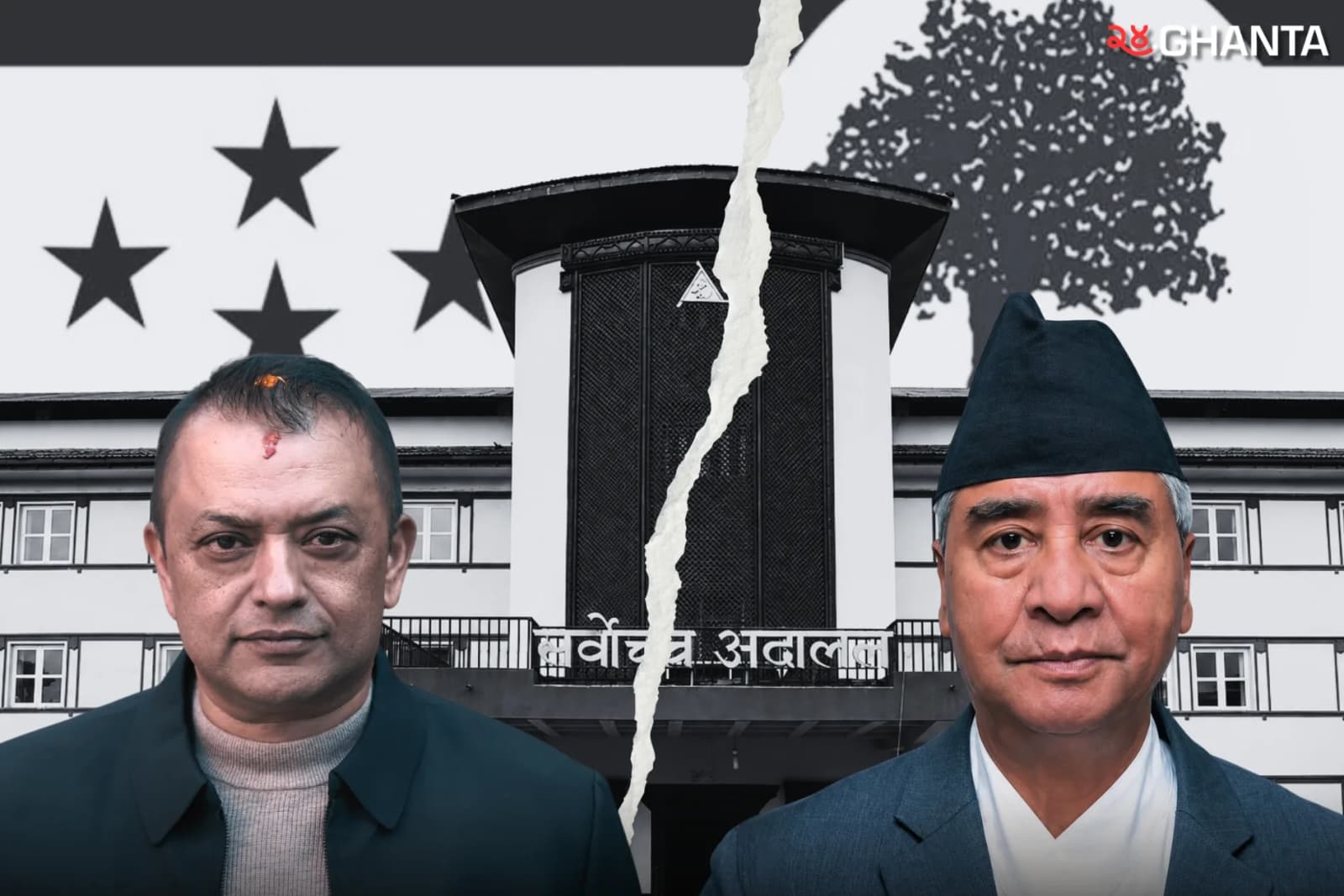
The Supreme Court in Kathmandu on August 6 agreed to reopen the legal battle over who legitimately leads the Nepali Congress, accepting separate review petitions filed by former party president Sher Bahadur Deuba and former acting president Purna Bahadur Khadka. The challenge targets the Court’s April 17 verdict, which had upheld the Election Commission’s recognition of the central committee headed by Gagan Thapa after the party’s controversial special general convention. Deuba and Khadka argue that important questions involving the authority to convene the convention, delegate participation, Election Commission procedure and the legality of electing a new leadership through a special convention were not properly resolved.
What the Review Actually Changes
The biggest point is that Gagan Thapa has not lost the presidency. Allowing a review does not cancel the April judgment or automatically invalidate the Election Commission’s decision. Until a new final ruling is issued, Thapa continues as Nepali Congress president and his central working committee continues to exercise the party’s recognised legal authority. Constitutional lawyers cited in reports have stressed that the Court has reopened the examination of the case, not reversed its outcome.
How the Leadership Dispute Began
The dispute grew out of the Nepali Congress special general convention organised in Kathmandu in January 2026 after then-general secretaries Gagan Thapa and Bishwa Prakash Sharma pushed ahead despite opposition from the Deuba-led establishment. The organisers argued that the party statute made a special convention mandatory once the required proportion of general convention representatives demanded one; reports at the time said more than half of the representatives had backed the demand. The convention eventually elected Thapa as president and installed a new central working committee.

Election Commission Recognised Thapa
The Election Commission decided on January 16 to recognise the Thapa-led Nepali Congress, relying partly on the party statute's provision allowing at least 40 percent of general convention representatives to demand a special convention and on the status of general convention representatives as the party's highest authority. The decision gave the Thapa leadership official control of the party's recognised organisational structure, flag and tree election symbol, prompting the Deuba camp to take the dispute to the Supreme Court.
What the April 17 Verdict Said
A Supreme Court division bench of Justices Sharanga Subedi and Nripdhwoj Niraula ruled on April 17 in favour of the Thapa-led side and upheld the Election Commission's decision. Reporting on the detailed judgment said the bench regarded the demand from the required number of delegates for a special convention as something party leaders could not simply ignore and concluded that the Election Commission had acted within its authority when updating the party's official records.
Why Deuba and Khadka Went Back to Court
Deuba and Khadka filed separate review petitions on July 22 and July 28, asking the Supreme Court to reconsider what they described as an erroneous judgment. Their case is not simply that they disagree politically with Thapa's leadership; they argue that there were legal and procedural failures in how the special convention was called, how its decisions were made and how the Election Commission subsequently recognised the new committee.
The 18 Grounds Behind the Challenge
The two petitioners have reportedly presented 18 grounds for review. Among the central questions are whether only the elected Central Working Committee had authority to summon a special convention, whether the then-general secretary could independently facilitate it, whether delegates who demanded a special convention had also authorised it to elect an entirely new leadership, and whether a special convention can perform the leadership-changing role normally associated with a regular general convention.
Questions Over Delegates and Documents
The Deuba camp has additionally alleged that forged documents were submitted, withdrawn signatures were not properly considered and the actual number of participating delegates requires closer scrutiny. It also argues that the Election Commission should have conducted a more extensive inquiry and provided the challenging side an adequate opportunity to make its case before changing the party's official records. These remain allegations to be examined by the Court rather than established findings.
A Completely Fresh Hearing Comes Next
The dispute now effectively returns to the stage before the April judgment. A new three-justice bench is expected to hear the case from the beginning, with the respondents formally notified, written replies collected, the Election Commission's original records obtained and evidence from both sides examined. Judges who participated in the earlier judgment and the bench that granted permission for review are not expected to decide the reopened case. No final outcome has yet been determined.
Deuba Camp Steps Away From Immediate Split
The court order may have an even faster political impact outside the courtroom. Before the review was granted, leaders associated with Deuba had been preparing a national gathering in Kathmandu from August 14 to 16, with the possibility of creating a separate political party if reconciliation with Thapa's leadership failed. After the review order, senior leader Bimalendra Nidhi indicated that the gathering would continue but that there was no longer an immediate reason to move toward forming a new party while the legitimacy question was again before the Supreme Court.
Shashank Koirala Takes a Larger Role
Preparations for the gathering had already entered an advanced stage. After Purna Bahadur Khadka declined to lead a possible new political organisation, Shashank Koirala, son of Nepali Congress founder BP Koirala, was brought into a prominent coordinating role. Proposals concerning organisational structure, political direction, finances and contemporary national issues were being prepared for discussion at the gathering.
Deuba Returns at a Critical Moment
Former prime minister Sher Bahadur Deuba is scheduled to arrive in Kathmandu on the evening of August 11, after spending more than five months abroad, including periods in Singapore and Hong Kong for what he has described as medical treatment. His return comes just three days before the dissident gathering, meaning he will be back in Nepal as his supporters decide whether to pursue reconciliation, maintain a parallel pressure campaign or wait for the Supreme Court process to develop.
Congress Convention Calendar Faces New Uncertainty
The Thapa-led leadership has meanwhile been preparing for the party's 15th general convention. The latest August 7 reporting says ward-level conventions are scheduled to start on August 18, with the national general convention planned between September 30 and October 5. The renewed court battle has prompted leaders to consider whether that timetable should continue unchanged, particularly because a final judgment may not arrive before the organisational process is already underway.
Both Camps Are Trying to Control the Political Meaning
The two sides are interpreting the review differently. Leaders in the Deuba camp view the Court's willingness to reconsider the April verdict as validation that serious legal questions remain, while leaders around Thapa argue that the review should not be mistaken for a rejection of their legitimacy. Thapa-aligned General Secretary Pradip Paudel has urged both sides not to treat the order as a victory or defeat, saying it could instead become an opportunity to pursue a political settlement and party unity.
What the Supreme Court Could Ultimately Decide
The fresh bench could broadly uphold the April judgment, leaving Thapa's leadership intact, or conclude that serious legal errors occurred and overturn all or part of the earlier ruling. A third possibility is that hearings continue while both factions carry on their political activities, leaving the Nepali Congress operating under prolonged legal and organisational uncertainty. The Court has not publicly fixed a final timetable for resolving the reopened dispute.
Why This Case Matters Beyond One Party
The case is about more than whether Gagan Thapa or the old Deuba-aligned establishment controls the Nepali Congress. It could help define how far ordinary party leadership can resist a demand for a special convention, what powers delegates possess between regular conventions, how the Election Commission should handle competing legitimacy claims, and how courts intervene when internal party rules collide with political-party law. The eventual ruling could therefore influence how similar internal leadership disputes are handled across Nepal's political system.
The Bigger Question Now
For the Nepali Congress, the immediate question has shifted from "Will the party split?" to "Can the reopened court case create enough time for the two camps to reunite?" Thapa remains president, Deuba is returning, the dissident gathering is going ahead, and a major general convention is approaching. With the legal battle reopened just as these political deadlines converge, the next few weeks could determine whether Nepal's oldest democratic party moves toward reconciliation or enters another prolonged struggle over its leadership.
Published Aug 7 in Politics