
The Hidden Victims: Why Male Domestic Abuse Is Rarely Discussed
This article explores why male victims of domestic abuse are rarely discussed, using survivor stories, data from Nepal, the UK and the US, and Nepal’s gender-neutral legal framework to show that abuse can affect anyone, but stigma, shame and fear of not being believed often keep male victims silent.
· 6 min read
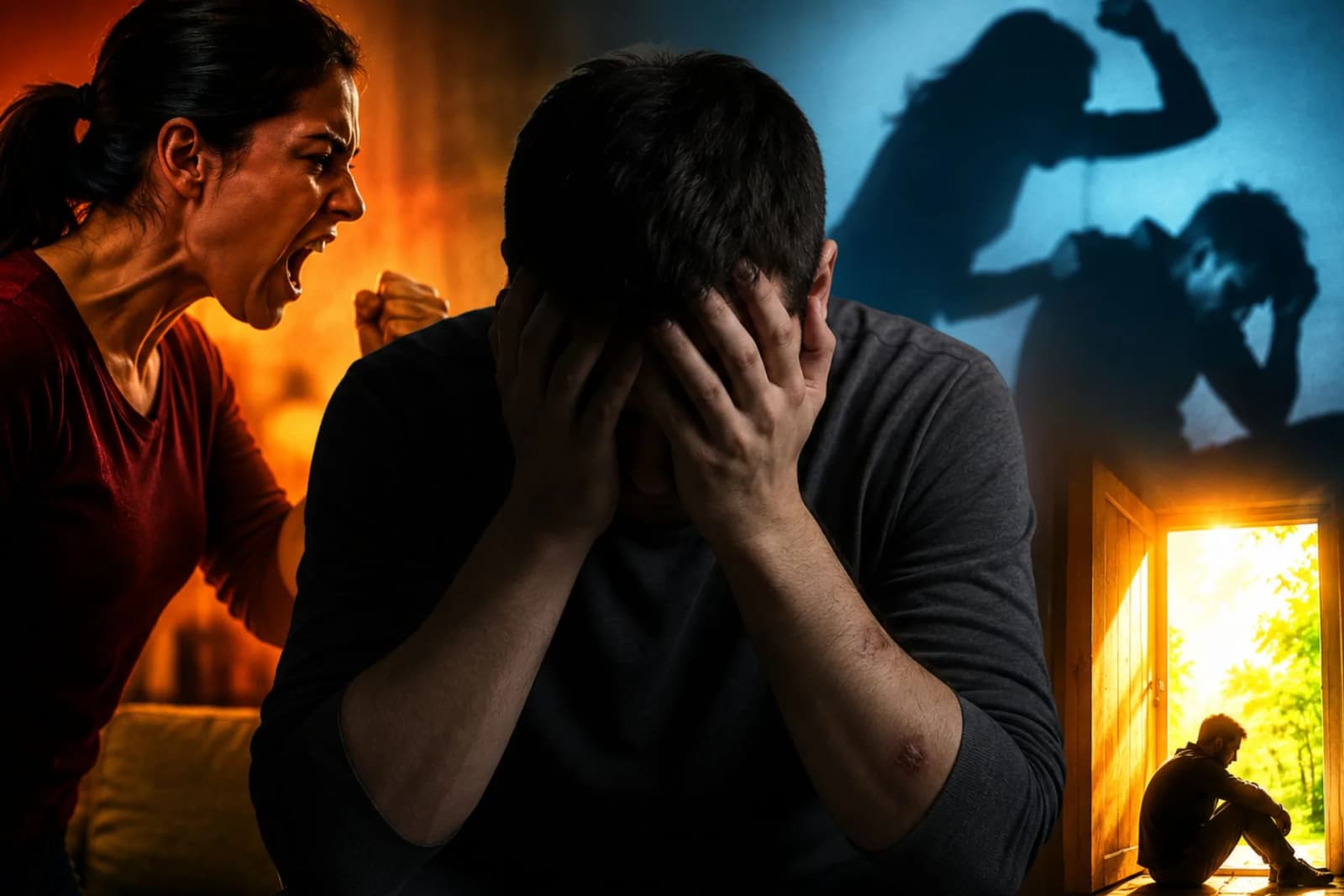
1. When the Abuser Wasn't Who Anyone Expected
The hospital told Alex Skeel he was just ten days from death.
Not because of a car crash. Not because of an illness. But because boiling water had been thrown on him by the person who was supposed to love him.
Alex was 22 when he finally escaped. By then, his partner of five years had isolated him from his family, broke his phones, lied that his grandfather had died just to watch him cry, and even attacked him with a hammer while he slept.

He was so controlled that he treated his own burns with cling film because he was not allowed to seek medical help.
His abuser wasn't a stranger, and she wasn't a man. She was his girlfriend, Jordan Worth, and in 2018, she became the first woman in the UK ever convicted of coercive control.
If a story like this is hard to imagine, that's exactly the problem.
2. The Numbers Nobody Counted
Nepal Police's own annual fact sheet, the most detailed government data on this subject in the country, recorded 16,416 domestic violence cases in a single fiscal year (2023/24), making up 78.3% of all gender-based violence cases registered nationwide. That's not a typo. Domestic violence alone outnumbers every other category; “rape, trafficking, child marriage, and acid attacks combined.”
The report tracks victims' age, education, occupation, and even province, but the gender lens only points one way. The publicly available data does not separately identify male domestic violence victims, making it difficult to determine how many men may be affected.
That's not because it isn't happening. It's because nobody built the form to ask.
However, 36 of the 111 domestic homicide victims in England and Wales that year were men.
About one in three men in the United States experienced contact sexual violence, physical violence, and stalking by an intimate partner during their lifetime.
Nearly 56% of those men first experienced this or other forms of violence by that same partner before the age of 25.
Nearly one in four men experienced some form of contact sexual violence in their lifetime.
“About one in 14 men were made to penetrate someone during their lifetime” ,a form of sexual violence the CDC treats as distinct from rape, but no less real.
More than one in 38 men experienced completed or attempted rape in their lifetime. Of those, about 71% first experienced it before age 25.
About one in 17 men were victims of stalking at some point in their lifetime, and nearly 41% of them experienced it before age 25.
97% of men who experienced rape, physical violence, or stalking by an intimate partner had only female perpetrators.
In Nepal, domestic violence makes up the overwhelming majority of gender-based violence cases, yet male victims remain largely absent from publicly available domestic violence data. In the UK, men account for nearly one-third of all domestic homicide victims.
What the Law Says
The Domestic Violence (Crime and Punishment) Act, 2009 is largely drafted using gender-neutral language. In Sections 2 and 3, the Act refers to a "person" and a "domestic relationship" rather than limiting protection to either men or women. This means that, in law, protection against domestic violence is available to all individuals within a domestic relationship regardless of gender.
In simple terms,the Act defines domestic violence as physical, mental, sexual, or economic harm committed by one person against another person within a domestic relationship.
Constitution of Nepal
The Constitution guarantees:
Right to Equality (Article 18)
Everyone is equal before the law.
Right Against Exploitation (Article 29)
Protects individuals from exploitation and abuse.
Right to Live with Dignity (Article 16)
This right applies to all citizens regardless of gender.
Therefore, constitutional protections are not limited to women.
Although Nepal's legal framework does not distinguish between male and female victims of domestic violence, many men still hesitate to come forward when they experience abuse. Research and survivor accounts suggest that feelings of shame, embarrassment, and fear of being judged often discourage men from reporting their experiences. Traditional expectations that men should be strong, emotionally resilient, and capable of defending themselves make it difficult for some victims to admit that they are being abused by a partner or family member.
Another major barrier is the fear of not being believed. In many societies, domestic violence is commonly viewed as a crime in which men are the perpetrators and women are the victims. While women remain the majority of reported victims, this perception can make it harder for male victims to be taken seriously when they seek help. As a result, some men choose to remain silent rather than face ridicule, disbelief, or social stigma. This may help explain why male victims often remain underrepresented in official statistics despite legal protections being available to them.
What Abuse Looks Like When the Victim Is a Man
One reason male victimization remains poorly understood is that many people struggle to imagine what abuse against men actually looks like. Domestic violence is often associated with physical injuries inflicted by male perpetrators. However, research suggests that male victims can experience many of the same forms of abuse reported by female victims.
A qualitative study published in Partner Abuse examined the experiences of men who had been abused by female partners. Participants described coercive control, emotional manipulation, humiliation, isolation from family and friends, false accusations, and physical violence. Many reported feeling trapped in their relationships and reluctant to seek help because they feared they would not be believed or would be ridiculed. Several participants also described feelings of shame and confusion surrounding their experiences.
The study suggests that domestic abuse can involve far more than physical violence alone. The experiences described by participants highlight how control, intimidation, and psychological manipulation can affect victims regardless of gender. For some men, the abuse itself was compounded by the challenge of convincing others that their experiences were real and deserving of support.
The Real Question
This research does not suggest that men experience domestic violence more than women. Nor does it diminish the serious and well-documented violence faced by women around the world. The evidence consistently shows that women remain the majority of reported domestic violence victims and often suffer the most severe forms of abuse.
What this research does show is that the conversation is more complex than many people assume. Nepal's laws do not exclude male victims. International studies confirm that male victimization exists. Survivor stories demonstrate that abuse can occur in relationships regardless of gender. Yet public awareness, data collection, and support systems do not always fully reflect that reality.
The issue is not whether male victims exist. The evidence shows that they do. The issue is whether society is willing to recognize them when they come forward.
Recognizing male victims does not take attention away from female victims. It simply ensures that every victim of abuse is seen, heard, and protected.
Sources :
Luke's Story: 'My Wife Beat Me Up And Stabbed Me', BBC News, BBC, 18 April 2018.
FY 2080/81 Annual Infographics (English), Nepal Police, Nepal Police Headquarters, 2024.
Domestic Abuse Statistics UK, NCDV, National Centre for Domestic Violence, 2024.
CDC, Intimate Partner Violence, Sexual Violence, and Stalking Among Men (NISVS), May 16, 2024.
Domestic Violence (Crime and Punishment) Act, 2009, Nepal Law Commission, Government of Nepal, 2009.
Constitution of Nepal, Nepal Law Commission, Government of Nepal, 2015.
Male Victims Of Female-Perpetrated Partner Violence: A Qualitative Analysis Of Men’s Experiences, Partner Abuse, SAGE Publications, 2023
Tags
Published Jul 10 in Researched Article