
Waiting for a Bus in Kathmandu? This App Can Now Show You Where It Is
Kathmandu Valley commuters can now use the KTM Public Transport app to see GPS-enabled buses in real time and estimate when they may reach their stop, with around 1,200 public vehicles reportedly connected to the system. The wider plan goes beyond tracking buses, with authorities also working toward GPS information displays at major stops, clearer pick-up/drop-off points, expanded night services and a future cashless fare system.
· 6 min read
KATHMANDU | AUGUST 19, 2026
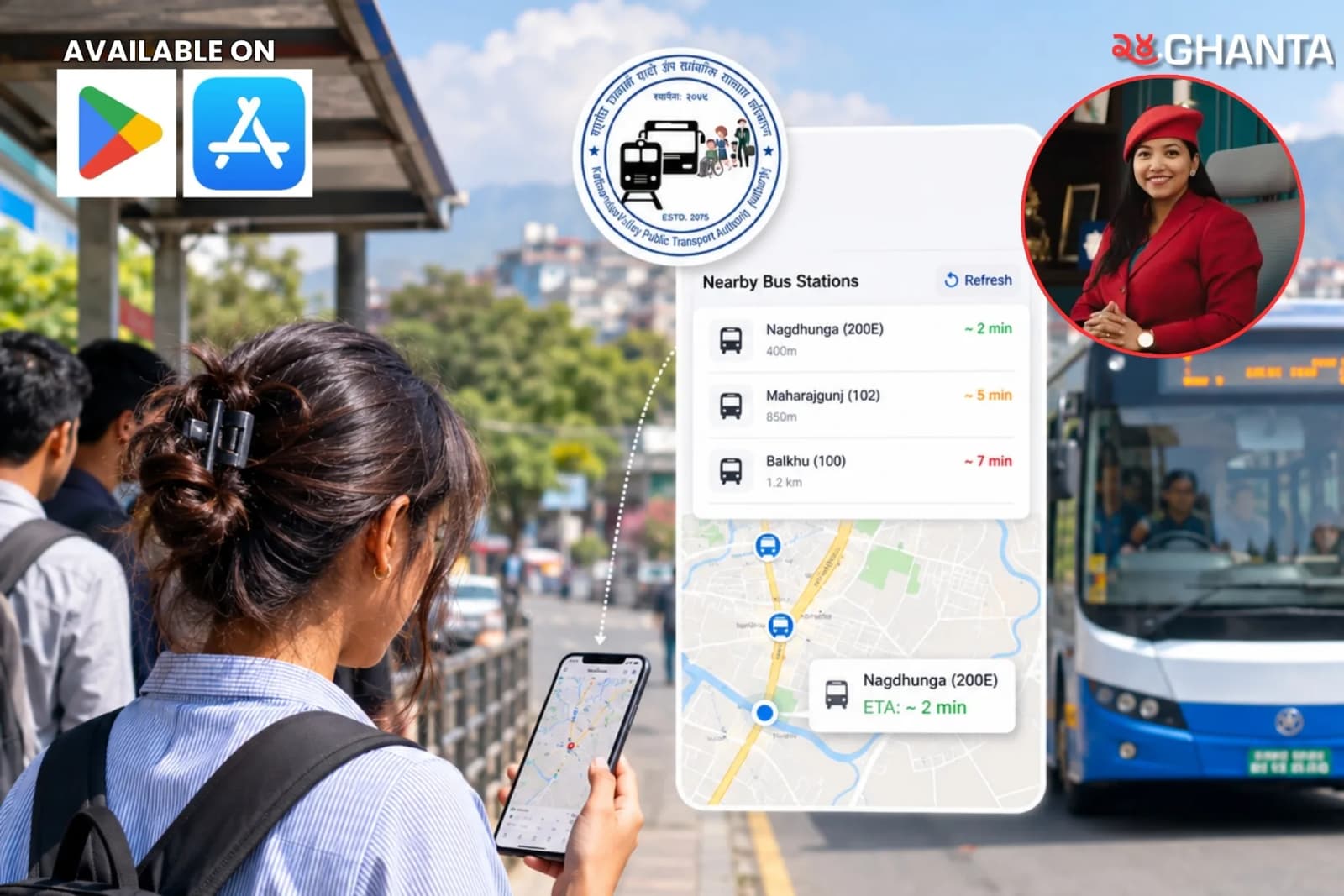
Commuters across Kathmandu Valley can now track GPS-connected public buses and check their estimated arrival times through the KTM Public Transport mobile app, formally launched on Wednesday by Kathmandu Metropolitan City's Acting Mayor Sunita Dangol, who also chairs the Federal Capital Urban Area Public Transport Council. With around 1,200 public vehicles reportedly connected to the system so far, authorities are using the technology to make everyday public transport easier to understand, more predictable and more convenient for passengers.
No More Guessing Where Your Bus Is?
For Kathmandu commuters, one of the most useful features is simple: knowing where a bus is before it arrives.

The app uses GPS information from connected public vehicles to display their real-time locations. Passengers can therefore check buses through their phones instead of waiting at a stop without knowing when the next vehicle may arrive.
The system also provides estimated arrival information, helping commuters better plan when to leave or how long they may need to wait.
Around 1,200 Vehicles Are Connected
Around 1,200 public vehicles have so far been connected to the tracking system, according to information provided during the launch.
Dangol said there are more than 3,000 public buses operating in Kathmandu Valley, meaning the current system does not yet cover every vehicle.
Authorities are looking to expand the database, including through possible integration of vehicle information held by police.
For passengers, this means an important limitation: a bus that does not appear in the app does not necessarily mean there is no bus on that route. Coverage depends on whether the vehicle has been connected to the system.
The App Does More Than Track Buses
The official app listings show that KTM Public Transport has developed into a broader travel tool.
Alongside real-time tracking, passengers can check routes, schedules and stop information, find nearby bus stops using GPS and view information about transport operators.
The app also includes fare estimation, allowing users to get an estimated fare based on their selected route and distance.
Passengers can additionally submit complaints or feedback directly through the system.
Recent updates have added multilingual functionality, help and guidance features and emergency contact information.
The App Is Available on Android and iPhone
KTM Public Transport is available through both Google Play and Apple's App Store.
The application is listed as being developed for the Federal Capital City Public Transport Authority, with Nepal's National Information Technology Center identified as the provider on Apple's platform.
The official Android listing describes its objective as making travel in the capital easier, faster and more reliablethrough real-time public transport information.
Why Does Kathmandu Need Real-Time Bus Information?
Kathmandu's public transport system has traditionally required passengers to rely heavily on experience, asking conductors or waiting at roadside stops without knowing exactly when a vehicle is coming.
Real-time information can reduce some of that uncertainty.
A passenger could potentially check where the next connected bus is, identify a nearby stop, view the route and get an estimated fare before starting the journey.
The Federal Capital City Public Transport Authority is legally empowered to develop systems such as real-time passenger information and GPS monitoring as part of its broader responsibility for improving public transport management in Kathmandu Valley.
Night Buses Are Also Getting Attention
The app launch is part of a wider effort to improve how people travel around the Valley.
Kathmandu, Lalitpur, Chandragiri and Budhanilkantha began operating a pilot night-bus service from April 14.
According to figures presented by Dangol, approximately 22,000 to 25,000 passengers use the night service each month, while around 28,000 passengers used it in June.
The service is particularly aimed at people whose jobs finish after regular public transport becomes difficult to find.
More Night Routes Could Be Coming
Authorities are now discussing an expansion of the night-bus network.
Dangol said discussions are underway with Sajha Yatayat over additional routes, while cooperation with other transport operators will also be needed to expand services across the Valley.
Local governments have been encouraged to financially contribute according to their capacity because Kathmandu Valley's transport network crosses municipal boundaries.
Students Could Get Faster Morning Services
The council is also considering additional and faster morning public transport targeted at students.
Such a service could help address heavy morning demand when large numbers of school and college students travel alongside office workers and other commuters.
Details of the proposed routes, schedules and implementation timeline have not yet been finalised.
GPS Information Could Come to Bus Stops
The longer-term plan is not limited to smartphone users.
The council has approved a programme to establish GPS-based public transport information systems at major bus stops and bus parks in partnership with local governments.
If implemented widely, passengers could eventually access live transport information at physical stops rather than needing to rely entirely on a mobile phone.
Kathmandu Is Also Moving Toward Cashless Fares
Another significant decision involves how passengers pay.
The council agreed to prepare the necessary legal framework for a cashless public transport fare system.
A fully integrated system has not yet been introduced, so passengers should not interpret the decision as meaning Kathmandu buses have already become cashless.
Instead, authorities are preparing the groundwork required to introduce such a system in the future.
Bus Stops and Pick-Up Points Could Become Clearer
The council also decided to determine formal bus stops and pick-up/drop-off points during the current fiscal year.
This could address another longstanding problem in Kathmandu, where public vehicles frequently pick up or drop passengers at inconsistent locations.
The council additionally plans to encourage passengers to obtain tickets and continue studies and research into improving public transportation.
Part of a Bigger Public Transport Plan
The KTM Public Transport app is therefore only one part of a much larger effort.
Authorities are simultaneously working on GPS tracking, real-time passenger information, designated stops, night buses, morning services and cashless fares.
Earlier this year, Dangol said the broader objective is to create a public transport system good enough that people can choose it instead of relying on private vehicles.
Whether that transformation happens will depend on how quickly more buses are connected, how accurate the live information remains and whether the wider transport reforms move from plans into everyday use.
But for passengers accustomed to standing beside Kathmandu's roads wondering when their bus is coming, being able to see a connected vehicle approaching on a phone is a significant change.
Published Aug 19 in Society