
A 10-Year Promise, Paint Peeling in Months: Consumer Court’s Berger Paints Ruling Raises Bigger Questions About Warranty Advertising in Nepal
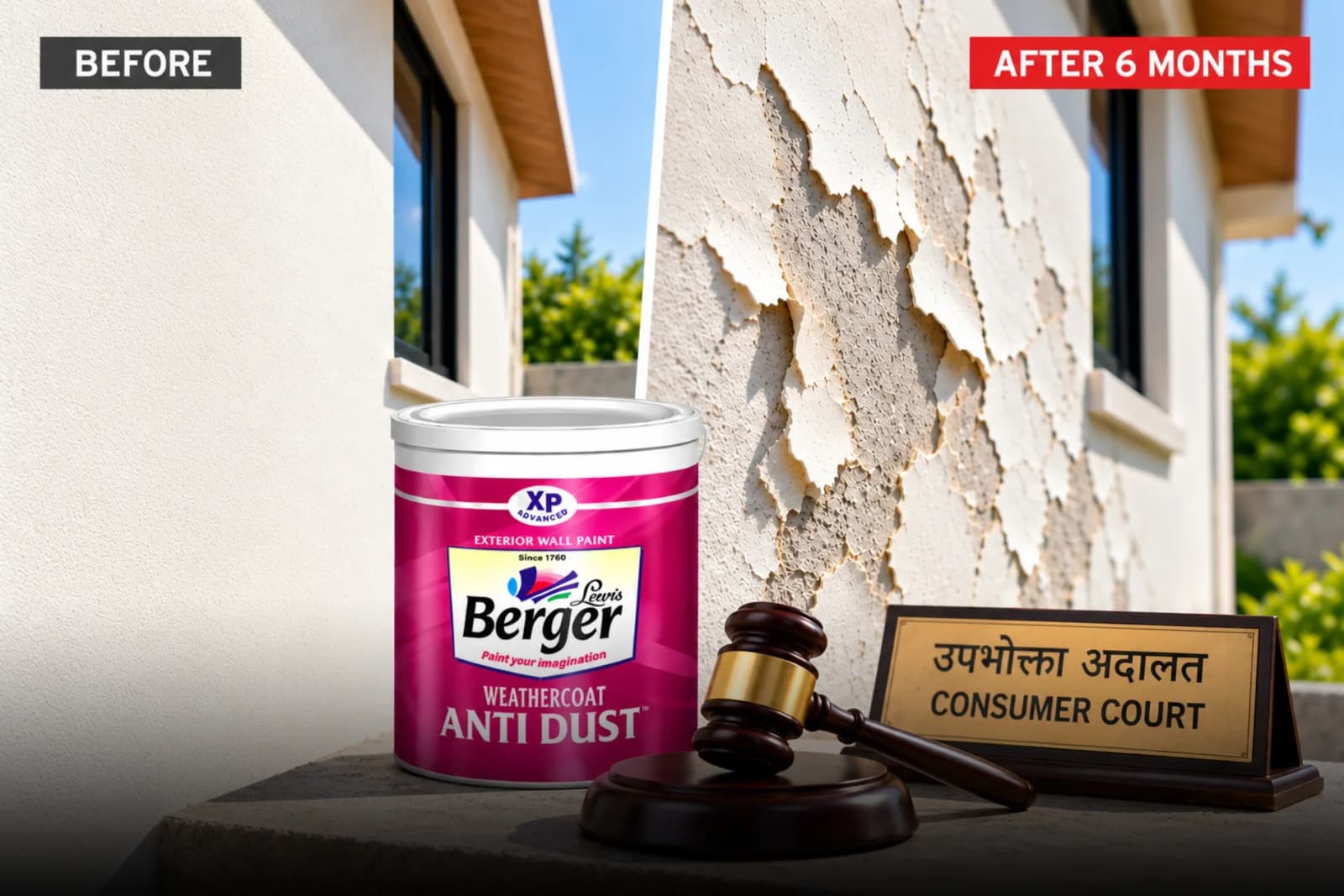
Nepal’s Consumer Court has ordered Berger Jenson & Nicholson (Nepal) and its dealer to pay Rs 12,78,400 in compensation to three consumers after paint promoted with warranties of up to 7–10 years allegedly began peeling and deteriorating within just 6–8 months. The ruling goes beyond three damaged homes, sending a wider message that companies cannot attract customers with major warranty promises and then rely on restrictive conditions or dealer agreements to escape responsibility.
· 5 min read
KATHMANDU, NEPAL, SEPTEMBER 6, 2026
A Warranty Promise That Ended in Court
Three consumers, Deepak Raj Giri, Siddhanta Shrestha and Dayaram Karki, took legal action against Berger Jenson & Nicholson (Nepal) Pvt. Ltd. and Bhaktapur-based dealer Friends Forever Trading Pvt. Ltd. after paint sold with advertised warranties of 7 to 10 years allegedly began peeling and deteriorating within only 6 to 8 months. In a ruling delivered by the Consumer Court and whose full text has recently drawn wider public attention, the court ordered the manufacturer and dealer to pay a combined Rs 12,78,400 in compensation, finding that their responsibilities toward consumers and advertised warranty commitments had not been properly fulfilled.
Customers Say the Paint Failed Within Months
The dispute began after the three homeowners purchased Berger paint from Friends Forever Trading in Ghalate, Bhaktapur, at different times.

According to case details, Deepak Raj Giri purchased paint on Bhadra 6, 2076 BS, Siddhanta Shrestha on Chaitra 15, 2078 BS, and Dayaram Karki on Baisakh 19, 2081 BS.
They said they bought the products believing claims that the paint carried warranties lasting 7 or 10 years. Instead, they alleged that problems appeared within approximately 6 to 8 months, including fading and peeling.
The consumers said the dealer was informed and company representatives subsequently inspected the affected properties, with assurances initially given that the problem would be addressed. The dispute eventually reached the Consumer Court after the customers said the promised solution and warranty support did not materialize.
Court Questions How Warranty Was Advertised
A major part of the case was not simply whether the paint had deteriorated, but what consumers had been promised before buying it.
Evidence considered in the proceedings included purchase bills, paint containers, warranty-related materials, photographs, videos and advertisements.
The court examined the difference between warranty claims presented publicly and conditions contained in warranty documentation. One certificate issued to Siddhanta Shrestha stated that the warranty applied to a minimum purchase of 40 litres of WeatherCoat All Guard.
The court questioned the logic of publicly promoting a warranty on paint containers and advertisements while introducing a minimum-purchase condition for issuing warranty coverage.
A 7-Year Warranty That Became Smaller Every Year
The court also examined another important condition in the warranty arrangement.
According to the ruling, the warranty certificate provided for Siddhanta Shrestha placed declining limits on the company's responsibility. Coverage reportedly started at 90 percent in the first year, fell to 80 percent in the second year, and continued decreasing until reaching 10 percent in the seventh year.
The court found problems with placing such limitations on the warranty when the product had been publicly promoted with broader warranty messaging.
The judgment linked this issue to obligations under Nepal's Consumer Protection Act, 2075, including provisions concerning product labelling and misleading advertising.
Private Dealer Agreement Could Not Erase Consumer Rights
Another significant part of the judgment concerned the agreement between Berger Jenson & Nicholson (Nepal) and Friends Forever Trading.
The dealership agreement reportedly contained provisions under which goods would be considered commercially satisfactory after being received by the dealer and stated that the manufacturer's products carried no warranty in the dealer relationship.
But the court rejected the idea that such a commercial arrangement could allow a manufacturer to escape obligations created toward consumers through its products and public advertising.
In effect, the ruling draws an important distinction: an internal agreement between a manufacturer and its dealer cannot simply erase legal responsibilities owed to the person who ultimately buys the product.
Manufacturer and Dealer Both Held Responsible
The court did not place the entire burden on one side of the supply chain.
It found that both the manufacturer and seller had responsibilities connected to the warranty and sale of the product.
The judgment said Berger Jenson & Nicholson (Nepal) must bear Rs 12,14,500 of the compensation, while Friends Forever Trading operator Dinesh Giri must bear Rs 63,900.
Together, the compensation comes to Rs 12,78,400.
How Much Will Each Consumer Receive?
Under the ruling, the compensation is to be distributed among the three consumers based on the court's assessment of their claims and losses:
Siddhanta Shrestha — Rs 6,34,800
Deepak Raj Giri — Rs 3,46,100
Dayaram Karki — Rs 2,97,500
The three amounts together total Rs 12,78,400.
Why This Case Matters Beyond Three Houses
The significance of the ruling goes beyond peeling paint.
Businesses regularly use warranties, guarantees and durability claims to convince consumers that paying for a particular product will provide protection for years. Those promises can become an important reason why a customer chooses one product over another.
The Consumer Court's reasoning signals that such claims cannot simply function as attractive advertising at the time of sale and then become heavily restricted when a customer later asks the company to honour them.
It also reinforces the principle that manufacturers and sellers have responsibilities across the supply chain and cannot necessarily shift consumer-facing obligations through private commercial contracts.
A Bigger Warning About Advertising in Nepal
For Nepali consumers, the case raises a simple but important question: When an advertisement promises years of protection, how much can a customer legally rely on that promise?
The Consumer Court's decision provides a significant answer. A warranty displayed on advertising material or a product is not merely a marketing decoration; when that promise influences a purchase, businesses may be held accountable for the commitments they make.
For companies, the message is equally important: the conditions written after a sale should not contradict the impression created when convincing a customer to buy.
What began with paint peeling from three homes has therefore developed into a wider consumer-rights case, one that could make both businesses and buyers in Nepal pay much closer attention to the promises printed on advertisements, packaging and warranty documents.
Published Sep 6 in Society