
Bhotekoshi Flood Leaves Nepal Facing Rs. 7 Kharba 23 Arba Reconstruction Challenge As Energy, Roads, Bridges, Homes And Businesses Suffer Massive Damage
Nepal estimates Rs. 7 Kharba 23 Arba 31 Crore 52 Lakh will be needed for recovery and reconstruction after the Bhotekoshi flood. The disaster damaged hydropower and solar projects, roads, bridges, thousands of homes, schools, health institutions, businesses, and farmland across five districts, making long-term rebuilding a major national challenge.
· 5 min read
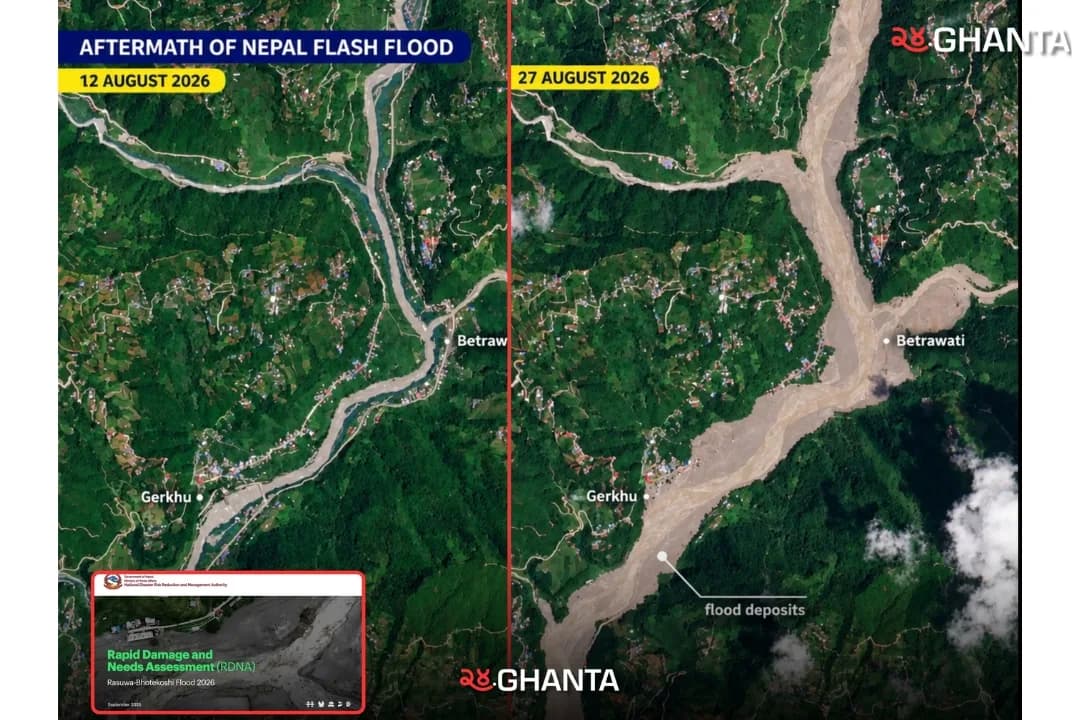
Kathmandu, September 11, 2026: Nepal is facing a major reconstruction challenge after the devastating Bhotekoshi flood of Bhadra 10. A government rapid assessment estimates that Rs. 7 Kharba 23 Arba 31 Crore 52 Lakh will be needed for recovery and reconstruction across the affected areas.
The figure comes from the Rapid Damage and Needs Assessment (RDNA) prepared by a joint technical team including the National Planning Commission and the National Disaster Risk Reduction and Management Authority. The assessment covers damage to infrastructure, homes, public services, businesses, agriculture and other sectors across Rasuwa, Nuwakot, Dhading, Gorkha and Chitwan.
The scale of the estimate shows that recovery will go far beyond repairing a few roads and bridges. Nepal will have to rebuild major parts of its energy and transport systems while restoring homes, schools, health facilities, businesses and agricultural land.

Infrastructure Takes The Biggest Share
Infrastructure represents the largest part of the recovery requirement.
The assessment estimates that Rs. 4 Kharba 73 Arba 57 Crore 19 Lakh will be needed for infrastructure recovery alone.
Energy and transport are among the sectors facing the biggest rebuilding costs.
The government says 13 hydropower projects with a combined capacity of 759 megawatts were affected. Another five solar plants with a combined capacity of 24 megawatts were also impacted.
Restoring the energy and grid system is estimated to require around Rs. 3 Kharba 90 Arba 62 Crore 30 Lakh 40 Thousand.
The scale of damage to power projects shows how the flood has created consequences far beyond the communities directly hit. Damage to hydropower plants and related infrastructure can affect electricity generation, investment and economic activity during the recovery period.
Roads And Bridges Face A Major Rebuilding Task
Transport infrastructure also suffered extensive destruction.
According to the assessment, 69 kilometres of roads were damaged, while 33 motorable bridges were washed away and another four motorable bridges were partially damaged.
Of the 64 suspension bridges assessed in the flood-affected areas, 53 were damaged.
The estimated cost of restoring transport infrastructure stands at around Rs. 73 Arba 34 Crore 29 Lakh 60 Thousand.
Restoring these connections will be critical not only for normal travel but also for moving construction materials, food, medicine and other supplies into affected communities during reconstruction.
More Than 7,500 Private Homes Damaged
The disaster was not limited to major infrastructure.
Across Rasuwa, Nuwakot, Dhading, Gorkha and Chitwan, the assessment recorded damage to 7,570 private homes.
It also identified damage to 48 public buildings, 18 schools, seven health institutions and 30 cultural heritage sites.
Recovery needs for housing and the wider social sector are estimated at around Rs. 1 Kharba 3 Arba 54 Crore 99 Lakh.
Among the 15 affected local levels across the five districts, Bidur Municipality in Nuwakot alone recorded 3,026 damaged houses.
The housing figures show that reconstruction will have to address much more than physical structures. Thousands of affected families will also need safe shelter and restored access to basic public services.
Agriculture, Banks And Thousands Of Businesses Affected
The economic impact of the flood extends into agriculture, banking, trade and other businesses.
The assessment estimates that around Rs. 50 Arba 77 Crore 49 Lakh will be required for recovery in the productive sector.
According to the RDNA, the flood affected 1,806 hectares of crops, 17 bank branches and around 4,800 business establishments.
This means rebuilding homes alone will not be enough for many families. Farms, shops and other sources of income will also have to be restored for local economies to recover.
Nearly Rs. 95 Arba Needed For Disaster Risk Reduction
One of the most important parts of the assessment looks beyond replacing what was destroyed.
The report estimates that around Rs. 94 Arba 75 Crore 31 Lakh will be required for disaster risk reduction and river management.
Another Rs. 51 Crore 54 Lakh is estimated for mud and debris management.
This raises a major issue for Nepal’s reconstruction strategy: whether damaged infrastructure should simply be rebuilt in the same way or whether recovery should also make settlements, roads, bridges and other structures safer against future disasters.
Reconstruction Divided Into Two Phases
The government assessment divides recovery into immediate and long-term phases.
Around Rs. 8 Arba 73 Crore 50 Lakh is estimated to be required for immediate relief and short-term reconstruction within the next six months.
The much larger requirement comes in the long term. The assessment estimates that around Rs 7 Kharba 14 Arba 58 Crore 2 Lakh will be needed for long-term reconstruction.
This shows that the financial challenge will continue long after emergency rescue and relief operations are completed.
The Rs. 7 Kharba 23 Arba Estimate Is Still Preliminary
The total estimate of Rs. 7 Kharba 23 Arba 31 Crore 52 Lakh should not yet be treated as the final reconstruction bill.
The rapid assessment was prepared using information collected from ministries, government agencies and local levels. Authorities also examined conditions before and after the flood and used technical assessments to calculate sector-wise damage and recovery needs.
A more detailed post-disaster assessment is expected to provide a clearer picture of losses, reconstruction priorities and funding requirements.
The final cost could increase if additional losses are identified or if some settlements need relocation, new land, or more expensive reconstruction measures.
From Emergency Response To Long-Term Recovery
The Bhotekoshi flood has now created two major challenges for Nepal.
The first is continuing support for people directly affected by the disaster. The second is finding the financial and institutional resources required to rebuild damaged infrastructure, homes, businesses and public services while reducing future disaster risks.
With the preliminary recovery requirement already standing at more than Rs. 7 Kharba 23 Arba, reconstruction will require coordination between federal, provincial and local governments, affected communities, development partners and other institutions.
The figures make clear that the effects of the Bhotekoshi flood will continue long after roads reopen and debris is removed. Restoring power projects, bridges, homes, schools, businesses, farms and essential services will require a long-term national recovery effort.
For thousands of affected families, the success of reconstruction will ultimately be measured not only by how much money is allocated, but by how quickly safe homes, livelihoods, schools, roads and basic services return to their communities.
Photo gallery(1)
Published Sep 11 in Nepal