
Ambulances Carrying Cannabis? Inside Koshi’s Growing Smuggling Network
Ambulances meant to rush patients to hospitals are repeatedly turning up in cannabis-smuggling cases across Koshi Province, with police recovering hundreds of kilograms from emergency vehicles around Dharan, Bhedetar, Morang and Sunsari. The cases expose a wider trafficking corridor running from cannabis-producing hill districts toward the Tarai and Nepal-India border, while increasingly creative smuggling methods are making enforcement more difficult.
· 6 min read
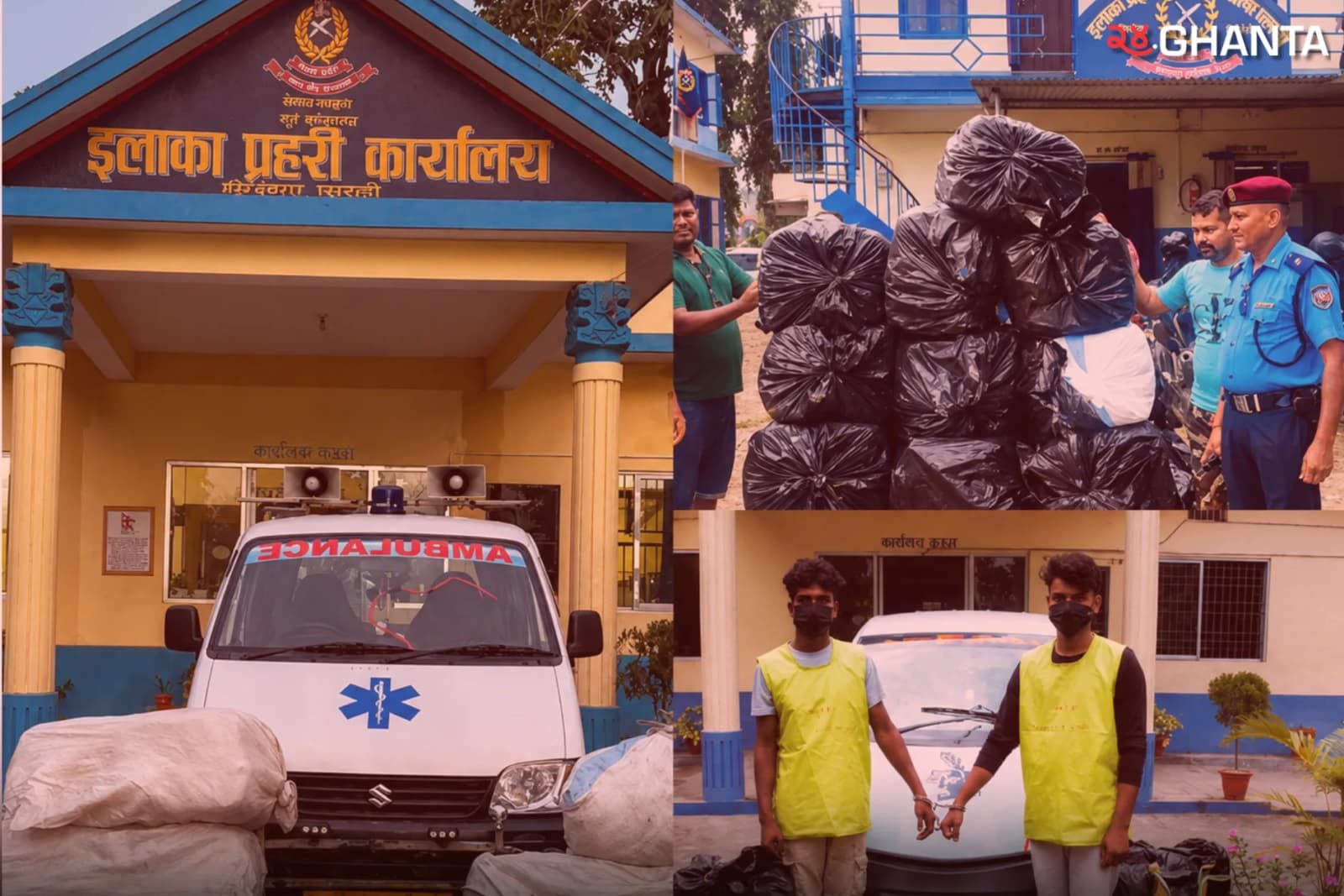
Suspected cannabis-smuggling networks operating in Koshi Province have repeatedly used ambulances and other low-suspicion vehicles to transport large quantities of marijuana during 2025 and 2026, particularly along the Dhankuta-Bhedetar-Dharan-Sunsari corridor leading toward Nepal’s southern border. Police believe ambulances are attractive to traffickers because emergency vehicles receive road priority, are less likely than ordinary vehicles to face lengthy checks and can move rapidly at night without immediately raising suspicion. The growing number of seizures has forced police to reconsider how even vehicles associated with life-saving services are monitored.
440 Kilograms Found Inside a Dharan Ambulance
One of the clearest examples came on Baisakh 29, 2083, when police recovered 440 kilograms of cannabis from ambulance Ko 1 Cha 7359 in Dharan. Koshi Province Police records state that the cannabis had been packed inside plastic sacks, while the people associated with transporting it fled. The ambulance was operated by Budhasubba Diagnostic Center Pvt Ltd in Dharan.
It Was Not an Isolated Case
Months earlier, police had seized another ambulance near Bhedetar in Sangurigadhi Rural Municipality-6 carrying 459.965 kilograms of cannabis. In a separate Morang operation in late December 2025, police recovered 521 kilograms from another ambulance and fired warning shots as suspects attempted to escape; two people were subsequently detained.

An Indian Ambulance Was Caught Too
The strategy has crossed the border as well. In May, police intercepted an Indian-registered ambulance in Barahakshetra Municipality-2, Sunsari, carrying 148 kilograms of cannabis. Police arrested driver Dharmendra Kumar Yadav and passenger Mohammad Sadam, both from Bihar’s Supaul district, and began investigating whether the cannabis was being transported toward India.
Why Ambulances Are Attractive to Smugglers
The very reason ambulances work well during medical emergencies can make them attractive to criminals. They are expected to move quickly, other vehicles make way for them, and security personnel may hesitate to delay a vehicle that could be carrying a critically ill patient. Koshi police officials have acknowledged that traffickers appear to be exploiting the assumption that an ambulance is unlikely to be searched as quickly or thoroughly as an ordinary vehicle.
The Route Begins in the Hills
Police investigations and repeated seizures point toward a broader pattern. Cannabis originating around Dhankuta and neighbouring eastern hill areas is transported down through Bhedetar and Dharan before moving toward Sunsari, Morang and other border districts. Police reporting has repeatedly identified Sunsari, Morang, Dhankuta and Udayapur among the areas where cannabis transport and seizures are particularly significant.
Sunsari Has Become a Critical Link
Sunsari's location makes it especially important. The district connects the eastern hills with the East-West Highway, Koshi Highway and several routes toward the Indian border. The repeated recovery of cannabis around Dharan, Barahakshetra, Koshi Rural Municipality and other parts of Sunsari suggests traffickers are using multiple road and river-linked routes rather than relying on a single checkpoint or border crossing.
Cannabis Seizures Have Risen Sharply
The broader numbers show why police consider the issue serious. Koshi Police reported 5,815 kilograms of cannabis seized in fiscal year 2079/80, while seizures reached 26,705 kilograms in 2081/82. Police and media data cited for the following year show the volume remaining extremely high, indicating that enforcement operations are finding much larger consignments than just a few years earlier.
Across the five annual figures contained in the police data cited in the original reporting, seizures add up to more than 72 tonnes of cannabis. That figure does not necessarily mean trafficking itself increased by the same proportion, larger seizures can also reflect stronger enforcement, but it clearly shows the enormous scale of cannabis moving through the region.
Smugglers Are Constantly Changing Vehicles
Ambulances are only one part of the strategy. Police say cannabis traffickers have also used vegetable vehicles, trucks, motorcycles, private cars, fuel tankers and other commercial vehicles to disguise shipments. In June, Koshi Police even reported recovering cannabis concealed underneath sacks of potatoes inside a mini-truck, illustrating how traffickers continually adjust methods when established routes come under greater surveillance.
Even Government-Style Number Plates Were Exploited
A particularly unusual case occurred in December 2024, when Sunsari police recovered 690 kilograms of cannabis from two SUVs carrying government-format number plates. Preliminary checks found that the numbers matched vehicles associated with the Ministry of Law, Justice and Parliamentary Affairs and the Commission for the Investigation of Abuse of Authority.
Later reporting, however, quoted Sunsari Police as saying the seized vehicles themselves were private vehicles using government number plates, rather than confirmed vehicles belonging to those government agencies. Police fired four rounds while stopping the vehicles after suspects attempted to evade the checkpoint.
The Emergency Service Faces a Trust Problem
Repeated misuse creates a problem far beyond individual criminal cases. Ambulance drivers carrying genuine patients depend on speed and public cooperation. If security agencies become compelled to stop and search more ambulances because of trafficking cases, legitimate emergency services could suffer delays.
That is why the issue is not simply about cannabis enforcement. It is also about protecting the credibility of an emergency service that depends on public and police trust. Nepal already has national guidelines governing ambulance services, while authorities have previously warned that misuse can result in action.
Nepal’s Cannabis Law Still Prohibits Trafficking
Under Nepal’s Narcotic Drugs (Control) Act, 2033, cultivation, production, purchase, sale, distribution, transport, storage, import, export and consumption of cannabis are generally prohibited. That means transporting hundreds of kilograms through an ambulance remains a serious narcotics offence regardless of the continuing political debate over cannabis legalisation.
But Gandaki Has Taken a Different Direction
The enforcement story in Koshi is unfolding at the same time Nepal is debating a dramatically different approach to cannabis elsewhere. Gandaki Province has become the first province to establish a regulated legal framework for cannabis cultivation for medicinal and industrial purposes. The provincial assembly unanimously approved the legislation in July, and by early August it had received provincial endorsement and entered into effect, requiring official permission and government monitoring.
Legalisation Does Not Mean Open Cannabis Trade
Gandaki's decision should not be confused with unrestricted legalisation. The framework is designed around licensed medicinal and industrial cultivation, not ordinary recreational production or trafficking. Nepal's national Narcotic Drugs law continues to prohibit most cannabis cultivation and commerce, creating an important legal and regulatory question over how provincial initiatives interact with federal law.
Koshi Faces a Different Immediate Problem
For Koshi, the immediate challenge is less about building a legal cannabis industry and more about controlling an already active illegal supply chain. Police are dealing with production in hill districts, movement through highways and rural routes, storage points in the Tarai and attempted transport toward border areas.
Destroying cannabis plants alone may therefore not be enough. Investigators also have to identify financiers, transport coordinators, vehicle owners, storage operators and buyers if they want to disrupt the networks behind repeated large-volume seizures.
The Bigger Question
An ambulance carrying a few hidden packages would already be troubling. Ambulances appearing with hundreds of kilograms of cannabis point to something much larger: traffickers are deliberately targeting the vehicles and institutions that security systems are trained to trust.
The question now is how authorities can close that loophole without slowing real ambulances carrying patients whose lives depend on every minute.
That balance may become one of the most difficult parts of Koshi Province's fight against an increasingly adaptable cannabis-smuggling network.
Published Aug 7 in Crime