
Claude’s Invisible Mark: Anthropic Moves To Make AI Content Traceable Worldwide
Anthropic has begun adding invisible machine-readable watermarks to text and digitally signed provenance information to supported files generated by Claude, following EU AI transparency rules that became applicable on August 2, 2026. The system is being rolled out globally, meaning Claude users in Nepal are also covered when using supported models, although older models are still being updated and the markings are not a perfect way to prove AI authorship.
· 5 min read
Claude’s Invisible Watermarks Are Already Here — And Nepal Is Included
SAN FRANCISCO/KATHMANDU, August 13, 2026 — Anthropic has started implementing machine-readable markings for content generated by supported Claude models, including invisible watermarks embedded in text and digitally signed provenance information for supported files. The rollout follows European Union AI transparency rules that became applicable on August 2, 2026, but Anthropic says the system applies globally wherever supported Claude models are offered — meaning Claude users in Nepal are also included.
What Has Already Been Implemented?
The change is already active for new Claude models launched in the European Union on or after August 2, 2026. These models support machine-readable marking from launch, allowing generated text to carry an invisible watermark while supported generated files can include digitally signed provenance information.

However, this does not mean every Claude model and every Claude response is already watermarked. Anthropic is still adding support to some models that were released before August 2, meaning the wider rollout remains ongoing.
Does This Apply To Nepal?
Yes. Nepal is included in Anthropic’s global rollout.
Claude is available in Nepal, and Anthropic says the marking system is applied at the model level wherever supported Claude models are offered worldwide, rather than being limited only to users inside the European Union.
This means a person in Nepal using a Claude model that already supports the technology may receive watermarked text or files carrying AI provenance information, even though Nepal itself is not governed by the EU AI Act.
The European regulation triggered the transparency requirement, but Anthropic has chosen to extend the system more broadly instead of limiting it to Europe.
How Does Claude’s Text Watermark Work?
For supported models, Anthropic embeds an imperceptible machine-readable watermark directly into generated text.
The watermark is not visible to a normal reader and is not designed to change the meaning or appearance of the response. It can remain associated with text when users copy and paste it, although major changes to the writing can weaken or remove the signal.
Anthropic has not publicly disclosed every technical detail behind how the text watermark is created or detected.
What Happens To Images And Other Files?
Supported files are handled differently from plain text.
Instead of using the same text watermark, Claude can attach digitally signed provenance information to supported files. For supported image formats, this can use the C2PA standard, which is designed to provide information about the origin and editing history of digital media.
This can help platforms or verification systems determine whether Claude was involved in creating or processing a file.
Why Is Anthropic Doing This?
The rollout is closely linked to Article 50 of the European Union AI Act, which includes transparency requirements for certain AI-generated and manipulated content.
Those obligations became applicable on August 2, 2026 and require covered AI providers to make generated content detectable through machine-readable methods.
The broader goal is to make it easier for people and digital platforms to understand when content has been generated or altered using artificial intelligence.
What If Claude Only Proofreads Human Writing?
This is one of the biggest concerns surrounding the policy.
A Claude watermark does not automatically mean Claude wrote an entire document from scratch. Human-created material that Claude helps edit, summarize, translate, rewrite or otherwise process may also carry signals showing that Claude was involved.
This creates an important distinction between AI-generated content and AI-assisted content.
For example, a student, journalist, writer or developer in Nepal could write something themselves and later use Claude for editing or proofreading. A machine-readable Claude signal should therefore not automatically be treated as proof that the entire work was AI-written.
Could This Affect Students And Writers In Nepal?
Potentially, yes.
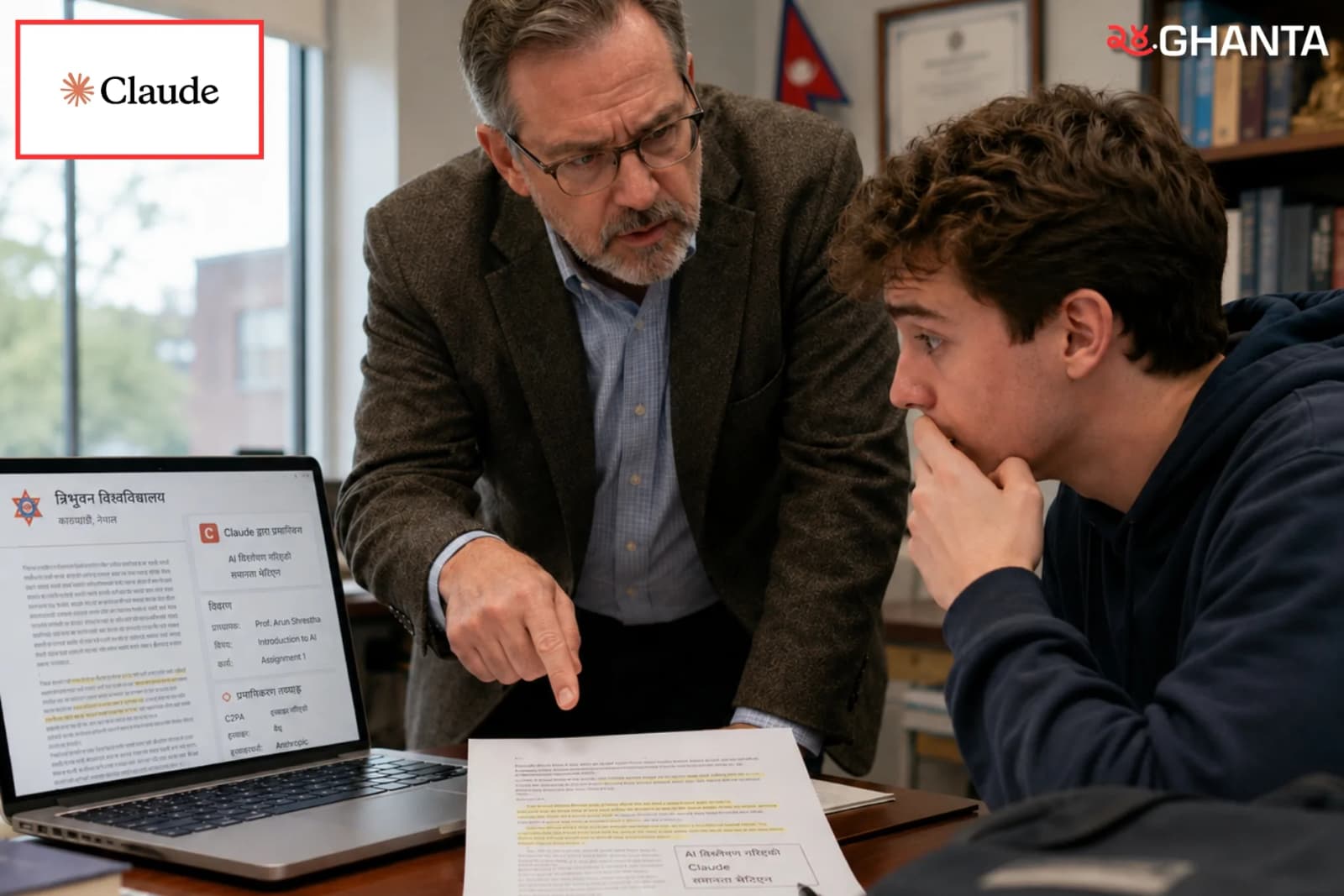
As Claude's marking system becomes more widely supported, universities, employers, publishers or online platforms in Nepal could eventually use detection or provenance tools to identify whether Claude interacted with submitted content.
However, the presence of a Claude mark alone would not prove that the person cheated, plagiarized or did not create the original work. It may simply show that Claude played some role in processing the material.
This distinction could become particularly important for students using AI for grammar correction, translation, research assistance or proofreading.
Can Claude’s Watermark Disappear?
Yes. Anthropic warns that the technology is not foolproof.
A text watermark may become difficult or impossible to detect after:
Extensive rewriting
Heavy paraphrasing
Translation
Mixing Claude-generated text with other writing
Similarly, provenance information attached to images or other files can disappear after screenshots, file conversions or processing through software that removes metadata.
Because of this, the absence of a watermark does not prove that AI was never used.
Can Anyone Detect The Watermark Yet?
Anthropic is developing ways for users and third parties to identify its machine-readable markings, but the company has not publicly released every technical detail behind its text detection system.
This means the system should currently be understood as a provenance signal, rather than a perfect AI detector capable of proving exactly who wrote a piece of content.
Why Are Some Users Concerned?
Criticism has focused largely on how the markings might be interpreted.
Writers, developers, students and other users worry that content written mainly by a human could still be labeled or perceived as AI-generated simply because Claude was used for proofreading or editing.
Others question how reliable the technology can be when substantial editing or file conversion may remove the signal.
At the same time, supporters argue that provenance technology can improve transparency as AI-generated content becomes increasingly common online.
So, Has Claude Watermarking Already Started?
Yes — but the rollout is not complete.
Supported newer Claude models already carry machine-readable marking capabilities, while Anthropic continues adding support to older models.
And importantly for Nepali users, the technology is not restricted to Europe. Supported Claude models used in Nepal can also produce marked content because Anthropic is applying the system globally wherever those models are available.
Published Aug 13 in Technology