
Death Of Dissent: Political Hubris And Lack of Leadership In The Indian Protests
· 7 min read
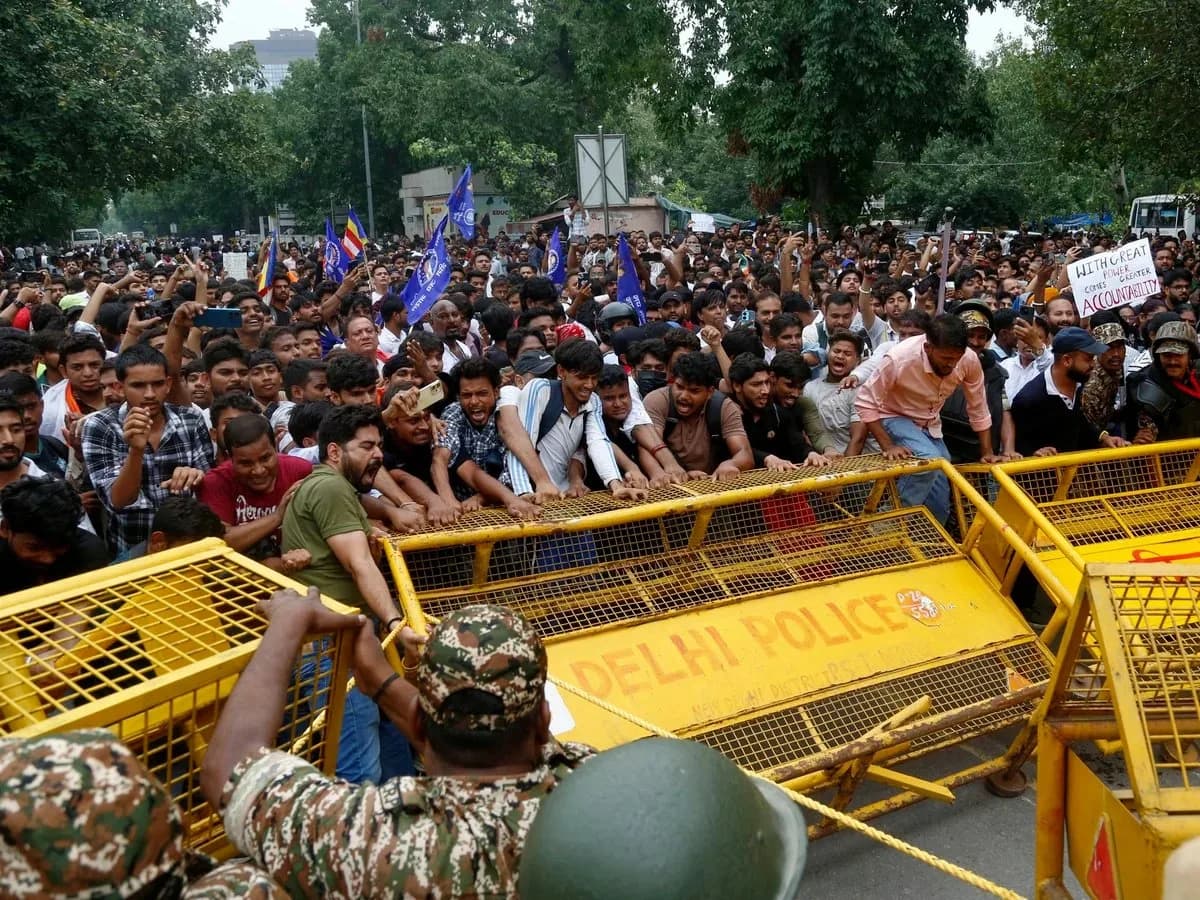
On 20th July, the streets that had witnessed the hunger strike of reputed activist, innovator, and educator Sonam Wangchuk for approximately 23 days saw a protest of an unprecedented scale. The streets of Jantar Mantar in Delhi were chock-filled with students and professionals of varied ages. The major reason for the protest: the recent NEET paper leak that became the tipping point for the masses, forcing them to make banners, face tear gas, and ask for the resignation of the Education Minister. The NEET leak scandal, which caused the death of 20 innocent student lives, along with various other leaks and irregularities in the education system of India, led to this moment; for the apolitical students locked in their dorm rooms for their whole lives to come forward and speak up. But what happened on that day—the brutal beatings by the police, lathi charges, use of tear gas, and brutality by those in civilian clothes—is not how the alleged mother of democracy should ideally operate. So, is dissent really dead in the streets of Jantar Mantar?
The Indian consensus, as visible from afar, is divided by futile arguments and worthless competition over whose religion is the better one. From afar, it is transparent how divided the country has become ever since the rise of the anti-Islam and anti-secular narrative. It does not help that the internet is filled with people loudly embracing their, for lack of better words, problematic ideologies, and, to one-up that, people cheering for them in the comments. And to one-up that, the hyper-nationalistic approach to any problem. But they came together for this movement; approximately 50,000 people were present at the protest site in Delhi alone. This speaks volumes about the rage among the masses regarding the ruling party. This movement and cause drove them together, but that may not be enough. The people present or absent do not want to associate their political ideology with this supposed non-political ‘Gandhian’ movement. But if we look at it objectively, a movement is never not political. The demand is the resignation of a political figure, and it is happening in Rajpath, along the periphery of Parliament, the most political area of Delhi. But why are people unwilling to associate their politics with this movement?
The rise of the Cockroach Janata Party from Instagram and its lacklustre leadership, along with the absent opposition, topped with an anti-Congress, anti-anti-ruling-party narrative, is so strong that people are unwilling to associate with politics. The media of India is strong, to say the least. The mainstream media has visibly picked a side, and it is the side of the ruling party. The news fed to the masses every day contains triggers for this state of politics. The anti-Islam, anti-secular, anti-liberal language and narrative have been fed to the Indian masses for ages. So much so that being called a liberal or secular is almost an insult on the Indian internet. This sense of pride drawn from religion, a hollow sense of pride in being superior to their neighbours, especially their arch-rivals Pakistan, has long been prevalent. This false sense of superiority, idolisation of the ruling party, and the central figure of the government has led to this day, where people do not want to associate with this movement on a political front. But on the flip side, it can also be said that regardless of people’s politics, everyone is standing for this one cause that has united the majority of India. That is why my hypothesis is that the government was so confident in its media machinery that it led itself to believe that dissent would be suppressed forever, and people divided by politics would never come together for a cause.

But the reality is that people filled the streets, proof enough that India knows how to speak up. And even though the rise of this unity was quickly overshadowed by the state’s reaction, dissent never dies. Whenever any state increases its crackdown and brutality, the repercussion is never silence or apathy; it is always emotion and dissent. This political movement, in my view, has just begun. Maybe the Education Minister won’t resign, but the fire that burned in the heart of every student at the protest won’t quench that easily. The comfortable reign of the ruling party has started to tremble just a bit; if not a revolution, this might just be a wave beginning the earthquake. India is not like Nepal, where a limited number of people can easily infiltrate and cause wreckage, and neither should it aspire to be. The answer to police brutality and government hubris is always more noise and more protests, never violence. The violence and fire in Nepal have only led to heaps of ashes that could have been easily avoided. Nevertheless, when state machinery showcases its power, the answer is never silence. But what decides the path and purpose of any protest is always its leadership. Nepal had none, which led it to quickly turn into anarchy. Without leadership and an action plan, there is not much difference between a collective and a mob.
When Abhijeet Dipke, founder of Cockroach Janata Party, an Instagram meme page that later turned into an umbrella for voices against the ruling party, announced the protest, he may not have predicted its scale himself, for leadership was absent throughout the day. This may very well have been due to manoeuvred political movements by calling the leaders into a meeting with Health Minister JP Nadda, or due to their negligence, as visible in egregious statements given by the then spokesperson of the CJP, Vijeta Dahiya. But their absence when students were being brutally beaten by untagged and unnamed police officers in civilian clothes was loud enough. This leads to conversations not only about the movement but also about the involvement of the people orchestrating the protests.
The motives might not be in question, but their involvement and aptitude for the work very well should be. When police were displaying state power and suppressing people left, right, and centre, the leaders of the protests were nowhere to be found. The face of the protest that gave this movement legitimacy was taken to the hospital, allegedly without consent. Abhijeet Dipke was reportedly detained, but it was later announced that he was not. The spokesperson was seen ranting senselessly while munching on a burger, and other leaders were seen in talks with JP Nadda. It is disappointing that a protest of this scale was left leaderless. Disappointing indeed, but not surprising. The Gen Z movement in Nepal had the same mistake—lack of leadership. All the leaders that later got into the ruling party, and all the leaders that did not; no one was the face of the protest, no one had the tenacity to control a crowd of that force. And the state, like the power-lusty state it was, fired bullets blindly. The violence that ensued the very next day was outrageous and unprecedented, but that is what anarchy looks like. Every unsuccessful leaderless protest is nothing but a mob, and every successful leaderless protest is nothing but anarchy.
Furthermore, on 21st July, Leader of the Opposition Rahul Gandhi sat in protest before the Prime Minister’s Residence. The reason is crystal clear: to utilize the heightened emotions of the masses to gain political favour, as the figure had never before been seen involved with this movement in any form. But how many of the students resonate with the Gandhi family or the despised opposition during the ruling party’s tenure is a question that will unfold with the passing of time.
Regardless, for this protest to work, either CJP’s President Abhijeet Dipke has to take responsibility for himself and become a better leader for the movement, or the movement needs to find legitimacy somewhere else. Because 20th July was a prime example not only of state cruelty, police brutality, and shamelessness when the figure in question was laughing outside Parliament, but also of a lack of leadership that could have guided the protest in a better direction. But Indian masses should not divert their focus from the state and should keep questioning, because a government that chooses tear gas and batons over dialogue and cooperation surely has no answers.
Published Jul 22 in Politics