
From Nepal to a Global Innovation Award: The Scientist Behind a Winning Battery Technology
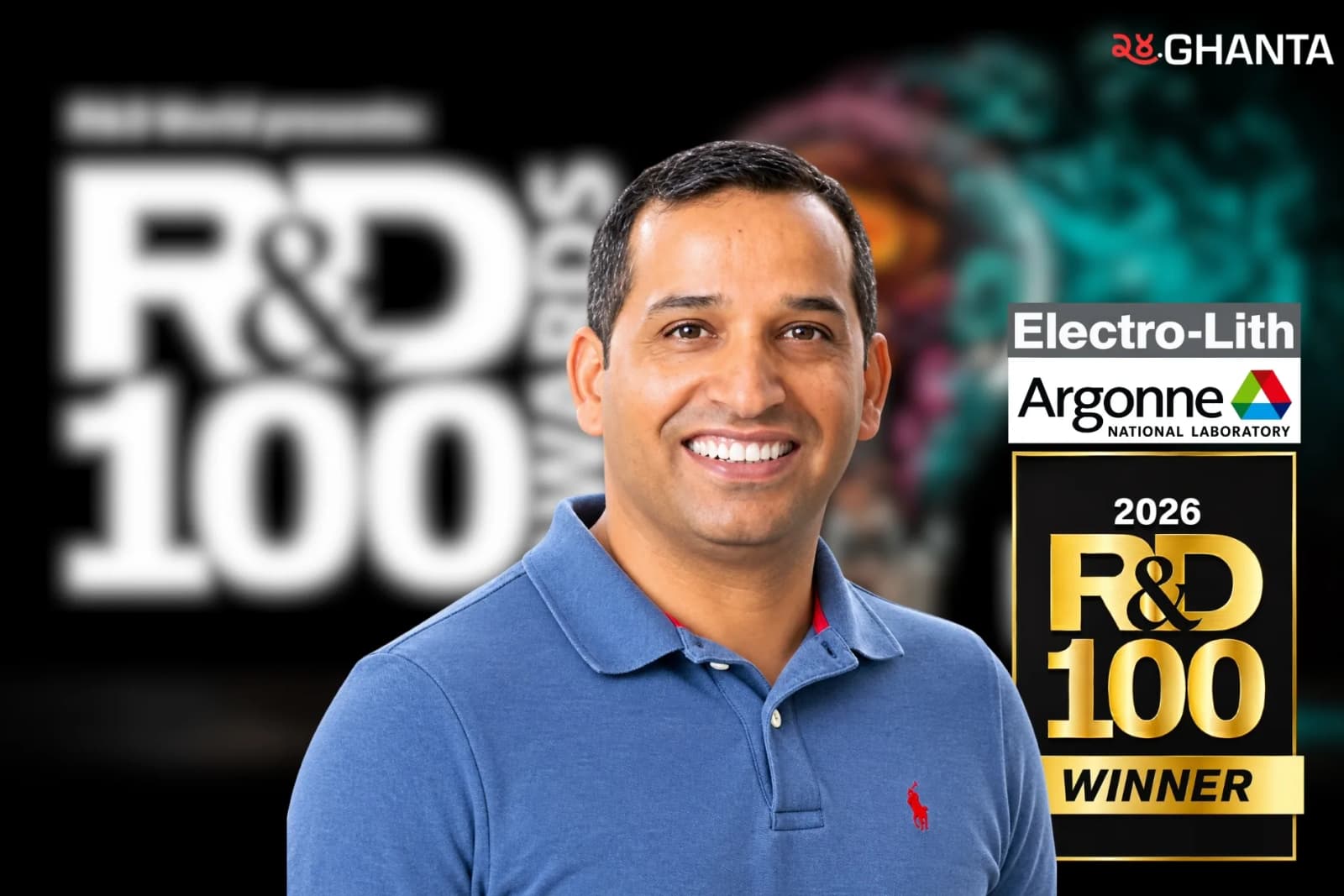
Nepali researcher Dr. Shiva Prasad Adhikari has been recognized as part of the team behind Electro-Lith, an Argonne National Laboratory and General Motors technology selected as one of the 2026 R&D 100 Award winners. The recognition places the battery-related innovation among 100 technologies chosen from 149 finalists in this year’s global competition.
· 4 min read
KATHMANDU | AUGUST 19, 2026
Nepali scientist Dr. Shiva Prasad Adhikari, working in the United States, has been recognized as part of the research team behind Electro-Lith, a technology developed by Argonne National Laboratory with General Motors that has won a 2026 R&D 100 Award. Announced this month in the United States, the recognition places Electro-Lith among 100 technologies selected from 149 finalists worldwide for their technological significance and innovation.
What Exactly Did His Team Win?
Electro-Lith was selected as a winner in the Process/Prototyping category of the 2026 R&D 100 Awards.

The official winners list identifies Argonne National Laboratory as the primary organization and General Motors LLC as the co-developer of Electro-Lith.
This is particularly significant because the awards recognize technologies rather than simply honoring individual scientists. Dr. Adhikari's recognition therefore comes through his reported contribution to the wider team responsible for the winning technology.
Why Are the R&D 100 Awards Important?
The R&D 100 Awards have been running for more than six decades and recognize 100 significant new technologies each year.
The 2026 competition marks the 64th edition of the awards.
This year's judging involved more than 50 industry professionals, with 149 technologies reaching the finalist stage before the final 100 winners were announced.
The competition covers areas including analytical and testing technologies, IT and electrical systems, mechanical and materials innovation, process and prototyping, and software and services.
What Is Electro-Lith?
Electro-Lith is a technology connected to advanced battery manufacturing and was entered by Argonne National Laboratory and General Motors.
According to reports, the technology is designed to improve aspects of lithium-ion battery production, with the potential to make manufacturing more efficient and economical.
That matters as lithium-ion batteries have become essential to electric vehicles, phones, laptops and large-scale energy storage.
Improvements in the way these batteries are manufactured can potentially reduce production complexity, energy requirements and costs as global battery demand continues to expand.
Argonne Had a Strong Year
Electro-Lith was not Argonne's only success in the 2026 competition.
The laboratory had multiple technologies among this year's winners, spanning fields such as advanced manufacturing, battery recycling, critical materials, quantum networking and other emerging technologies.
Electro-Lith's inclusion therefore places the technology within a broader portfolio of research being developed at one of the United States' major national laboratories.
Who Is Dr. Shiva Prasad Adhikari?
According to reports, Dr. Adhikari has built a research career spanning chemistry, advanced materials, batteries, energy and emerging manufacturing technologies.
His academic background includes graduate-level chemistry education in the United Kingdom and United States.
His published research record also extends beyond battery technology. Scientific databases show work under the name Shiva P. Adhikari involving molecular chemistry and DNA-recognition research, demonstrating experience across different areas of chemistry.
Why Battery Research Matters Right Now
Battery technology has become increasingly important as countries move toward electric transportation and greater use of renewable energy.
Electric vehicles require large battery packs, while solar and wind energy systems increasingly depend on storage technologies capable of holding electricity for later use.
At the same time, manufacturers face pressure to reduce the cost, energy consumption and environmental footprint involved in producing batteries.
Innovations that improve manufacturing could therefore have an impact far beyond a laboratory.
A Nepali Researcher on an International Stage
For Nepal, Dr. Adhikari's reported contribution carries another significance.
It demonstrates how researchers with Nepali roots can participate in technological projects being developed at major international research institutions and alongside global companies.
Dr. Adhikari has used his experience to encourage young Nepalis to pursue science, technology, engineering and mathematics (STEM) and has emphasized the importance of sustained learning, opportunity and research.
Nepal’s Challenge Is Turning Talent Into Opportunity
Individual success stories also raise a larger question for Nepal.
The country continues to produce students and researchers capable of competing internationally, but creating strong domestic opportunities in advanced science remains a challenge.
Research laboratories, reliable funding, collaboration between universities and industry, and long-term investment in scientists are important if more research careers are to develop within Nepal itself.
Celebrating Nepali scientists abroad can therefore be accompanied by a broader conversation about how Nepal can create an environment in which future scientists can conduct internationally significant work closer to home.
Formal Ceremony Coming in November
The 2026 R&D 100 winners were announced on August 6, but the formal celebration is still ahead.
The R&D 100 gala banquet is scheduled for November 19, 2026, at the Grand Hyatt Scottsdale Resort in Arizona.
Researchers, engineers, technology developers, and representatives from innovative organizations are expected to gather for the event.
For Dr. Adhikari, the recognition represents more than another line on a scientific résumé. It puts a Nepali researcher within the story of a technology officially selected among 100 of the year's notable innovations and offers young Nepalis another example of where a career in science can lead.
Published Aug 19 in World