
From Nepali Kitchens to Global Shelves: How Pickles Became a Rs 21 Crore Export
Nepal exported pickles worth Rs211.69 million during the first 11 months of the last fiscal year, reaching more than a dozen countries, with Italy, Australia and the United Kingdom emerging as the three largest markets. The growth is being driven by entrepreneurs who are converting traditional household recipes into branded businesses that create jobs, support local agriculture and introduce Nepali flavours to international consumers.
· 6 min read
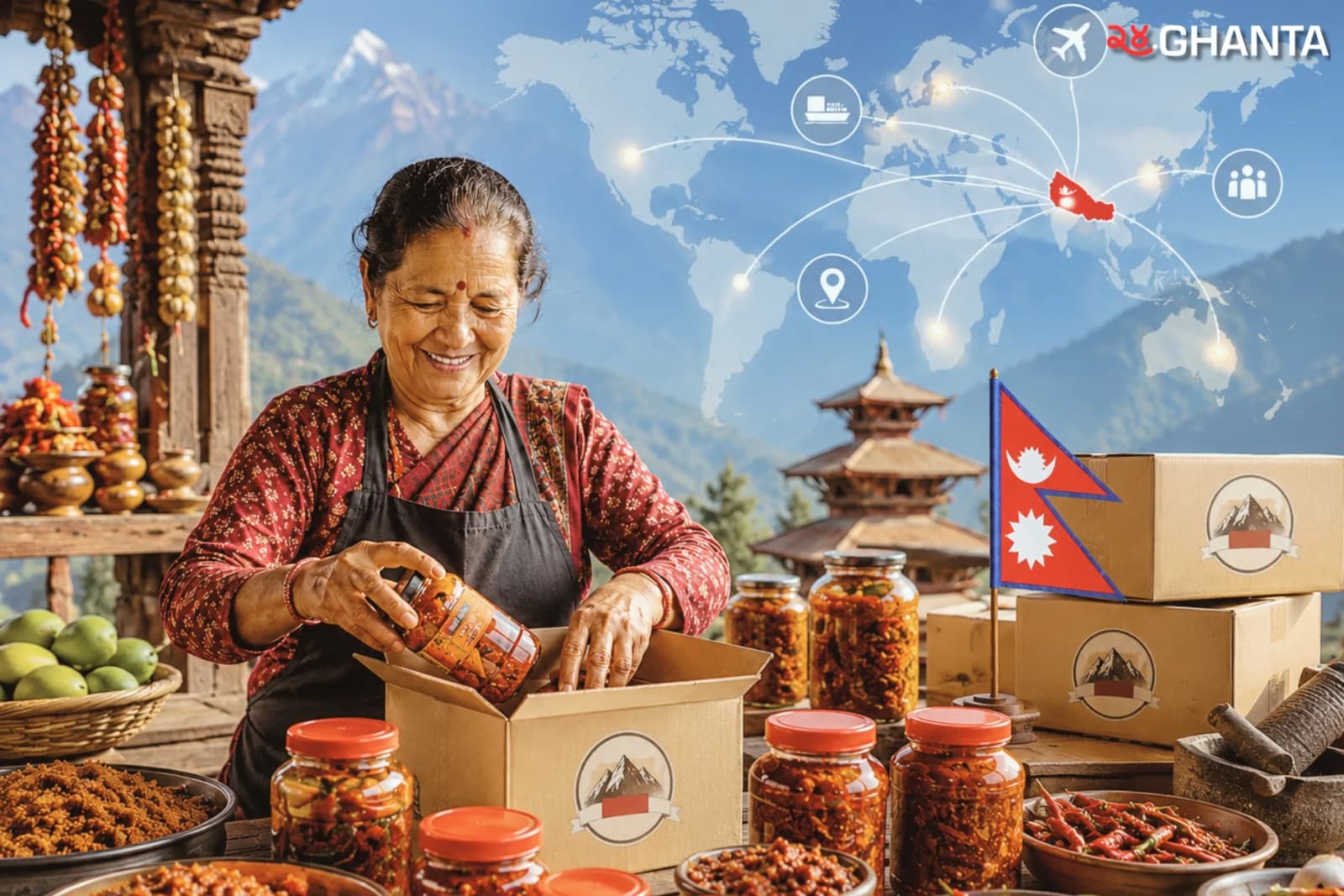
Traditional Flavours Reach the World
Nepali entrepreneurs, including homemakers, students and established public figures, exported locally produced pickles worth Rs 21 crore 16 lakh 90 thousand during the first 11 months of the last fiscal year. The products reached markets across Europe, Asia, North America, Australia and Africa as traditional Nepali recipes increasingly developed into branded commercial products.
Exports Cross Rs 21 Crore
Nepal exported pickles to Italy, Australia, the United Kingdom, Canada, Japan, South Korea, the United States, Belgium, Mauritius, Denmark, the United Arab Emirates, Malaysia and India during the reporting period.

The export value of Rs 21 crore 16 lakh 90 thousand shows that a food product once prepared mainly for household use is becoming an important part of Nepal’s processed-food trade.
Italy Becomes Largest Market
Italy emerged as the largest international market for Nepali pickles, importing 57,267 kilograms worth Rs 3 crore 73 lakh 80 thousand.
Australia ranked second with imports worth Rs 3 crore 64 lakh 90 thousand, while the United Kingdom followed closely with purchases worth Rs 3 crore 61 lakh 10 thousand.
Together, these three countries imported Nepali pickles worth nearly Rs 11 crore, accounting for more than half of the total reported export value.
India Buys the Smallest Amount
Despite being Nepal’s largest overall trading partner, India purchased Nepali pickles worth only Rs 4 thousand during the period.
At the same time, Nepal imported Indian pickles worth Rs 3 crore 33 lakh 90 thousand, showing a major imbalance in pickle trade between the two neighbouring countries.
China Leads Nepal’s Pickle Imports
Nepal imported pickles worth a combined Rs 11 crore 86 lakh 70 thousand during the first 11 months of the fiscal year.
China was the largest supplier, exporting pickles worth Rs 8 crore 48 lakh 80 thousand to Nepal.
South Korea supplied pickles worth Rs 3 lakh 65 thousand, Japan supplied products worth Rs 37 thousand, while Bhutan exported pickles worth only Rs 2 thousand.
Nepal Records Trade Surplus
Nepal exported pickles worth Rs 21 crore 16 lakh 90 thousand while importing products worth Rs 11 crore 86 lakh 70 thousand during the period.
This means Nepal recorded a pickle-trade surplus of approximately Rs 9 crore 30 lakh 20 thousand.
The figures suggest that Nepali producers are earning more from overseas pickle sales than the country is spending on imported pickles.
Exports Grow Rapidly
Nepal’s pickle exports have increased sharply over the past several years.
In fiscal year 2020–21, exports were worth only Rs 39 lakh 20 thousand.
The value increased to Rs 3 crore 86 lakh 60 thousand in fiscal year 2021–22 and reached Rs 10 crore 98 lakh 40 thousand in fiscal year 2022–23.
Exports rose further to Rs 15 crore 8 lakh 10 thousand in fiscal year 2023–24.
In fiscal year 2024–25, Nepal exported pickles worth Rs 18 crore 26 lakh 40 thousand.
The latest 11-month export figure of Rs 21 crore 16 lakh 90 thousand has already exceeded the total recorded during the previous fiscal year.
Imports Also Increase
Nepal’s pickle imports have also grown over the years.
Imports were worth Rs 2 crore 52 lakh 30 thousand in fiscal year 2020–21.
The amount increased to Rs 7 crore 64 lakh 60 thousand in fiscal year 2021–22 and reached Rs 10 crore 2 lakh in fiscal year 2022–23.
Imports stood at Rs 7 crore 21 lakh 60 thousand in fiscal year 2023–24 and increased to Rs 9 crore 21 lakh 60 thousand in fiscal year 2024–25.
During the latest 11-month period, pickle imports reached Rs 11 crore 86 lakh 70 thousand.
Small Investment Creates Big Business
Sangeeta Pandey, founder of Aama Ko Achar, began her pickle business with an investment of only Rs 3 thousand and 10 kilograms of dalle khursani.
What started as a small activity later developed into a recognised Nepali pickle brand.
Pandey launched the business at the age of 49 to remain active and financially independent. Fourteen years later, the company now produces pickles in tonnes.
Production Reaches Tonnes
Pandey said her company produced approximately 1.5 tonnes of pickles in one year.
The business purchases ingredients such as bamboo shoots, bitter gourds, mangoes and cucumbers in large quantities for commercial production.
According to Pandey, nearly 90 percent of Aama Ko Achar’s products are exported to international markets.
Traditional Pickles Gain Buyers
Aama Ko Achar produces several traditional Nepali pickle varieties.
These include mango, fenugreek, flaxseed paste, gundruk, soybean, lapsi, radish and green chilli pickles.
The company also produces spice products such as chicken masala, turmeric, biryani masala, buff masala, tea masala and chat masala.
Dried meat products are also included in its growing product range.
Women Turn Skills Into Income
The growth of commercial pickle businesses shows how household skills can create financial opportunities.
Women who once prepared pickles only for family use are now turning their recipes into registered businesses.
These enterprises can support financial independence, create jobs, and generate income from products made with local ingredients.
Former Lawmaker Enters Pickle Business
Former lawmaker Shanta Chaudhary has also entered the pickle industry as a source of regular income.
She officially launched Shanta Ko Achar Udhyog in Dang after initially running the business informally.
Chaudhary said she decided to commercialise her pickle-making skills because the business could become a sustainable income source.
Rs 500 Business Creates 35 Jobs
Chaudhary began making pickles with an initial investment of only Rs 500.
The small venture later expanded and now provides employment to around 35 people.
Her experience shows how a business based on traditional knowledge can grow through branding, packaging, regular production and customer trust.
Local Farmers Could Benefit
The expansion of pickle businesses could create a stronger market for Nepali farmers.
Commercial producers require large quantities of chillies, mangoes, radishes, cucumbers, bamboo shoots, lapsi and other local ingredients.
This could help farmers secure regular buyers and reduce the waste of seasonal fruits and vegetables.
Food Processing Adds Value
Pickle production adds value to agricultural products by processing and preserving them for longer periods.
Instead of selling only fresh produce, farmers and businesses can earn more by converting raw ingredients into packaged food products.
The industry can also encourage rural entrepreneurship and small-scale food processing outside major cities.
Quality Will Decide Future Growth
Traditional taste alone may not be enough to compete in large international markets.
Exporters must maintain food safety, hygienic production, accurate labelling, durable packaging and consistent quality.
Businesses may also need laboratory testing and internationally accepted certification to enter supermarkets and wider retail networks abroad.
Branding Nepali Food Globally
Nepali pickles offer an opportunity to introduce the country’s food culture to international consumers.
Ingredients such as dalle khursani, lapsi, gundruk, bamboo shoots and timur can help Nepali products stand out in foreign markets.
The Nepali diaspora may remain an important customer base, while wider interest in spicy, fermented and traditional foods could create additional demand.
More Than an Export Figure
The export value of Rs 21 crore 16 lakh 90 thousand represents more than commercial trade.
It reflects the growth of women-led businesses, traditional food knowledge, local agriculture and small-scale entrepreneurship.
With stronger quality control, better packaging and improved access to global markets, Nepali pickles could become a widely recognised international food product.
Published Jul 21 in Society