
Government Approves 10th Amendment To Education Regulations, Bringing Major Changes To School Governance
The government has approved the 10th amendment to the Education Regulations, bringing changes to school levels, student protection, teacher transfers, principal appointments and local education governance.
· 4 min read
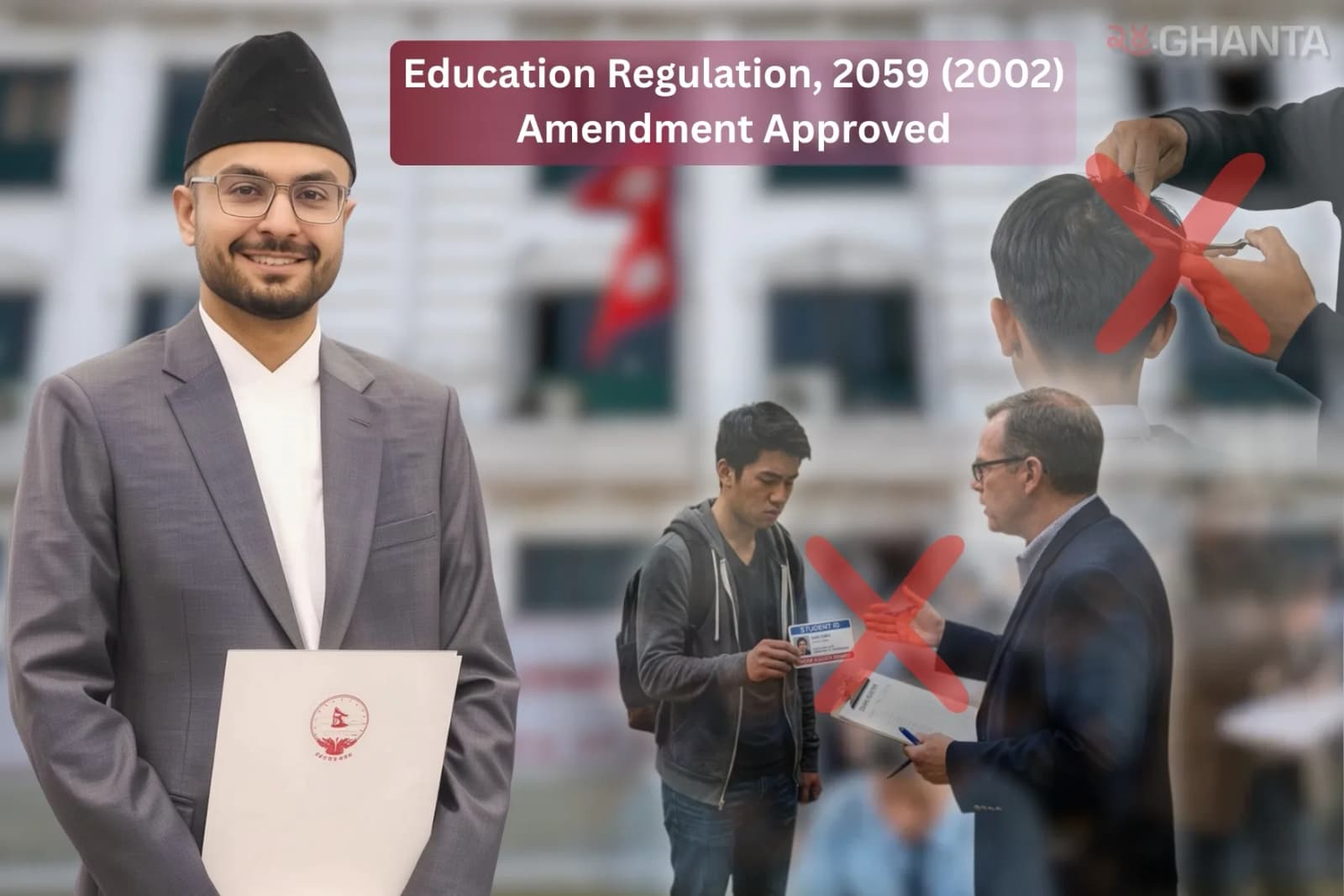
KATHMANDU, July 7 — The Government of Nepal has approved the 10th amendment to the Education Regulations, 2059, through a Council of Ministers decision on Asar 22 (July 6), introducing new rules on school classification, student protection, school deposits, principal appointments, teacher transfers, local-level education committees and examination management.
The amendment was made under the authority of Section 19 of the Education Act, 2028. The revised regulations are being prepared for implementation after official publication in the Nepal Gazette.
The amendment brings several changes to Nepal’s school education system, especially in areas related to student rights, local government responsibilities and school administration.

Major Changes In The 10th Amendment
School levels redefined
Classes 1 to 8 have been classified as the basic level, while classes 9 to 12 have been classified as secondary education.
New deposit requirement for schools
A deposit of Rs. 10 lakh will be required to open a secondary-level school. Similarly, a deposit of Rs. 5 lakh will be required to obtain permission to open an institutional school at the basic level.
Student humiliation banned
Schools will not be allowed to carry out activities that negatively affect students physically, mentally or psychosocially. Students cannot be publicly shamed, discriminated against, deprived of classes or exams, forced to cut their hair, or insulted based on their appearance, clothing, makeup or grooming.
No punishment over unpaid fees
The regulations clearly state that students cannot be humiliated or treated unfairly for reasons such as non-payment of school fees.
Local education committees strengthened
The education branch at the local level will work as the secretariat of the village or municipal education committee. These committees must meet at least once every three months.
Learning achievement testing committee at local level
A local-level committee will be formed to assess the learning achievement of basic-level students. The committee will be chaired by a secondary school principal and will include teacher representatives, at least one woman representative, local education officials, and representatives from the Education Development and Coordination Unit.
Informal education committee at district level
A District Informal Education Committee will be formed to oversee, manage, coordinate and inspect informal education programs. The committee will include officials from district and local bodies, representatives of NGOs, Dalits, persons with disabilities and the Nepal Teachers’ Federation.
Distance education committee
A Distance Education Committee will be formed under the chairmanship of the Education Ministry secretary to formulate, coordinate and manage policies related to distance education.
New rules for principal appointment
Local levels must call applications to appoint principals in vacant community school positions. For the basic level, applicants generally need a bachelor’s degree, while for the secondary level, a master’s degree is required. However, teachers with specific education qualifications and five years of permanent service may also be eligible under certain conditions.
Teacher transfer after three years
Permanent teachers who have completed three years of service can be transferred from one community school to another. Transfers must be made within the same level and subject where applicable.
Vacant teacher posts must be reported quickly
Schools must enter vacant teacher position details into the Integrated Educational Management Information System and inform the concerned local level in writing within seven days of the vacancy.
Decision on vacancy filling within seven days
After receiving vacancy information, the local level must decide within seven days whether to fill the post through transfer or by advertisement through the Teacher Service Commission.
Sick leave certification
Teachers’ accumulated sick leave must be certified by the local-level education officer based on the principal’s recommendation at the end of each academic session.
Pension provision for teacher’s family
If a teacher dies before completing seven years of service while employed, or after starting to receive a pension, the teacher’s eligible family member will be entitled to receive the pension.
The amendment is expected to affect community schools, institutional schools, teachers, students, local governments and education administrators across the country. It also gives local levels a bigger role in school monitoring, teacher management and student learning assessment.
Published Jul 7 in Nepal