
Separating Exploitation From Teen Love: Why The Debate Matters
Nepal is debating whether consensual relationships between teenagers aged 16 to 18 should be treated the same as serious sexual crimes. The proposed Romeo-Juliet Clause aims to separate teenage relationships from exploitation while keeping strict punishment for abuse and coercion. The debate now raises a bigger question: how should the law balance child protection, consent, and fairness?
· 4 min read

Can two teenagers in a consensual relationship be treated the same as a s*xual predator?
That question is at the centre of a growing legal debate in Nepal as lawmakers consider introducing a "Romeo-Juliet Clause" into the country's rape laws.

The discussion gained momentum in March 2025 when then Home Minister Ramesh Lekhak raised the issue before the Law, Justice, and Human Rights Committee. He proposed two possible reforms: either lower the legal marriage age to 18 or introduce a Romeo-Juliet model that would allow consensual relationships between teenagers aged 16 and 18 without automatically treating them as statutory r@pe, provided there is genuine consent and no coercion.
So, what exactly is the Romeo-Juliet Law?
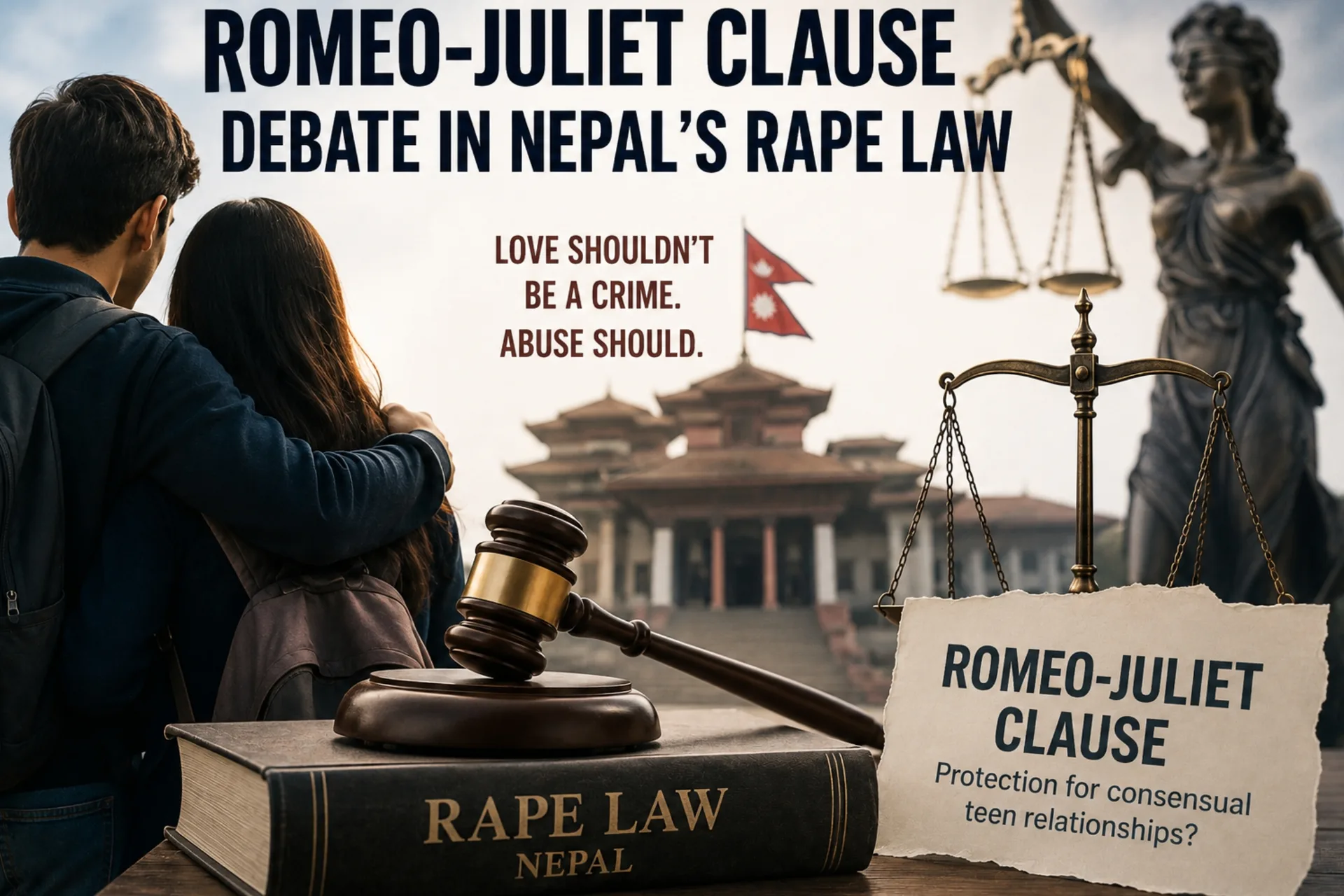
The law takes its name from William Shakespeare's famous play Romeo and Juliet. Juliet was just 13 years old, while Romeo was slightly older. Over time, their story came to symbolize young love caught between social rules and authority.
The principle behind the law is simple. It recognizes that there is a difference between an adult exploiting a child and two teenagers who are close in age and involved in a consensual relationship. Supporters argue that teenagers in such situations should not automatically face the same legal consequences as child s@x offenders.
The legal concept first took shape in Florida, USA, in 2007. Since then, several jurisdictions in countries such as the United States, Canada, and the United Kingdom have adopted similar close-in-age exceptions. These laws do not make underage sex legal. Instead, they allow courts to consider the circumstances of each case before imposing severe criminal penalties.
Nepal's interest in the issue comes from real cases where teenagers in consensual relationships have found themselves facing serious criminal charges. In some instances, families opposed to the relationship, including inter-caste relationships, have filed complaints despite both teenagers claiming the relationship was consensual. Under Nepal's current legal framework, anyone under the age of 20 is considered unable to legally consent, meaning such cases can be treated in the same way as predatory abuse.
Supporters believe this is the gap a Romeo-Juliet Clause could help address. They argue that the law should be able to distinguish between exploitation and genuine teenage relationships. They also believe it could reduce pressure on Nepal's courts by preventing consensual teenage relationships from being processed as serious criminal cases, allowing greater focus on cases involving real abuse and coercion.
Where Things Stand Now: The Current Proposal
However, the proposal has also raised concerns. Critics warn that such an exception could be misused if offenders falsely claim a relationship was consensual. Others point to Nepal's social realities, where teenage relationships, particularly inter-caste relationships, remain controversial in some communities. Changing the law, they argue, will not automatically change social attitudes.
The debate has now moved beyond discussion. Nepal is currently drafting a Romeo-Juliet Clause that would introduce a proposed three-year age-gap exemption for teenagers between the ages of 16 and 18 while continuing to impose strict penalties for coercion, exploitation, and abuse.
Law Secretary Udaya Raj Dhungana, who is involved in the drafting process, has said that the goal is not to weaken r@pe laws but to separate exploitation from natural adolescent relationships. Senior advocate Meera Dhungana has also pointed to cases where r@pe complaints have been used to break up relationships that families disapprove of. At the same time, child-rights and women's rights groups remain cautious. Former National Human Rights Commission member Mohna Ansari has warned that any reform should only proceed after broad public discussion to minimize the risk of misuse.
At its heart, the Romeo-Juliet debate is not about reducing protection for children. It is about whether the law should recognize the difference between exploitation and consensual relationships between teenagers who are close in age. As Nepal considers possible reforms, lawmakers face the challenge of balancing child protection, fairness, and social realities. Whatever decision is ultimately made, the debate has already raised important questions about consent, justice, and how the legal system should respond to young relationships in modern Nepal.
Sources :
Neal Davis Law Firm. (2026, April 20). Texas Romeo and Juliet law: Definition, examples & exemptions. Neal Davis Law Firm.
Dhakal, B. (2025, May 11). Understanding the Romeo and Juliet law: Protecting teen love from harsh legal consequences. NepalNews.
SEAANDJOB. (2026, May 25). Nepal plans 'Romeo-Juliet' clause in rape law to shield consensual teen couples.
Published Jul 7 in Researched Article