
Mani Walls: The Sacred Stone Walls Found Along Nepal’s Himalayan Trails
Discover the sacred Mani walls of Nepal’s Himalayas, their Buddhist meaning, carved prayer stones, cultural importance, and traditions in Khumbu and Langtang.
· 8 min read
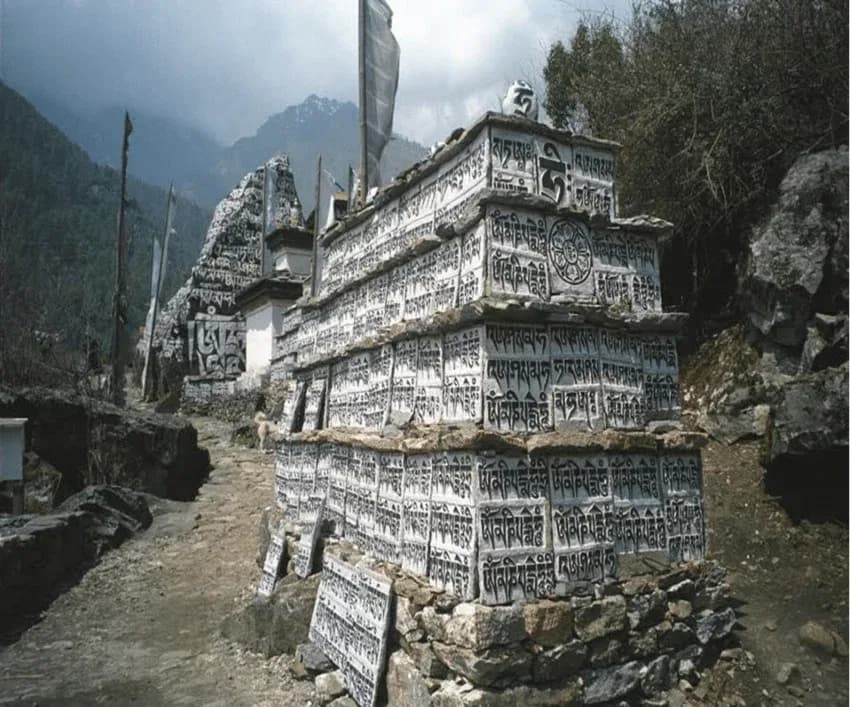
High in the Himalayas of Nepal, where mountain trails connect remote villages, monasteries, and centuries-old settlements, travelers often encounter long stone walls covered with beautifully carved prayers. Known as Mani walls, these sacred structures are an important part of Nepal’s Buddhist heritage and Himalayan culture.
Mani walls are made from individual stones, often called Mani stones, that are engraved with Buddhist prayers, sacred symbols, and mantras. One of the most commonly seen inscriptions is “Om Mani Padme Hum,” a widely known Buddhist mantra associated with Avalokiteshvara, the bodhisattva of compassion. These walls are particularly common in areas where Tibetan Buddhist traditions have a strong influence, including the Khumbu, Langtang, and other Himalayan regions of Nepal.
What Are Mani Walls?
A Mani wall is a traditional stone structure built using carved stones carrying Buddhist prayers or religious inscriptions. Unlike an ordinary boundary wall, a Mani wall has a spiritual purpose. Each carved stone can represent an act of devotion, prayer, or offering.

The stones may contain mantras, Buddhist teachings, religious symbols, or images. They are carefully placed together to form walls that can stretch along village paths, mountain trails, and areas near monasteries.
For visitors, Mani walls can appear to be a simple example of Himalayan stonework. For local communities, however, they can represent faith, cultural identity, memory, and generations of religious practice.
The Meaning Behind “Om Mani Padme Hum”
The mantra “Om Mani Padme Hum” is closely connected with Avalokiteshvara, known as a bodhisattva associated with compassion in Mahayana and Tibetan Buddhist traditions.
The mantra is one of the most recognizable Buddhist inscriptions found across the Himalayan region. It can be seen carved into stones, prayer wheels, monasteries, walls, and other religious structures.
While translations and interpretations of the mantra can vary, its widespread use reflects the importance of compassion and spiritual practice in Himalayan Buddhist communities.
Why Are Mani Walls Important in Nepal?
Mani walls are important because they connect religious belief with everyday life. They are not normally separate from the communities around them. Instead, they can be part of the paths people use, the villages where they live, and the landscapes where religious traditions have developed over generations.
Building, carving, repairing, and maintaining Mani stones can be an act of devotion. In Himalayan communities, contributing to religious structures may also be understood as a way of making offerings and generating spiritual merit.
In the Khumbu region, for example, Mani walls have traditionally been built and maintained with contributions from local families and communities. This community involvement has helped keep the tradition alive across generations.
Mani Walls in the Khumbu Region
The Khumbu region is one of the best-known areas of Nepal for Tibetan Buddhist cultural heritage. Home to Sherpa communities and famous Himalayan settlements, the region contains monasteries, chortens, prayer flags, prayer wheels, and Mani walls along its mountain trails.
For trekkers traveling through the Everest region, Mani walls are a familiar sight. They can be found beside trails and near settlements, adding a distinctive cultural character to the Himalayan landscape.
A Mani wall is not simply something to photograph while trekking. Its religious significance means visitors are expected to treat it with respect.
The Buddhist Tradition of Passing Mani Walls
One important custom concerns the direction in which people pass religious structures.
Visitors following Tibetan Buddhist tradition generally walk clockwise around Mani walls, keeping the wall on their right side. The same clockwise practice is commonly associated with other sacred Buddhist structures in the Himalayan region.
Travelers should avoid climbing over, walking through, sitting on, or casually moving stones from a Mani wall. Respecting these customs is an important part of responsible cultural tourism in Nepal.
Mani Walls and Langtang Valley
The Langtang Valley is another important area where Mani walls form part of the cultural landscape.
Research in the Langtang Valley documented 80 Mani walls, showing the scale and importance of these structures within the region. Some Mani walls have also been reconstructed after major earthquakes, including the devastating 2015 Nepal earthquake.
This is important because Mani walls are not always preserved as completely untouched structures from the distant past. Some have been repaired, rebuilt, or reconstructed as communities continue to maintain their religious and cultural heritage.
As a result, determining the exact age of an individual Mani wall can be difficult.
The Impact of the 2015 Earthquake
Nepal's 2015 earthquake caused widespread damage across many Himalayan communities. Religious buildings, homes, trails, monuments, and cultural structures were affected.
Mani walls were among the cultural structures that required repair or reconstruction in affected areas. Their rebuilding demonstrates that these walls are living parts of local communities rather than abandoned monuments.
When a Mani wall is reconstructed, the process can preserve more than stones. It can also preserve a community's religious practices, craftsmanship, memories, and connection to the landscape.
Mani Stones: Faith Carved Into Rock
The individual stones used in Mani walls are often as significant as the walls themselves.
Carving prayers into stone requires skill and patience. Traditionally, these inscriptions have been produced by skilled craftspeople and religious practitioners. The finished stones can vary considerably in size, design, lettering, and imagery.
Over time, thousands of carved stones can become part of a single wall. Together, they create a physical record of religious devotion and local craftsmanship.
This makes Mani walls an unusual form of cultural heritage: religious art, architecture, and community tradition are combined in one structure.
Mani Walls and Himalayan Tourism
Nepal's Himalayan trails attract visitors from around the world, particularly to destinations such as the Everest and Langtang regions. Mani walls are an important part of the cultural experience for travelers exploring these areas.
However, tourism also creates a responsibility to protect sacred heritage.
Travelers can help by following local customs, avoiding damage to religious structures, not removing stones or carvings as souvenirs, and listening to local guidance when visiting villages and monasteries.
Taking a photograph is generally very different from physically interacting with a sacred structure. Respect for local beliefs should remain a priority.
More Than a Stone Wall
What makes Mani walls remarkable is their combination of simplicity and meaning.
At first glance, they may look like long piles of stones arranged beside a mountain path. But each carved stone can represent prayer, devotion, craftsmanship, and a connection between generations.
Their importance is also not limited to religion. Mani walls contribute to the cultural identity of Himalayan communities and form an important part of the visual landscape of regions such as Khumbu and Langtang.
They show how cultural heritage can exist not only inside museums and monuments but also along ordinary paths used by local people every day.
Protecting Nepal’s Mani Wall Heritage
The preservation of Mani walls depends heavily on the communities that live around them. Natural weathering, earthquakes, development, trail changes, and tourism can all affect these structures.
Documentation and research can help record their locations, inscriptions, construction styles, and history. At the same time, local knowledge remains essential because communities understand the religious meaning and traditional practices connected to these walls.
Preserving Mani walls therefore means protecting both the physical stones and the traditions surrounding them.
Frequently Asked Questions About Mani Walls
What is a Mani wall in Nepal?
A Mani wall is a sacred stone wall made from stones carved with Buddhist prayers, mantras, religious symbols, or images. They are particularly common in Nepal's Himalayan regions influenced by Tibetan Buddhism.
What does “Om Mani Padme Hum” mean?
“Om Mani Padme Hum” is a widely known Buddhist mantra associated with Avalokiteshvara, the bodhisattva of compassion. It is frequently carved into Mani stones throughout the Himalayan region.
Where can Mani walls be found in Nepal?
Mani walls can be found in several Himalayan areas of Nepal, including the Khumbu and Langtang regions, particularly along village paths, trekking routes, and near Buddhist religious sites.
Why do people walk around Mani walls clockwise?
In Tibetan Buddhist tradition, sacred objects and structures are commonly circumambulated clockwise. When passing a Mani wall, people traditionally keep it on their right side.
Are Mani walls hundreds of years old?
Some Mani walls may have a long history, but establishing the exact age of individual walls can be difficult. Many structures have been repaired or rebuilt over time, including after earthquakes.
Can tourists touch or climb Mani walls?
Visitors should treat Mani walls as sacred structures. They should not climb over them, remove stones, or damage the carvings. Following local customs and walking around them respectfully is the better practice.
A Living Symbol of Nepal’s Himalayan Heritage
Mani walls remain one of the most distinctive examples of living cultural heritage in Nepal's Himalayas. Built from ordinary stones but transformed through prayer and craftsmanship, they connect religion with the landscape and everyday life of mountain communities.
From the trekking trails of Khumbu to the villages of Langtang, these sacred walls continue to carry Buddhist traditions across generations. Their stones preserve prayers, while their continued maintenance reflects the enduring relationship between Nepal's Himalayan communities, their faith, and their mountains.
For travelers exploring Nepal, a Mani wall is more than a landmark along the trail. It is a reminder that the Himalayas are not only a natural wonder, but also a landscape shaped by centuries of living culture, faith, craftsmanship, and community memory.
Published Aug 19 in Timeless Nepal