
Nepal and India Agree to Expand Cross-Border Electricity Trade Capacity
Nepal and India have agreed to expand cross-border electricity trade capacity, allowing Nepal to import up to 1,530 MW and export up to 1,850 MW through key transmission lines.
· 4 min read
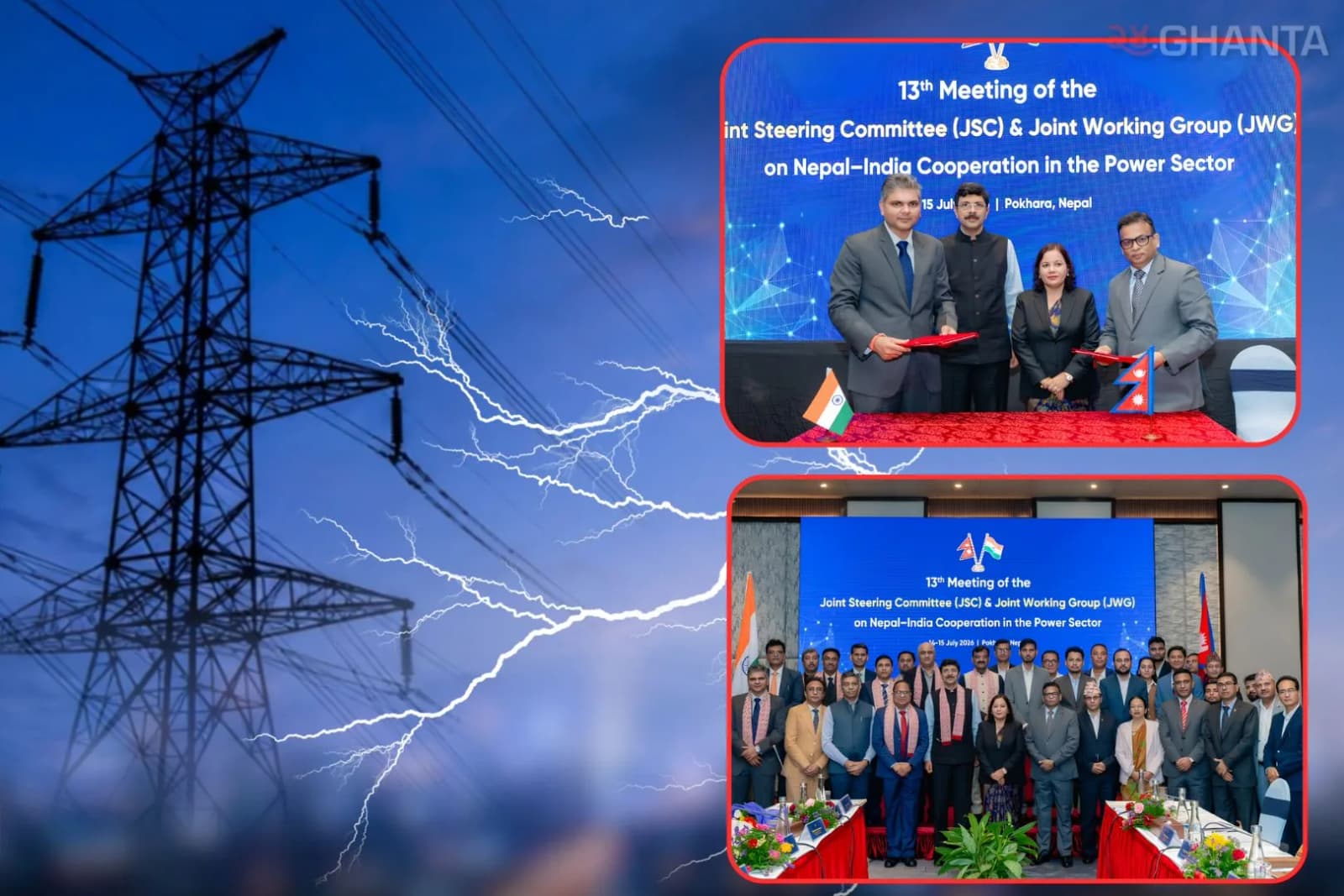
KATHMANDU, July 17 — Nepal and India have agreed to expand cross-border electricity trade capacity, increasing Nepal's total electricity import capacity to 1,530 MW and export capacity to 1,850 MW through existing and under-construction transmission lines.
The agreement was reached during the 13th Nepal-India Joint Steering Committee (JSC) meeting on power sector cooperation held in Pokhara on July 15.
Major Expansion in Power Trade
The secretary-level meeting was co-chaired by Sarita Dwadi, Secretary of the Ministry of Energy, Water Resources, and Irrigation of the Government of Nepal, and Pankaj Agarwal, Secretary of the Ministry of Power of the Government of India.

The agreement is expected to strengthen Nepal's growing hydropower sector by increasing its ability to export surplus electricity during the monsoon season while maintaining sufficient import capacity during the dry season.
Higher Capacity Through Dhalkebar Transmission Lines
Nepal and India agreed to expand electricity trade through the Dhalkebar-Muzaffarpur and under-construction Dhalkebar-Sitamarhi 400 kV cross-border transmission lines.
Under the agreement, Nepal's electricity import capacity through the two lines will increase from 1,000 MW to 1,400 MW, while export capacity will rise from 1,100 MW to 1,650 MW.
The increase provides Nepal with an additional 550 MW of electricity export capacity to India, a significant boost as domestic hydropower generation continues to grow.
New Butwal-Gorakhpur Line Adds Capacity
The under-construction New Butwal-Gorakhpur 400 kV transmission line will provide additional electricity trading capacity during its initial phase.
Nepal will be able to import up to 130 MW and export up to 200 MW through the line once it becomes operational under an interim arrangement.
Since Nepal's New Butwal 400 kV substation is expected to be completed only by December 2027, both sides agreed to initially operate the transmission line at 220 kV after the Nepal-side transmission line is completed, which is expected by August 2026.
Total Electricity Trade Capacity
Following the latest agreement, Nepal's total cross-border electricity trade capacity will increase to:
Import capacity: 1,530 MW
Export capacity: 1,850 MW
The expanded capacity is expected to help Nepal utilize surplus hydropower during the rainy season and improve long-term energy trade with neighboring countries.
New Transmission Projects Move Forward
The Joint Steering Committee approved the Detailed Project Report (DPR) for the Chameliya-Jauljivi 220 kV double-circuit cross-border transmission line, which is targeted for completion by December 2028.
The DPR for the Motihari-Nijgadh 400 kV double-circuit transmission line was also approved.
In addition, Nepal Electricity Authority and India's Power Grid Corporation have already signed shareholder and joint venture agreements for the Inaruwa-New Purnea and Dodhodhara (New Lamki)-Bareilly 400 kV cross-border transmission lines. Both countries agreed to move forward with establishing the joint venture company to accelerate construction.
Dhalkebar-Muzaffarpur Upgrade Approved
The meeting approved plans to upgrade the Dhalkebar-Muzaffarpur 400 kV transmission line through reconductoring using high-temperature low-sag (HTLS) conductors to increase its carrying capacity.
A final decision on the proposed Lucknow-Kohalpur/Lamki 400 kV transmission line will be made after further technical studies are completed.
Additional Electricity Export to Bangladesh Under Discussion
The two sides also discussed Nepal's request to export an additional 20 MW of electricity to Bangladesh through India's transmission network.
India informed Nepal that the proposal cannot move forward immediately because of limited capacity on the Behrampur-Bheramara transmission line connecting India and Bangladesh. Indian authorities will conduct further technical studies to determine whether the additional export can be accommodated through existing or alternative transmission routes.
Why the Agreement Matters
Nepal's hydropower production continues to increase, particularly during the monsoon season when domestic electricity generation often exceeds local demand.
Expanded cross-border transmission capacity will allow Nepal to export more surplus electricity instead of wasting it, generating additional revenue and strengthening regional energy cooperation. The increased import capacity will also help Nepal meet electricity demand during the dry season when hydropower production declines.
The agreement further supports the long-term Nepal-India power trade framework, including India's commitment to import 10,000 MW of electricity from Nepal over the next decade.
Tags
Published Jul 17 in Business