
Nepal Could Save Rs 53.66 Billion Annually by Replacing 30% of Fuel Vehicles With EVs
The Rs 53.66 billion figure is best presented as an NEA estimate/projection, not as a guaranteed saving. The available reporting also makes clear that replacing heavy diesel vehicles, particularly long-distance trucks, remains a significant technical and infrastructure challenge.
· 5 min read
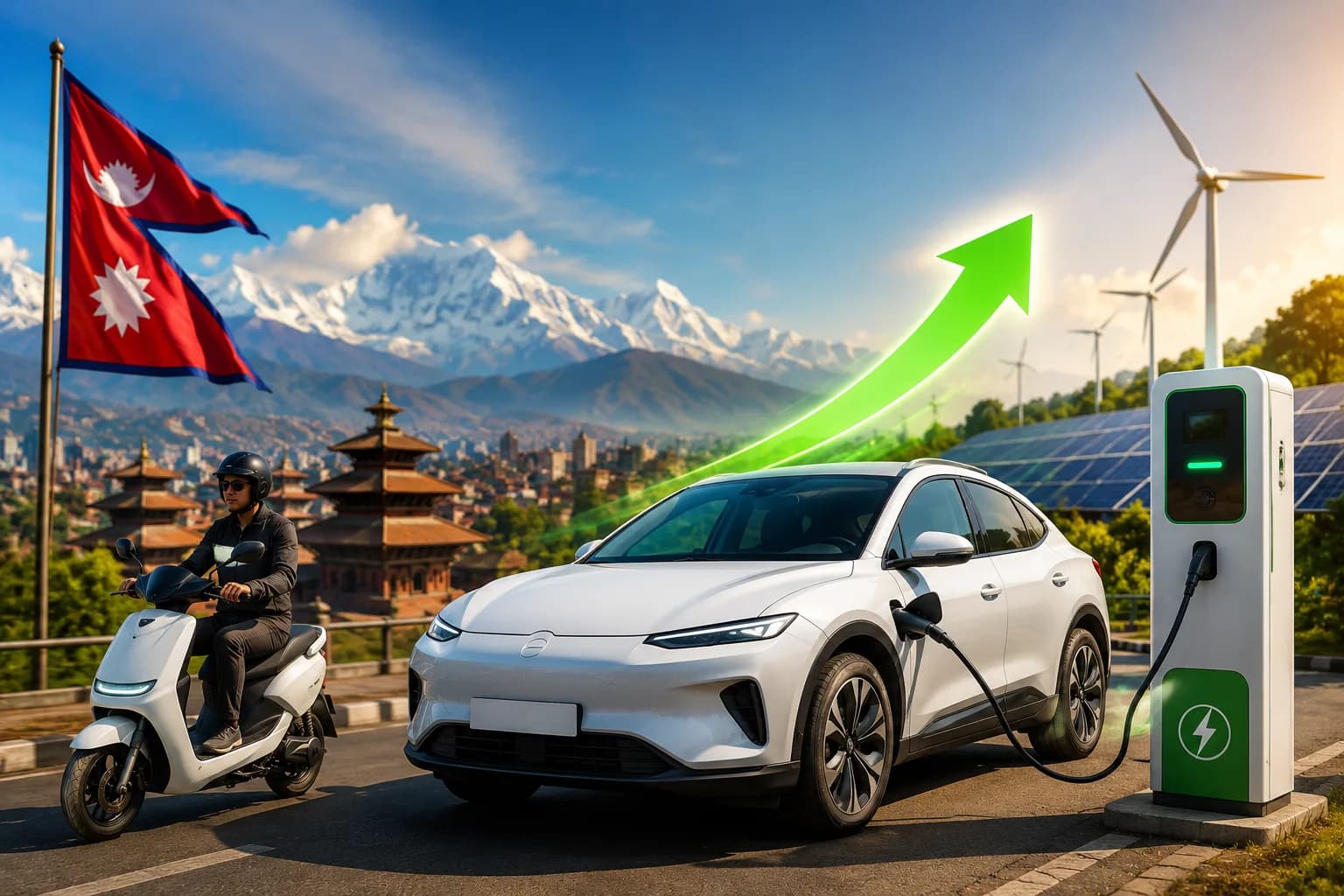
Nepal could save around Rs 53.66 billion every year in foreign currency if 30 percent of vehicles in the transport and freight sector were shifted from petrol and diesel to electric vehicles, according to an estimate presented by the Nepal Electricity Authority (NEA). The calculation suggests that such a shift could reduce fuel consumption by about 1.4 million litres per day, or roughly 511.7 million litres a year.
The estimate comes as Nepal continues to spend a large amount of money importing petroleum products. During the first 11 months of fiscal year 2025/26, Nepal imported petroleum products worth about Rs 297.8 billion from India, while the country’s total merchandise exports stood at Rs 277.96 billion. Diesel alone accounted for about Rs 152.7 billion of the fuel import bill, showing how strongly Nepal’s transport and economy depend on imported fossil fuels.
How EVs Could Reduce Nepal’s Fuel Bill
According to the NEA presentation, Nepal consumes an average of about 2.22 billion litres of petroleum products annually, with around 80 percent used by the transport sector. If 30 percent of transport and freight vehicles were replaced by EVs, the authority estimates that daily fuel savings could reach around 1.4 million litres. At the estimated fuel value, this could translate into approximately Rs 53.66 billion in annual foreign-currency savings.

The proposal is especially important for Nepal because the country has limited domestic fossil-fuel resources and relies heavily on imports. Reducing petrol and diesel use would therefore not only lower fuel purchases but could also reduce pressure on foreign exchange and the trade balance. Recent customs data show that petroleum products remain one of Nepal’s largest import categories.
Nepal’s EV Market Is Already Growing
Nepal has already seen a major increase in electric vehicle adoption. Department of Customs data show that 10,845 electric vehicles worth Rs 25.55 billion were imported during the first 11 months of fiscal year 2025/26. The imports included vehicles across different power categories, showing that EVs are moving beyond a small niche in Nepal’s automobile market.
The growth has continued over several years. Customs figures cited in recent reporting show that EV imports increased from 2,940 units in fiscal year 2019/20 to 44,509 units by fiscal year 2024/25. Electric cars, scooters, vans and other vehicles are becoming increasingly visible on Nepali roads, particularly in urban areas.
Nepal also has an important advantage in the EV transition: its electricity system is increasingly based on hydropower. The NEA has previously highlighted the potential of using electricity to replace imported petroleum and reduce dependence on fossil fuels. The authority has also been expanding the infrastructure needed to support electric mobility, including public charging facilities.
But the Rs 53.66 Billion Figure Is an Estimate
The Rs 53.66 billion figure should not be understood as money Nepal will automatically save if EV numbers increase by 30 percent. It is a projection based on the assumption that 30 percent of transport and freight vehicles can actually be replaced with electric alternatives and that the resulting fuel savings occur as estimated.
There are also practical challenges. Heavy trucks are among Nepal’s biggest diesel consumers, but electric trucks still face issues involving purchase cost, battery capacity, charging time, range and performance on long-distance and steep routes. Experts have therefore questioned whether every type of petrol- and diesel-powered vehicle can be replaced by an EV at the same pace.
Charging infrastructure is another major requirement. Nepal needs more reliable charging stations, stronger distribution networks and policies that encourage long-term investment in electric transport. The NEA has already introduced regulatory changes related to public EV charging stations, showing that infrastructure development is becoming part of the country’s broader electricity strategy.
EVs Could Also Reduce Pollution
The financial benefit is only one part of the argument for electric mobility. The NEA estimate says replacing 30 percent of transport and freight vehicles with EVs could reduce carbon emissions by about 3,575 tonnes per day, or around 1.3 million tonnes annually. The authority has also estimated that the reduction could create potential revenue through carbon credits.
Nepal’s growing EV market is therefore linked to several national goals: reducing imported fuel consumption, keeping more foreign currency inside the country, making greater use of domestic electricity and reducing transport-related pollution. However, achieving these benefits will require consistent policies, charging infrastructure and suitable electric alternatives for everything from motorcycles and cars to buses and heavy trucks.
What This Means for Nepal
The NEA’s Rs 53.66 billion estimate highlights a bigger economic opportunity behind Nepal’s EV transition. A larger shift toward electric mobility could reduce the country’s dependence on imported petrol and diesel while increasing domestic electricity consumption.
However, the transition will need to be planned rather than driven only by vehicle imports. Nepal will need reliable charging networks, affordable EVs, stronger electricity distribution, better public transport and electric options for heavy vehicles. If these challenges are addressed, the shift to EVs could become more than an environmental policy—it could become an important part of Nepal’s strategy to reduce its fuel import bill and strengthen energy security.
Published Aug 9 in Nepal