
One Year Ago, Nepal Turned to Sushila Karki After Gen Z Protests Changed the Country
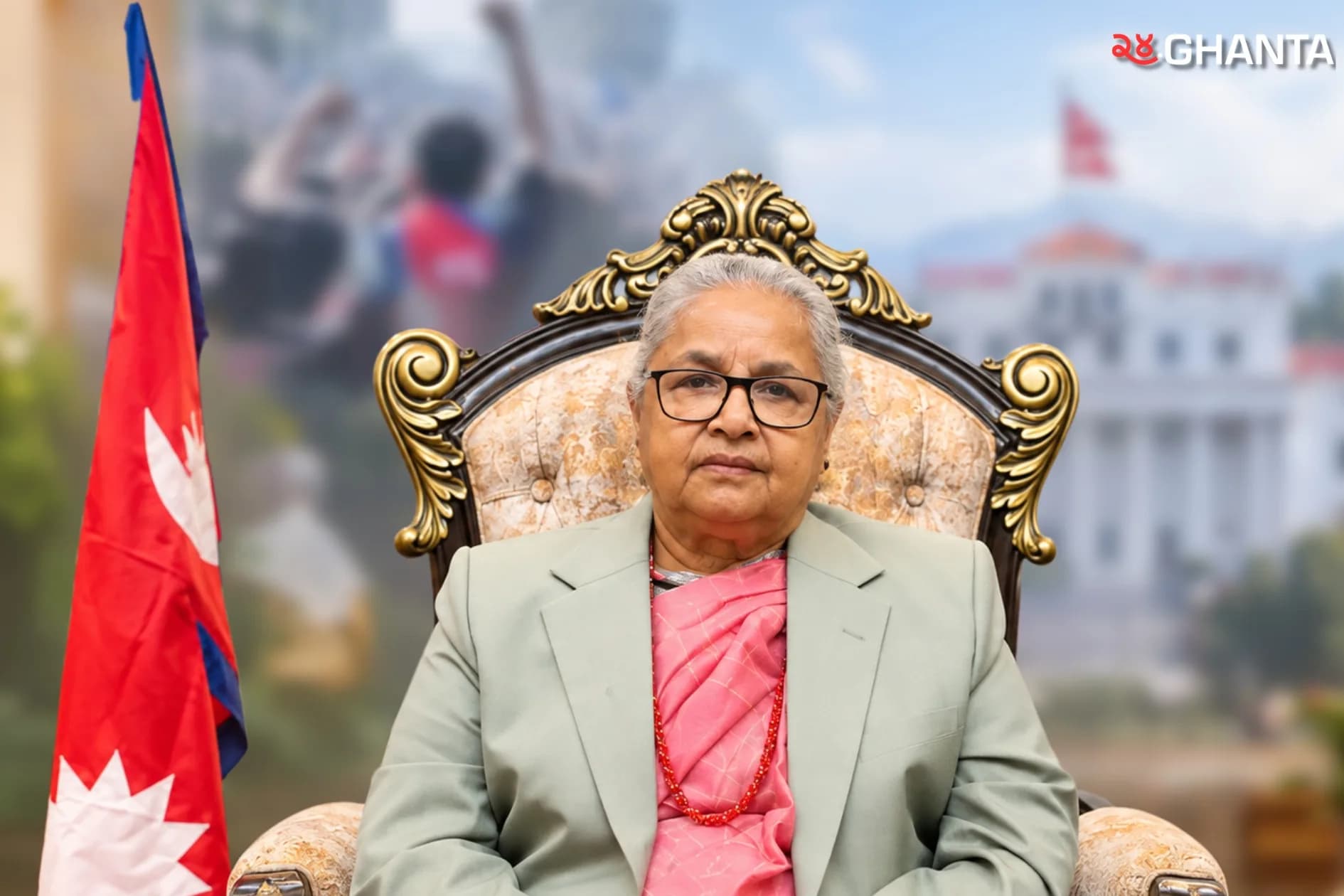
One year ago, on September 12, 2025, former Chief Justice Sushila Karki was sworn in as Nepal’s first woman Prime Minister, taking charge of an interim government after the Gen Z movement, deadly unrest and the resignation of KP Sharma Oli pushed the country into an extraordinary political crisis. Karki, already known as Nepal’s first female Chief Justice and for her strong anti-corruption image, was given the immediate responsibility of restoring stability and taking the country toward a new House of Representatives election within six months.
· 7 min read
KATHMANDU, NEPAL, SEPTEMBER 13, 2026
On Bhadra 27, 2082 (September 12, 2025), former Chief Justice Sushila Karki was appointed Prime Minister of Nepal’s interim government by President Ramchandra Paudel and took her oath at the President’s Office, Sheetal Niwas, Kathmandu, becoming the first woman in Nepal’s history to lead the government. She was chosen during an extraordinary national crisis after the Gen Z-led movement against corruption, poor governance, and a controversial social-media ban grew into deadly unrest, forced then-Prime Minister KP Sharma Oli to resign, and created an urgent need for a transitional government capable of restoring stability and taking Nepal toward a fresh election.

A Protest That Changed Nepal’s Political Direction
The political change came after young Nepalis took to the streets in Bhadra 2082 (September 2025). Although the immediate trigger was the government’s restriction on major social-media platforms, the anger went much deeper, with protesters raising concerns about corruption, unemployment, inequality, lack of opportunity and frustration with Nepal’s established political leadership.
The demonstrations turned deadly. Early reports at the time of Karki’s appointment counted 51 deaths, but the toll was later revised upward as more victims died from their injuries. The unrest also saw government offices, political party buildings and private properties attacked or burned, while security forces and the Nepali Army were deployed as the country faced one of its most serious political crises in years.
Why Gen Z Backed Sushila Karki
Karki was not a traditional party politician. That became one of the main reasons her name gained support among sections of the youth movement.
As negotiations continued over who should lead the transition, Karki emerged as a preferred candidate among Gen Z representatives. Young people also discussed and voted on possible leaders through online platforms including Discord, an unusual feature of a political transition driven heavily by a digitally connected generation.
Her reputation as a former judge willing to challenge powerful political interests and her public image as a strong opponent of corruption helped make her acceptable to many protesters. After discussions involving the President, Gen Z representatives, political stakeholders and the Army leadership, her name moved forward.
Nepal Got Its First Woman Prime Minister
When President Ramchandra Paudel appointed Karki on Bhadra 27, 2082 (September 12, 2025), she made history for a second time.
She had already become Nepal’s first female Chief Justice in 2016. Nine years later, she became the country’s first woman Prime Minister, moving from the highest position in Nepal’s judiciary to the highest position in its executive government.
The President’s official appointment stated that the decision was made to respond to the country’s “extraordinary circumstances,” the wishes and aspirations expressed by the younger generation, and consultations with political parties and other stakeholders. The interim government was given a central mandate: conduct another House of Representatives election within six months.
Her Appointment Was Constitutionally Unusual
Karki’s appointment was also one of the most unusual constitutional moments since Nepal adopted its current Constitution in 2015.
Normally, the Prime Minister is appointed through Article 76, which lays out the process for forming a government based on the composition of the House of Representatives. But Karki’s appointment came during circumstances that the Constitution did not clearly anticipate.
The President relied on his broader constitutional responsibility under Article 61, including the duty to protect and uphold the Constitution and promote national unity. The decision was therefore viewed as an emergency political and constitutional solution, but it also generated debate among constitutional experts about its legal basis.
Parliament Was Dissolved the Same Night
Hours after Karki took office on Bhadra 27, 2082 (September 12, 2025), another major decision followed.
On her recommendation, President Paudel dissolved the House of Representatives effective from 11:00 PM that night and set Falgun 21, 2082 (March 5, 2026) as the date for a new parliamentary election.
This made the purpose of the interim administration clear: stabilise the country after the uprising and prepare the way for Nepalis to choose a new House through an election.
From Biratnagar to Nepal’s Highest Offices
Karki’s journey to the Prime Minister’s Office had begun decades earlier.
Born in 1952 in Biratnagar, she studied political science before completing her legal education. She later taught at Mahendra Multiple Campus in Dharan, practised law and became involved in Nepal’s democratic movement against the Panchayat system. She was also briefly imprisoned during her political activism.
Her judicial career eventually took her to the Supreme Court. She became a temporary Supreme Court justice in 2009, later a permanent justice, and eventually became Nepal’s first female Chief Justice in July 2016.
A Reputation Built Around Tough Decisions
Before becoming Prime Minister, Karki had developed a public reputation for taking strong positions on corruption and government accountability.
Among her important judicial cases was the 2012 corruption conviction of then minister Jaya Prakash Prasad Gupta. Her judicial career also included major cases involving public appointments, anti-corruption institutions and accountability, helping build her image as a judge willing to confront politically powerful figures.
That reputation was tested in 2017, when lawmakers from the Nepali Congress and CPN (Maoist Centre) registered an impeachment motion against her while she was Chief Justice. The Supreme Court later issued an interim order allowing her to return to work, and the impeachment effort did not remove her from office.
From Chief Justice to Prime Minister
Karki had retired from the judiciary years before the Gen Z uprising. Few would have expected that she would later return to public office as the person asked to guide Nepal through one of its most difficult political transitions.
Her official government profile describes her new responsibility as restoring peace and stability, strengthening good governance, controlling corruption and creating the conditions for a stable democratic government through elections.
Her rise was particularly historic because she had broken two of Nepal’s biggest political and institutional barriers: first woman Chief Justice and first woman Prime Minister.
Her First Days Began After a Damaged Singha Durbar
Karki formally assumed office on Bhadra 29, 2082 (September 14, 2025), two days after taking the oath. But even the place from which she began working reflected the scale of the crisis Nepal had just experienced.
Because the Prime Minister’s Office had been damaged during the unrest, she began her official duties from the Home Ministry building inside Singha Durbar. Before taking charge, she visited the Martyrs’ Memorial at Lainchaur.
Her government also declared those killed during the Gen Z movement as martyrs, announced Rs 10 Lakh in immediate support for each bereaved family, and directed that injured protesters receive free medical treatment.
The Message Karki Gave After Taking Power
In her first major public remarks after becoming Prime Minister, Karki acknowledged that the uprising reflected deeper failures in Nepal’s system.
She linked the protests to growing public frustration over corruption and failures to deliver good governance and prosperity, while promising greater transparency, corruption control, employment opportunities, development and improvements in people’s quality of life.
For a generation demanding change, those promises placed a huge responsibility on an interim government that had been formed in exceptional circumstances.
A Day That Entered Nepal’s History
Bhadra 27, 2082 (September 12, 2025) was therefore about much more than the appointment of another Prime Minister.
It marked the day a former Chief Justice with no traditional party route to the premiership became Nepal’s first woman head of government, following a youth-led uprising that shook the country’s established political order.
For Sushila Karki, it was the second major “first” of her public life. For Nepal, it became a historic moment when a political crisis, a new generation’s demands and an unprecedented constitutional situation came together to reshape the country’s leadership.
One year later, Bhadra 27 remains one of the defining dates of Nepal’s Gen Z political movement and of Sushila Karki’s extraordinary journey from the courtroom to the Prime Minister’s chair.
Published 2 hours ago in Politics