
Over 800 Rare Nepali Documents Return Home After Decades in German Collection
More than 800 historical Nepali manuscripts and documents dating from the 13th to the 20th century have been formally handed over to Nepal’s National Archives after decades in the private collection of German collector Josef Peter Rindfleisch. The archive includes centuries-old palm-leaf records, royal orders, legal documents, manuscripts and travel accounts that provide valuable evidence of Nepal’s political, legal, social and cultural history.
· 4 min read
Kathmandu, October 2, 2026
Nepal Recovers a Major Historical Collection
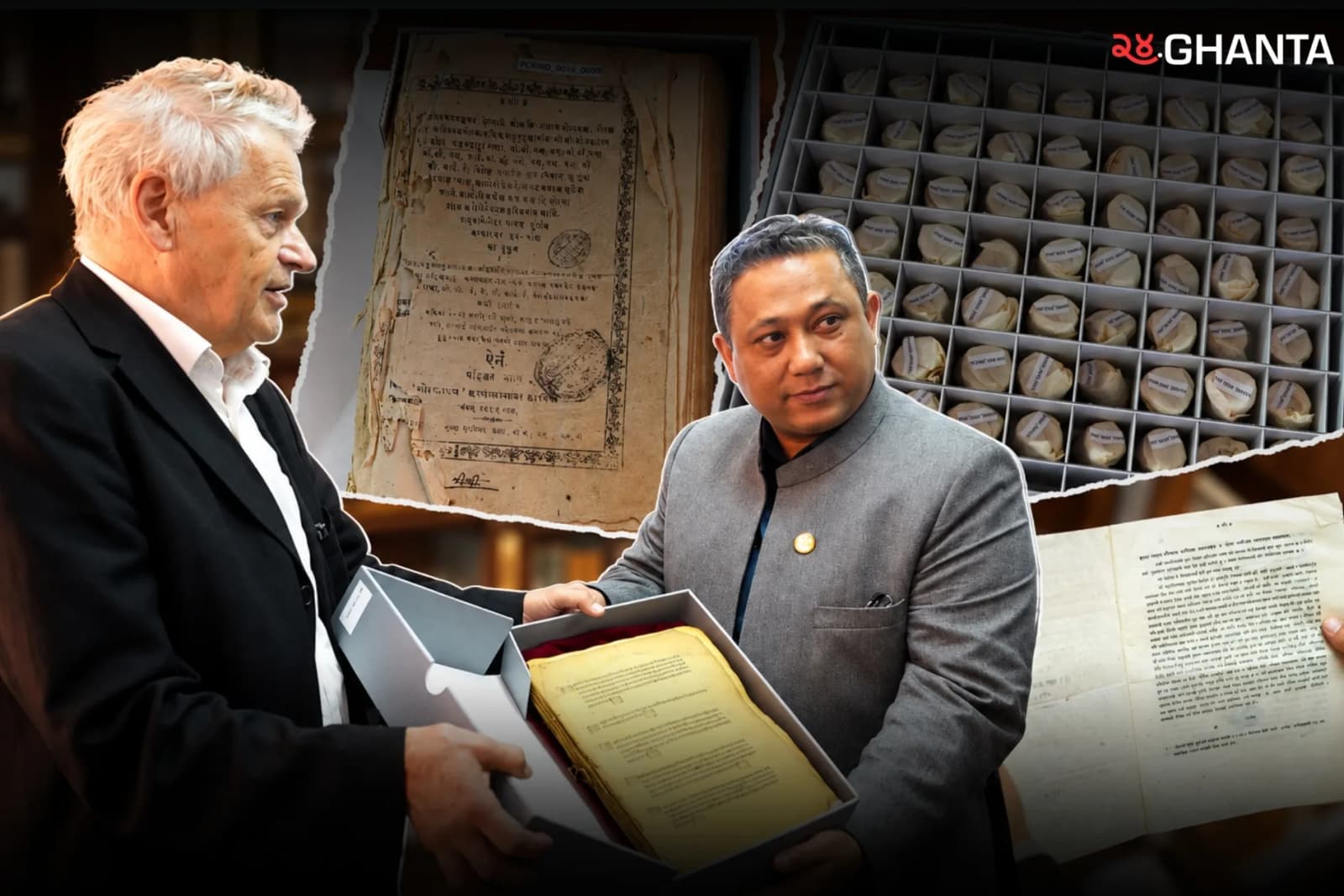
More than 800 rare Nepali manuscripts and historical documents collected by late German collector Josef Peter Rindfleisch have been formally handed over to Nepal’s National Archives in Kathmandu, with Professor Dr. Axel Michaels of Heidelberg University and the Heidelberg Academy of Sciences and Humanities presenting the collection to Foreign Minister Shisir Khanal on Friday. Dating from the 13th to the 20th century, the materials were returned to preserve Nepal’s written cultural heritage and restore the originals to their country of origin.
What Exactly Has Returned to Nepal?
The collection is known as the Josef Peter Rindfleisch Collection and contains documents spanning several centuries of Nepali history.

According to Heidelberg's detailed catalogue, the collection contains 465 palm-leaf rolls, 317 paper documents and 14 major archival volumes, alongside other historical materials.
The palm-leaf records are particularly significant. Many date to the Malla period and document matters such as land transactions, loans, property transfers and other legal agreements.
The paper collection contains royal decrees, official orders, land grants, contracts and petitions largely associated with the Shah and Rana periods.
Some Records Date Back to the 1200s
The oldest materials in the collection date to the 13th century, making parts of the archive more than 700 years old.
Heidelberg researchers say the collection includes some of the oldest surviving legal documents from the Kathmandu Valley.
Its contents provide researchers with evidence about subjects ranging from law, taxation, land ownership and religious endowments to state administration, military service, caste, diplomacy and everyday social history.
Who Was Josef Peter Rindfleisch?
Josef Peter Rindfleisch was a Bavarian businessman and philatelist who assembled the collection mainly during the 1980s and 1990s.
This is an important distinction: the collection was not assembled beginning in the 1780s. Rather, the historical documents themselves span the 13th through 20th centuries.
Rindfleisch wanted the collection eventually returned to Nepal. His son Walter Rindfleisch later reaffirmed that wish, helping set the repatriation process in motion.
How the Documents Reached Heidelberg
In February 2018, the materials were entrusted to Professor Axel Michaels at Heidelberg University for scholarly assessment, preservation and cataloguing.
At the time, researchers had limited reliable information about exactly how individual documents in the collection had originally been acquired and removed from Nepal.
Because many of the manuscripts were extremely old and fragile, conservation became a priority before they could safely make the journey home.
Years Spent Saving Fragile Manuscripts
Researchers and conservation specialists at Heidelberg spent years documenting and protecting the collection.
A condition survey was conducted in 2022, followed by extensive conservation work in 2023.
The palm-leaf documents were carefully humidified, cleaned and repaired where necessary using conservation materials. Several bound volumes also required treatment for mould damage.
The collection was subsequently digitized, allowing researchers to study the materials even after the physical originals returned to Nepal.
First Formally Returned in April
The legal handover process took a major step on April 24, 2026, at Heidelberg University's Centre for Asian and Transcultural Studies in Germany.
Sagar Prasad Phuyal, Chargé d’Affaires at the Embassy of Nepal in Berlin, and Professor Michaels signed the formal agreement transferring the collection to the Nepali state.
The physical collection has now reached Nepal and was formally presented to the National Archives on October 2.
Originals Stay in Nepal, Digital Copies Remain Accessible
The original documents will be preserved at Nepal's National Archives, bringing the physical historical materials back under Nepal's care.
Their digital reproductions and catalogue information will remain accessible through Heidelberg's research infrastructure, allowing scholars in Nepal and around the world to continue studying the collection without repeatedly handling the fragile originals.
This means repatriation will not end international research access to the archive.
Why These Documents Matter
Foreign Minister Khanal described the return as an important milestone for the preservation, protection and promotion of Nepal's written cultural heritage.
Beyond their age, the documents provide first-hand historical evidence about how Nepalese society, government and legal institutions operated over several centuries.
They cover the Malla, Shah and Rana periods and contain materials written in languages including Newari, Nepali, Sanskrit and English.
A Joint Nepal-Germany Effort
The repatriation involved cooperation among Nepali and German institutions, including the Embassy of Nepal in Berlin, Heidelberg University, Heidelberg Academy of Sciences and Humanities and Nepal's National Archives, alongside scholars and conservation specialists.
Friday's ceremony was jointly organized by the National Archives, Heidelberg Centre for Transcultural Studies, Heidelberg Academy of Sciences and Humanities and Saraf Foundation.
German Ambassador to Nepal Udo Eugen Volz, National Archives Director General Ram Bahadur Kunwar, Professor Michaels, government officials, researchers and cultural experts were among those attending.
More Nepali Heritage Could Come Home
Khanal said the government remains committed to efforts to repatriate Nepali historical antiquities held around the world.
The Rindfleisch collection is particularly significant because it combines physical repatriation with years of conservation, cataloguing and digitization.
After decades abroad and years of restoration in Germany, more than 800 pieces of Nepal's written history are now back where their stories began.
Published 1 hour ago in Nepal