
Sunsari Clash Reminds Nepal Why Unity Must Come Before Religious Division
The Sunsari clash has reminded Nepal that peace, religious tolerance and national unity must come before differences as communal tension raises concerns over the country’s secular identity.
· 5 min read
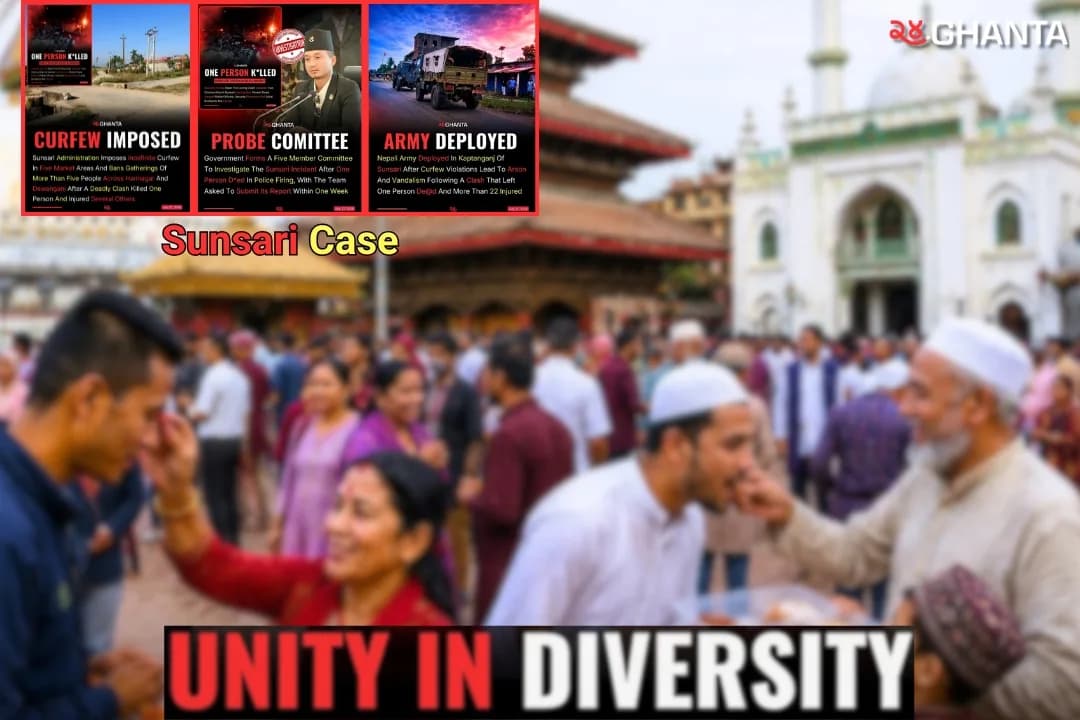
KATHMANDU, July 28 — The recent communal violence in Sunsari on July 27 has once again reminded Nepal of the urgent need to protect social harmony, religious tolerance and national unity as tensions between communities in Dewanganj and nearby areas led to curfews, vandalism, arson and public fear.
The incident reportedly began from a local religious dispute in Kaptanganj of Dewanganj Rural Municipality-3. What started as tension over religious symbols and sound systems quickly escalated into stone pelting, police action and wider unrest in parts of Sunsari.
One person, identified as 24-year-old Om Prakash Mehta, died after being hit by gunfire during police action, while several civilians and security personnel were injured. After the clash, local authorities imposed curfew in sensitive areas to prevent further violence.

A Local Dispute With A Bigger Warning
The Sunsari incident should not be seen only as a one-day clash between two groups. It is a warning sign for Nepal’s social fabric.
Nepal has always been a country where people of different religions, cultures, languages and traditions have lived together with mutual respect. Hindu, Muslim, Buddhist, Kirat, Christian and many other communities have all contributed to Nepal’s history, identity and culture.
This diversity is not a weakness. It is Nepal’s greatest strength.
But when small disagreements are allowed to turn into violence, that strength begins to weaken. Disputes over flags, processions, sound systems or religious expression should be solved through dialogue, local coordination and legal process, not through anger, retaliation or mob action.
Peace Must Come Before Differences
Every community has the right to practice its religion with dignity. At the same time, every community also has a responsibility to respect the beliefs, sensitivities and safety of others.
If one group feels unsafe, the whole society becomes weaker. If one community is targeted, Nepal’s unity is damaged. If religious identity is used to provoke anger, ordinary citizens from all sides suffer the most.
The answer to such disputes is not blame. The answer is communication, restraint and justice.
Local governments, religious leaders, security agencies and civil society must work together before tension turns into violence. Sensitive issues should be addressed early, especially in areas where different communities live closely together.
Nepal’s Secular Identity Must Be Protected
Nepal declared itself a secular and inclusive state on Jestha 4, 2063 BS. That identity can only remain meaningful if every citizen feels equally respected, regardless of religion, caste, ethnicity or culture.
If religious disagreements continue to turn into repeated conflict, Nepal’s secular identity will be weakened. A country cannot proudly call itself inclusive if its people begin to fear each other because of faith.
The danger is not only one incident. The bigger danger is the gradual normalization of religious division.
If Nepalis continue fighting among themselves over religion, the day may not be far when Nepal begins to look like countries where religion becomes stronger than nationality. That would be a dangerous path for a country whose real strength has always been coexistence.
Nepal must never reach a point where people identify each other first by religion and only later as Nepali.
Social Media And Rumors Add Risk
In today’s time, local disputes can spread very quickly through social media. Videos, rumors, and emotional posts can make a tense situation worse before verified information becomes public.
This is why citizens, media outlets, and public figures must act responsibly. Sharing unverified content during communal tension can increase fear and anger. Words used online can affect real lives on the ground.
At such moments, responsible communication matters as much as police deployment. People should wait for verified information and avoid posts that target any religious or cultural community.
State Response Must Be Fair
The government and security agencies must also act with fairness and sensitivity. When communal violence happens, the state must investigate the facts clearly, hold those responsible accountable, and ensure that no innocent person is targeted because of their identity.
People from every community must feel that the law protects them equally.
A fair investigation is important not only for justice, but also for rebuilding trust. If people believe the state is biased or slow, tension can return.
Nepal’s Future Depends On Unity
Nepal has faced many difficult moments in history, but its people have repeatedly shown the ability to live together. Shared festivals, mixed neighborhoods, common markets, schools and friendships have long connected communities across the country.
That spirit must not be lost.
The Sunsari clash should become a moment of reflection, not a reason for further division. Political leaders, religious groups, media and citizens all have a responsibility to calm the situation and protect Nepal’s unity.
Nepal belongs to all Nepalis. No religion, culture or community should be made to feel less important in the national story.
At a time when the country is trying to move forward, peace must come before provocation, dialogue must come before violence, and nationality must come before division.
Published Jul 28 in Opinion