
Sunsari Incident, Regional Outburst Of Communal Violence, Historical Precedence & The Future
· 9 min read
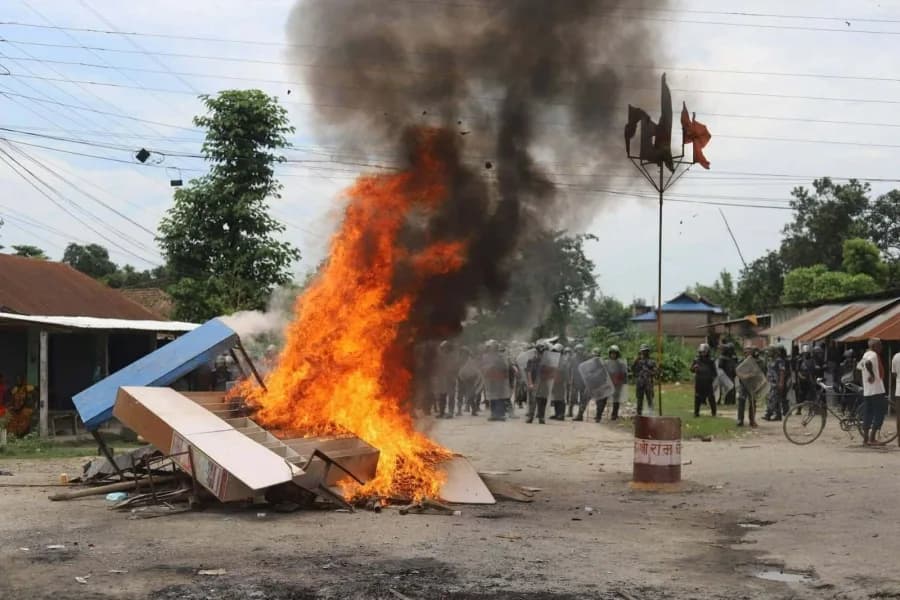
On the night of July 26, 2026, a confrontation in Dewanganj Rural Municipality, Sunsari, began as what appeared to be a local dispute during a Hindu Bolbam procession but within days, it had spread beyond Sunsari into several districts of the Terai, prompting curfews, highway blockades, political intervention and renewed debate over communal relations and police use of force in Nepal.
For many of us, the incident raised many questions, but more than the incident, the shocking escalation in a matter of not even days but hours. This raised many questions: of precedence, communal environment, and communities in the Terai region.

The answer, I believe is more complicated than the events of one evening. After the escalation that occurred in many places, the Sunsari Incident cannot be looked upon in isolation, as it carries historical context, precedence and many more. Understanding the present therefore requires looking at both the incident itself and the broader historical context that allowed it to resonate far beyond Dewanganj.
The Sunsari incident
According to police, local officials and multiple media reports, the violence began when a Bolbam religious procession returning from the Koshi Barrage passed through Kaptanganj in Dewanganj Rural Municipality.
Accounts differ on the precise trigger. Witnesses and local residents have pointed to disagreements over loud music played during the procession, while other reports mention disputes involving religious flags and allegations of provocation between members of the two communities. What is clear is that tensions quickly escalated into stone-pelting and confrontation between groups of local Hindu and Muslim residents.
Security personnel from Nepal Police and the Armed Police Force were deployed to control the situation. As violence intensified, the Armed Police Force opened fire. The firing left Om Prakash Mehta, 30, dead at the scene while several civilians sustained gunshot wounds. The death tally now has reached 2. A number of security personnel were also reportedly injured during the clashes. But after the incident, the police firing quickly became the centre of public attention.
Questions emerged over whether live ammunition was necessary, whether less-lethal options had been exhausted and whether some victims had been struck above the waist. Human rights observers and several political leaders called for an independent investigation, arguing that every use of lethal force by security agencies should be examined transparently.
Rather than calming tensions between two communities, the death became a rallying point. Over the following days, demonstrations spread into neighbouring districts including Siraha, Dhanusha, Saptari and Parsa. Several districts imposed curfews or prohibitory orders as authorities attempted to prevent further violence.
Shops closed, highways were temporarily blocked in some areas and additional security personnel were deployed across the southern plains. But people still left their homes, buildings were set ablaze, and bullets were fired; again.
The political response came under major scrutiny. Opposition parties criticised the government's handling of the crisis, arguing that senior leaders had reacted too slowly and failed to engage affected communities before tensions spread. Supporters of the government argued that political actors were attempting to exploit the incident to inflame communal sentiment.
The Home Ministry responded by recalling local security officials, forming an investigation committee and dispatching senior officials to Sunsari. As protests continued, Home Minister Sudan Gurung travelled to Sunsari and held discussions with the families of those killed.
On July 31, the government and the victims' families reached a seven-point agreement, but a larger question looms over if the demonstrations will come to an end and why the violence spread so quickly.
Why did one incident spread so quickly?
After what followed, the Sunsari violence can simply not be dismissed as a local law-and-order issue. Several factors allowed the incident to resonate across the Terai.
First, the dispute involved religious symbols and public processions, issues that have repeatedly become flashpoints in different districts over recent years. Arguments over procession routes, loudspeakers, flags and allegations of disrespect toward places of worship often carry symbolic meaning far beyond the immediate dispute.
Second, the death of Om Prakash Mehta changed the public perception of the incident. Before the police firing, many viewed the confrontation as a local clash between two communities. After a civilian was killed by security forces, many people interpreted the incident as a broader question of justice and state accountability.
Third, social media dramatically accelerated the spread of information and misinformation. Videos, photographs and edited clips circulated rapidly across Facebook, TikTok and messaging applications. Some showed police firing. Others showed stone-pelting or property damage. Many clips lacked context or chronology, making it difficult for viewers outside Sunsari to understand what had actually happened. As has happened in previous communal incidents, selective footage often travelled faster than verified information.
Finally, existing religious and political networks helped transform local anger into wider mobilisation. Religious organisations, local activists and political groups organised demonstrations in solidarity with the victims. While many protests remained peaceful, others descended into violence, leading authorities to impose curfews in additional districts.
The historical background
Communal violence has not been a defining feature of Nepal's modern history. For centuries, Hindu and Muslim communities lived alongside one another across the Terai, particularly in trading towns and agricultural settlements. Interdependence through commerce, farming and local governance generally outweighed religious conflict.
That history is important because it shows that today's tensions are not inevitable or ancient. They are shaped by more recent political, social and institutional developments.
One of the first major modern communal crises occurred in 2004, after twelve Nepali workers were killed by militants in Iraq. Public anger quickly turned into attacks on businesses, manpower companies and Muslim-owned properties in several parts of Nepal.
The riots demonstrated how events have a domino effect and could rapidly transform into domestic communal violence through rumour, emotion and collective blame. A few years later, Nepal entered another period of instability during the Madhesh Movement.
Beginning in 2007, protests across the Terai demanded greater political representation, federal restructuring, citizenship reforms and an end to the historical exclusion of Madheshi communities from state institutions. The Madhesh Movement was fundamentally a political movement rather than a religious one.
However, the prolonged confrontation between protesters and the state created deep distrust toward security agencies throughout the region. That distrust became even more significant during the promulgation of Nepal's new Constitution in 2015.
Large demonstrations erupted across the Terai over constitutional issues including provincial boundaries, citizenship and representation. Police, as precedented, responded with force in several districts. Dozens of people, including protesters, bystanders and security personnel, lost their lives during the unrest.
International organisations including Human Rights Watch criticised aspects of the police response and called for independent investigations into several shootings. These events remain central to understanding present-day perceptions of policing in the Madhesh.
Communal tensions also became more visible during the past few years. In 2023, incidents in Dharan, Malangawa and Nepalgunj highlighted how religious processions, provocative speeches, social media content and rumours could rapidly generate confrontation between communities.
Many of these disputes followed a similar pattern. A local disagreement would emerge. Videos or allegations would circulate online. Political and religious organisations would mobilise supporters. Demonstrations would be followed by counter-demonstrations. Police intervention would then become another source of controversy. The Sunsari incident fits into this broader pattern rather than standing alone.
The challenge of policing communal violence
Communal violence presents one of the most difficult situations faced by any police force. Security personnel have a legal duty to protect lives, prevent attacks on people and property and restore public order.
At the same time, international human rights standards make clear that live ammunition should only be used when absolutely necessary to protect life from an imminent threat.
This creates a high threshold for police use of lethal force. Every police shooting should therefore be independently investigated—not because every shooting is unlawful, but because the use of deadly force carries the highest level of responsibility.
The same principle applies to those participating in violence. Peaceful protest is protected under democratic principles. Arson, assault, attacks on places of worship and violence against civilians are criminal acts regardless of the identity or motivation of those responsible. Accountability should therefore remain individual rather than collective. Entire communities cannot be held responsible for the actions of a small number of individuals.
Where Nepal goes from here
The agreement reached between the government and the victims' families may help calm immediate tensions, but it cannot by itself resolve the deeper issues revealed by the crisis.
A credible and transparent investigation into the Sunsari shootings remains essential. The public will expect clear answers regarding the sequence of events, the command decisions made that night and whether security personnel acted within the law. If excessive force was used, those responsible should be held accountable. Likewise, individuals responsible for violence, arson or attacks on civilians should also face legal consequences.
Beyond accountability, Nepal may need to reconsider how communal tensions are managed before they become crises. Local administrations could strengthen dialogue with religious leaders before major festivals and processions, establish agreed routes and timings, improve communication between communities and intervene earlier when disputes begin to emerge.
Police training is another important area. Modern crowd management increasingly emphasises negotiation, de-escalation and less-lethal methods wherever possible. Live ammunition should remain an absolute last resort used only when there is an imminent threat to life.
The events in Sunsari also highlight the growing influence of social media. False information, edited videos and inflammatory posts can spread much faster than official clarification. Improving public communication during crises may therefore become as important as deploying additional security personnel.
Finally, Nepal's long history of coexistence should not be overlooked.
Despite recent violence, millions of Hindus and Muslims continue to live, work and celebrate alongside one another throughout the Terai. The challenge is not simply preventing the next riot. It is ensuring that local disputes remain local, that institutions respond fairly and transparently, and that no community is made collectively responsible for the actions of a few individuals.
The Sunsari violence has become one of Nepal's most significant communal crises in recent years. Whether it becomes another unresolved chapter in the country's history or a turning point that strengthens accountability, policing and inter-community trust will depend on the decisions taken in the weeks and months ahead. Prime Minister's address to the nation has been a step in the right direction, but the time to act is right now, because in any case, violence and communal hatred cannot and mustn't be the identity of Nepal.
Published Jul 31 in Politics