
Finance Minister Swarnim Wagle Says Nepal Must Build With Its Own Income and Reduce Loan Dependence
Finance Minister Swarnim Wagle says Nepal must increase domestic revenue, expand the tax base and reduce dependence on loans under the Rs 2.124 trillion budget.
· 4 min read
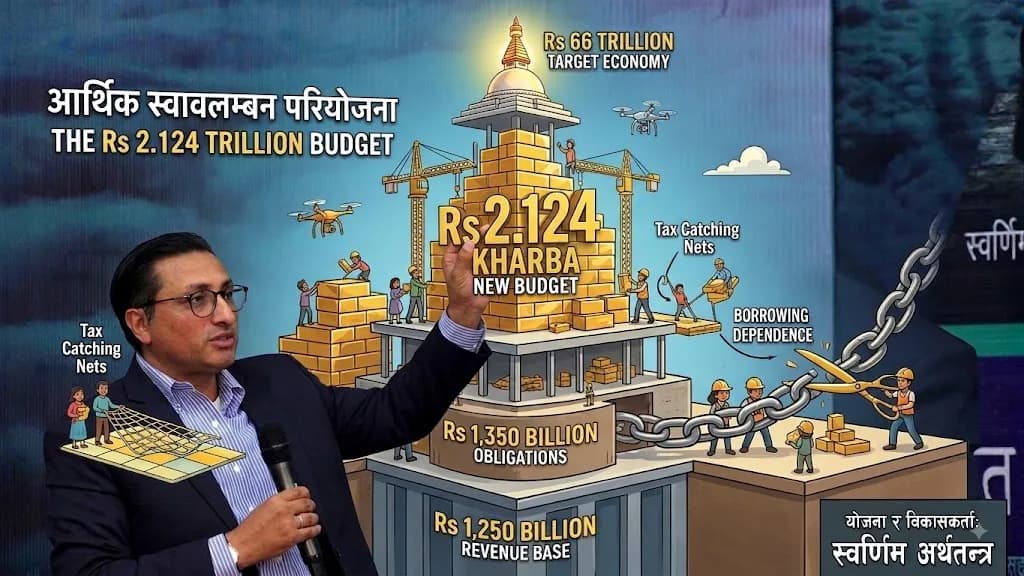
Kathmandu, August 13: Finance Minister Dr. Swarnim Wagle has said Nepal must gradually reduce its dependence on borrowing and strengthen domestic revenue to finance the country’s development. Speaking at the annual review program of the District Coordination Committee in Tanahun on Thursday, Wagle said the government’s new budget is designed to increase revenue, encourage private-sector activity and move Nepal toward greater financial self-reliance.
Wagle said Nepal has traditionally relied on loans to meet essential government expenses, even as the need for development continues to increase. He warned that borrowing from development partners is becoming more expensive, making stronger domestic income increasingly important for the country. According to his remarks, the government has regular and essential financial obligations of around Rs 1,350 billion, while annual revenue is around Rs 1,250 billion, leaving a significant gap that needs to be addressed.
Government Focuses on Expanding Tax Base
The Finance Minister said the government is working to bring more people and businesses into the formal tax system rather than simply increasing the burden on existing taxpayers. Expanding the tax base, encouraging voluntary tax compliance and providing incentives for tax payments are among the measures being pursued to increase government revenue.

Wagle also acknowledged concerns surrounding new taxes and said the government is working to ensure that ordinary citizens do not face unnecessary additional tax liabilities. His message comes as the government seeks to improve revenue collection while keeping the tax system fair and easier for people to follow.
The broader goal, according to Wagle, is to create a system where Nepal can generate enough domestic resources to meet a larger share of its own regular expenses and development needs. He also urged citizens to understand the connection between taxation and public development, saying Nepal cannot expect rapid infrastructure and economic development while avoiding both taxes and borrowing.
Rs 2.124 Trillion Budget Targets Economic Mobilization
The government has presented a total budget of approximately Rs 2.124 trillion for fiscal year 2026/27 (2083/84). The budget targets stronger economic activity, greater private-sector participation and reforms intended to improve the investment environment. The official budget totals Rs 2,124.34 billion, with revenue estimated at about Rs 1,405.31 billion.
The budget also sets an ambitious target of 7 percent economic growth, with the government seeking to revive private investment and increase production. Wagle has argued that the budget should be judged in relation to the size of Nepal’s economy rather than only by its total amount.
A major part of the government’s strategy is to encourage the private sector to invest and help mobilize Nepal’s wider economy. The government has also indicated plans to make it easier for Nepalis living abroad to invest in the country, with measures including diaspora-focused investment instruments and a more favorable investment environment.
Nepal Still Depends on Borrowing
Despite the government’s focus on domestic revenue, the new budget still requires substantial borrowing to cover the gap between expenditure and revenue. Budget figures show that around 66 percent of total spending is expected to come from revenue, while the remaining financing will come mainly through borrowing and foreign grants.
This highlights the challenge facing Nepal: increasing revenue while also creating enough economic growth to reduce the need for debt. The government’s approach is therefore not simply about collecting more taxes, but about expanding economic activity, encouraging investment, improving compliance and increasing the number of people and businesses contributing to the formal economy.
Wagle’s remarks underline a central challenge for Nepal’s economic future: the country wants faster development, but it also needs stronger domestic resources to pay for it. The success of the new budget will ultimately depend on how effectively the government can increase revenue, attract investment and turn its economic plans into actual results.
Published Aug 13 in Politics