
China Rejects Blame Over Rasuwa-Kerung Disaster As Questions Grow Over Warning And Cause
The Chinese Embassy in Nepal has rejected accusations that China failed to warn Nepal before the deadly Rasuwa-Kerung disaster and denied that the flood resulted from the failure of a geological-disaster dam on the Chinese side. However, newer scientific evidence points to a major glacial rock-and-ice collapse, debris flow and temporary upstream river blockage, leaving the exact sequence of events and warning failures under investigation.
· 4 min read
KATHMANDU, NEPAL | AUGUST 27, 2026
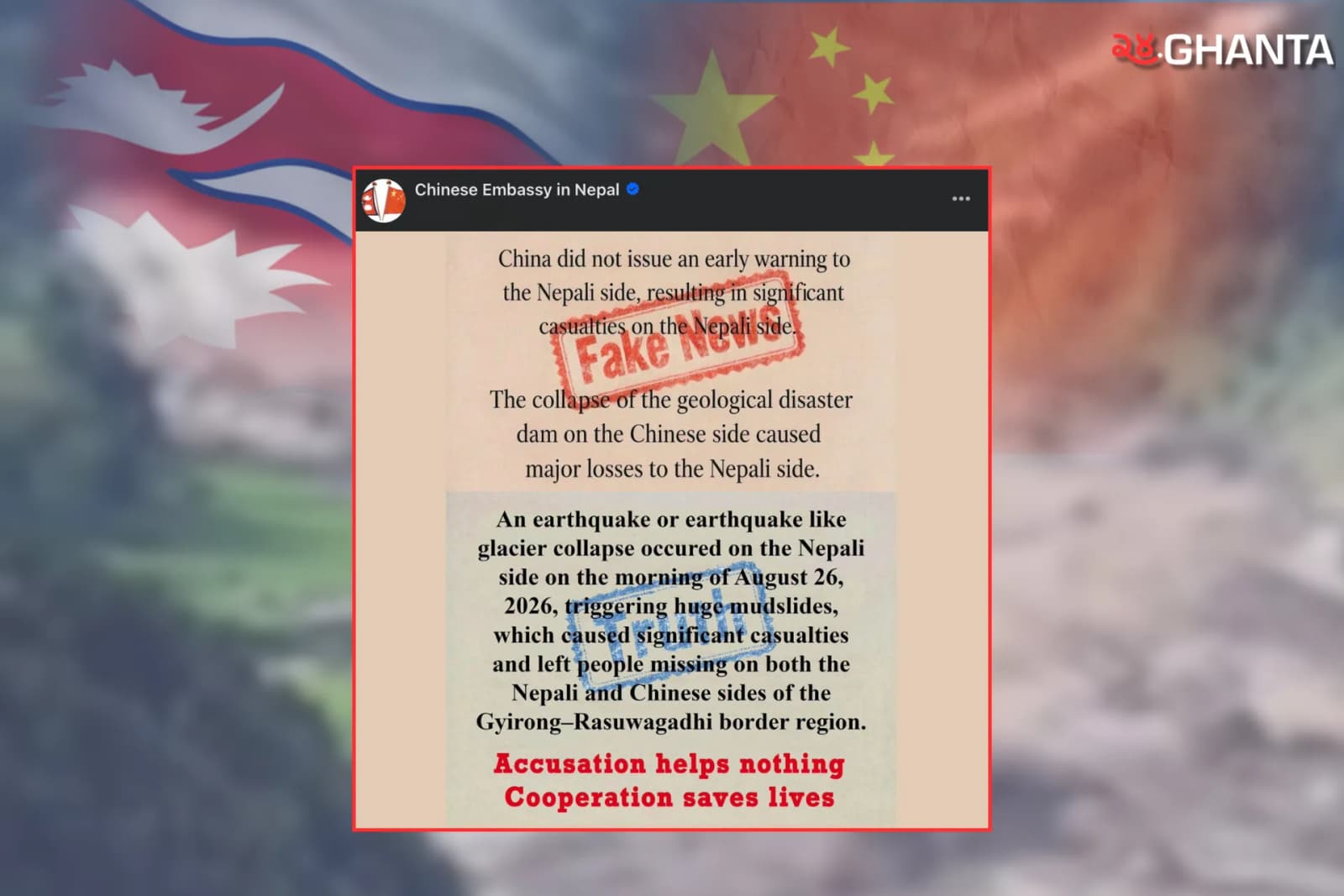
The Chinese Embassy in Nepal on Thursday rejected accusations that China failed to warn Nepal before Wednesday’s deadly Rasuwa-Kerung border disaster, saying claims about a missing early warning and the failure of a geological-disaster dam on the Chinese side were false. The dispute follows the August 26 flood and landslide disaster around Rasuwagadhi-Kerung on the Nepal-China border, where a massive surge of mud, rocks and water caused deaths, disappearances and widespread destruction on both sides, while questions continue over exactly what triggered the event and whether more warning was possible.
China Rejects Early-Warning Claim
The Chinese Embassy said allegations that Nepal suffered heavy casualties because China failed to provide advance warning were false and misleading.

It also rejected claims that the disaster was caused by the collapse of a geological-disaster dam on the Chinese side of the border.
The embassy said the circumstances were more complex than some reports and social-media posts had suggested.
Embassy Gives Different Account Of Cause
According to the embassy, an earthquake or earthquake-like avalanche occurred on the Nepal side on the morning of August 26, which then triggered a massive landslide.
It said the resulting disaster caused casualties and missing people on both the Nepal and China sides of the Rasuwagadhi-Kerung border area.
Scientific Findings Challenge Earthquake Explanation
However, more recent scientific assessments do not fully support the earthquake explanation.
The U.S. Geological Survey said the seismic energy initially interpreted as a magnitude-4.4 earthquake was actually generated by the collapse of glacial rock and ice followed by a debris flow.
Satellite analysis cited by Nepali disaster officials also showed an ice-and-rock landslide affecting the Lhende River around 20 kilometres northeast of the Rasuwagadhi border crossing.
Temporary Lake May Have Formed Upstream
Nepal’s Flood Forecasting Division has also reported preliminary evidence that debris blocked the river upstream in Tibet, creating a temporary lake before the blockage failed and released a sudden surge downstream.
Officials said satellite imagery received from Chinese authorities indicated that the blockage developed upstream from the border before the flood rushed into the Bhotekoshi-Trishuli system.
This is different from saying that a permanent or engineered Chinese “disaster dam” simply collapsed. Current evidence instead points toward a naturally formed debris blockage linked to a large ice-and-rock collapse.
Nepal And China Agree To Share More Information
Following the disaster, Nepali and Chinese officials agreed to strengthen the exchange of meteorological information.
During discussions between Nepal’s Department of Hydrology and Meteorology and the Chinese Meteorological Administration, the Chinese side agreed to immediately inform Nepal about relevant meteorological risks or impacts developing on the northern side.
Officials also noted that there had been no significant rainfall in the affected areas strong enough to clearly explain the scale of the disaster.
Warning-System Questions Remain
The disaster has nevertheless raised wider questions about cross-border warning systems because the destructive surge moved extremely quickly through the narrow Himalayan river corridor.
Nepali authorities reportedly had little time to react once the sudden rise was detected, while hydrological stations along the affected river system later stopped transmitting data.
The incident has therefore renewed calls for faster cross-border data exchange, satellite monitoring and automated warning systems in high-risk Himalayan valleys.
China Calls For Cooperation
The Chinese Embassy urged both sides to focus on rescue, relief and cooperation instead of assigning blame while hundreds of people remain affected.
Its message was that accusations would not resolve the crisis and that cooperation between Nepal and China was more important for protecting lives and supporting disaster response.
Cause Still Under Investigation
The exact chain of events is still being studied.
What is clearer from the latest available evidence is that a major glacial rock-and-ice collapse, landslide and debris flow played a central role, while a temporary upstream blockage may have intensified the destructive flood.
This means claims about responsibility, early warning and the precise location where the disaster began should be treated cautiously until a complete technical investigation is available.
Published Aug 27 in Nepal