
Fitch Ratings Keeps Nepal’s Credit Rating at BB− for Third Consecutive Year Despite Major Disasters and Economic Challenges
Fitch Ratings Has Maintained Nepal’s BB− Credit Rating for the Third Consecutive Year, Supported by Strong Foreign Currency Reserves and Remittances, While Weak Governance, Money Laundering Concerns, and Human Trafficking Risks Continue to Prevent an Upgrade.
· 7 min read
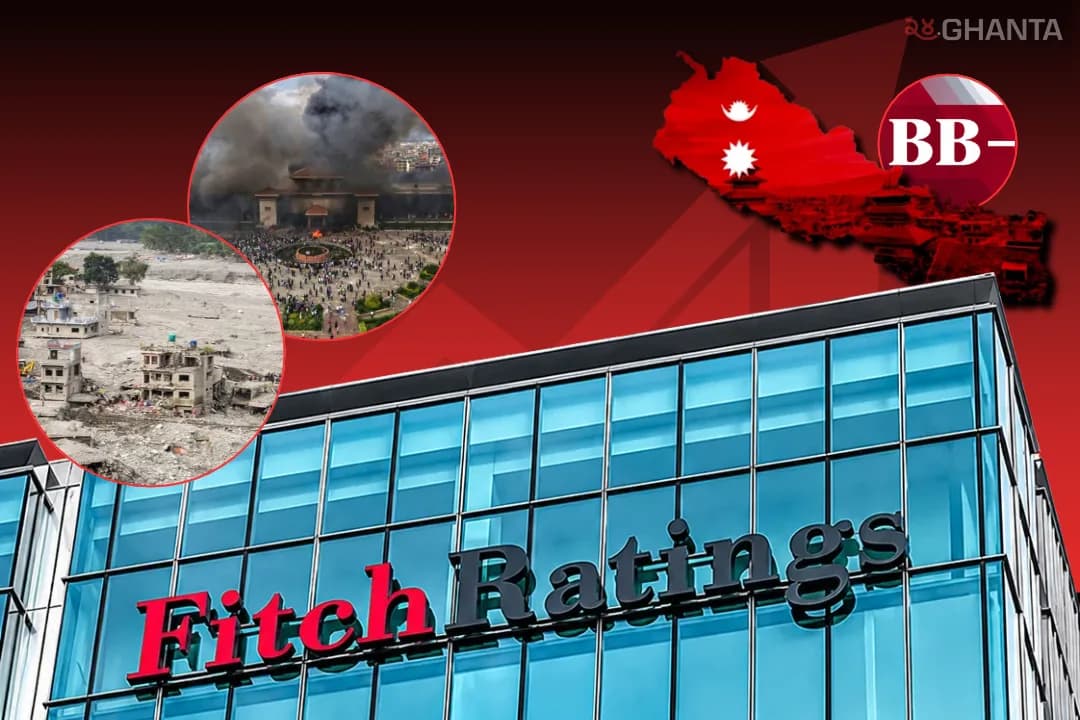
Kathmandu, November 15, 2026 — International credit rating agency Fitch Ratings has maintained Nepal’s long-term sovereign credit rating at BB− (BB minus), despite the country facing major political unrest, devastating floods, and growing economic challenges over the past year.
According to the latest review published on November 12, 2026, Nepal retained the same rating it received in November 2024 and November 2025. Fitch also maintained Nepal’s short-term rating at B and its country ceiling at BB−.
The unchanged rating suggests that Nepal has managed to preserve important elements of economic stability despite recent difficulties. However, it also indicates that the country continues to face significant financial and institutional risks.

What Does Nepal’s BB− Credit Rating Mean?
A sovereign credit rating measures a country's ability and willingness to repay its financial obligations.
Fitch's BB− rating places Nepal in the speculative-grade category, below investment grade. It indicates that the country currently has the capacity to meet its financial commitments but remains vulnerable to economic difficulties, political instability, and unexpected financial shocks.
For Nepal, maintaining the same rating for three consecutive years is considered a positive development, particularly after the challenges experienced in 2025 and 2026.
Chartered accountant Anal Raj Bhattarai described the unchanged rating as an encouraging sign that Nepal's financial position has not deteriorated significantly despite recent crises.
However, maintaining a BB− rating does not mean Nepal's economy is free from risk or that an upgrade is guaranteed.
Political Unrest and Floods Put Pressure on Nepal’s Economy
Nepal experienced two major crises that placed additional pressure on its economy.
The first was the Gen Z-led movement in September 2025, which disrupted businesses and damaged commercial infrastructure, affecting economic activities and investor confidence.
The second was the devastating flooding in August 2026, which caused widespread destruction and created substantial reconstruction requirements.
According to the report, flood-related damage and recovery needs could place a financial burden exceeding Rs. 700 billion (Rs. 7 kharba) on the country.
Despite these challenges, Nepal managed to maintain its previous sovereign credit rating.
Economic analysts consider this a positive indication of the country's ability to withstand major disruptions without experiencing a significant deterioration in its overall creditworthiness.
Strong Remittances and Foreign Currency Reserves Support Nepal’s Rating
One of the major factors supporting Nepal's credit rating is its relatively strong external financial position.
Nepal continues to receive substantial remittance inflows from Nepalis working abroad. These funds help maintain foreign currency reserves and support the country's ability to pay for imports and meet external financial obligations.
According to the analysis cited in the report, Nepal's foreign currency reserves are sufficient to cover approximately 20 to 22 months of imports of goods and services.
This provides an important financial buffer against external economic shocks.
Nepal's public debt position has also helped maintain the rating.
The country's total public debt is estimated at approximately 43–44% of its gross domestic product (GDP), with around half consisting of external debt.
Much of Nepal's external borrowing comes from international development partners, including the World Bank and Asian Development Bank, through relatively affordable, concessional loans.
This reduces the immediate financial pressure associated with expensive commercial borrowing.
Banking Stability Also Helps Protect the Economy
Nepal's monetary and banking conditions have contributed to the country's ability to maintain its credit rating.
Despite concerns that political unrest and economic difficulties could significantly increase bad loans, the banking sector's average non-performing loan ratio reportedly remained around 5–6% during the first quarter of the current fiscal year.
Although this level still presents challenges for financial institutions, the report suggests that the banking system has avoided a more severe deterioration.
Lower interest rates and sufficient liquidity in the banking system could also support business recovery and encourage economic activity.
However, the country's longer-term financial stability will depend on improvements in investment, business confidence, and economic productivity.
Three Major Reasons Nepal Failed to Receive a Credit Rating Upgrade
Although Nepal maintained its existing rating, several structural weaknesses prevented an improvement from BB− to BB.
1. Weak Governance and Institutional Performance
Governance remains one of the major obstacles to Nepal's credit rating improvement.
The report highlights concerns related to corruption control, policy stability, the implementation of legal reforms, and institutional effectiveness.
Nepal's performance in governance indicators remains relatively weak, affecting international confidence in the country's long-term economic management.
According to the analysis, Nepal's governance score is around 31 on the World Bank's relevant governance measures.
Weaknesses in environmental, social, and governance (ESG) performance also contribute to the country's rating limitations.
Improving transparency, accountability, and the implementation of government policies could help strengthen Nepal's future credit assessments.
2. FATF Grey List and Money Laundering Concerns
Nepal's inclusion on the Financial Action Task Force (FATF) grey list is another important concern.
The grey list identifies countries requiring increased monitoring because of weaknesses in their systems for preventing money laundering and terrorist financing.
According to the report, Nepal faces a February 2027 deadline for addressing identified shortcomings.
Remaining on the grey list can create additional difficulties for international financial transactions, investment confidence, and banking relationships.
Analysts believe that addressing these concerns and making progress toward removal from the grey list could improve Nepal's prospects for a future rating upgrade.
3. Human Trafficking Concerns and Climate-Related Financial Risks
International monitoring of Nepal's human trafficking prevention efforts has also raised concerns about the country's institutional performance.
According to the analysis cited in the report, these concerns have contributed to the broader governance-related challenges affecting Nepal's creditworthiness.
Climate change presents another significant economic risk.
Frequent floods, landslides, and other natural disasters can damage infrastructure, disrupt economic activity, and increase government spending on reconstruction.
The estimated Rs. 700 billion in disaster-related recovery requirements illustrates the potential pressure that climate-related events can place on Nepal's public finances.
How Fitch Ratings Evaluates Nepal’s Economy
Fitch uses a combination of economic data and qualitative assessments to determine a country's sovereign credit rating.
Its Sovereign Rating Model examines 18 economic and financial indicators across four major categories.
According to the methodology discussed in the report, the categories carry the following approximate weights:
Rating category | Weight |
|---|---|
Structural characteristics | 53.7% |
Public finances | 19.1% |
External finances | 17.3% |
Macroeconomic performance and policies | 9.8% |
Governance indicators form an important part of the structural assessment.
Fitch also applies qualitative adjustments to account for risks that may not be fully reflected in economic statistics.
These include political developments, institutional weaknesses, and environmental vulnerabilities.
The agency also considers climate-related risks, including flooding, drought, and rising temperatures, when assessing a country's long-term financial resilience.
What Could Help Nepal Achieve a Higher Rating?
Economic analysts believe Nepal has opportunities to improve its sovereign credit rating if it successfully addresses its structural and governance challenges.
The government is reportedly preparing amendments to 59 laws to improve the business environment and simplify administrative procedures.
Effective implementation of these reforms could strengthen investor confidence and improve economic activity.
Progress in combating money laundering, strengthening governance, controlling corruption, and reducing institutional weaknesses could also support a higher rating.
At the same time, maintaining strong foreign currency reserves, managing public debt responsibly, and improving disaster preparedness will remain important.
What Does the Rating Mean for Nepal’s Future?
Maintaining a BB− credit rating for three consecutive years indicates that Nepal has preserved a degree of economic resilience despite significant challenges.
The rating could provide some reassurance to foreign investors and international development partners regarding Nepal's financial stability.
However, the country remains below investment grade, and future improvements will depend on stronger governance, economic reforms, financial transparency, and effective risk management.
For Nepal, the next challenge is not simply maintaining its current rating but addressing the weaknesses that have prevented it from moving to a higher category.
Published 23 hours ago in Business