
Four Noodle Batches Recalled: What Consumers Need to Check Before Eating
Nepal’s food-safety regulator has ordered the immediate recall of specified batches of Golmol, Wai Wai, Premium Piro and MAMA instant noodles after laboratory testing found that they did not meet required quality standards. The order applies only to the listed batches manufactured at CG Foods Enterprises’ Bansgadhi facility in Bardiya, while sellers and distributors have been instructed to stop their sale and distribution.
· 5 min read
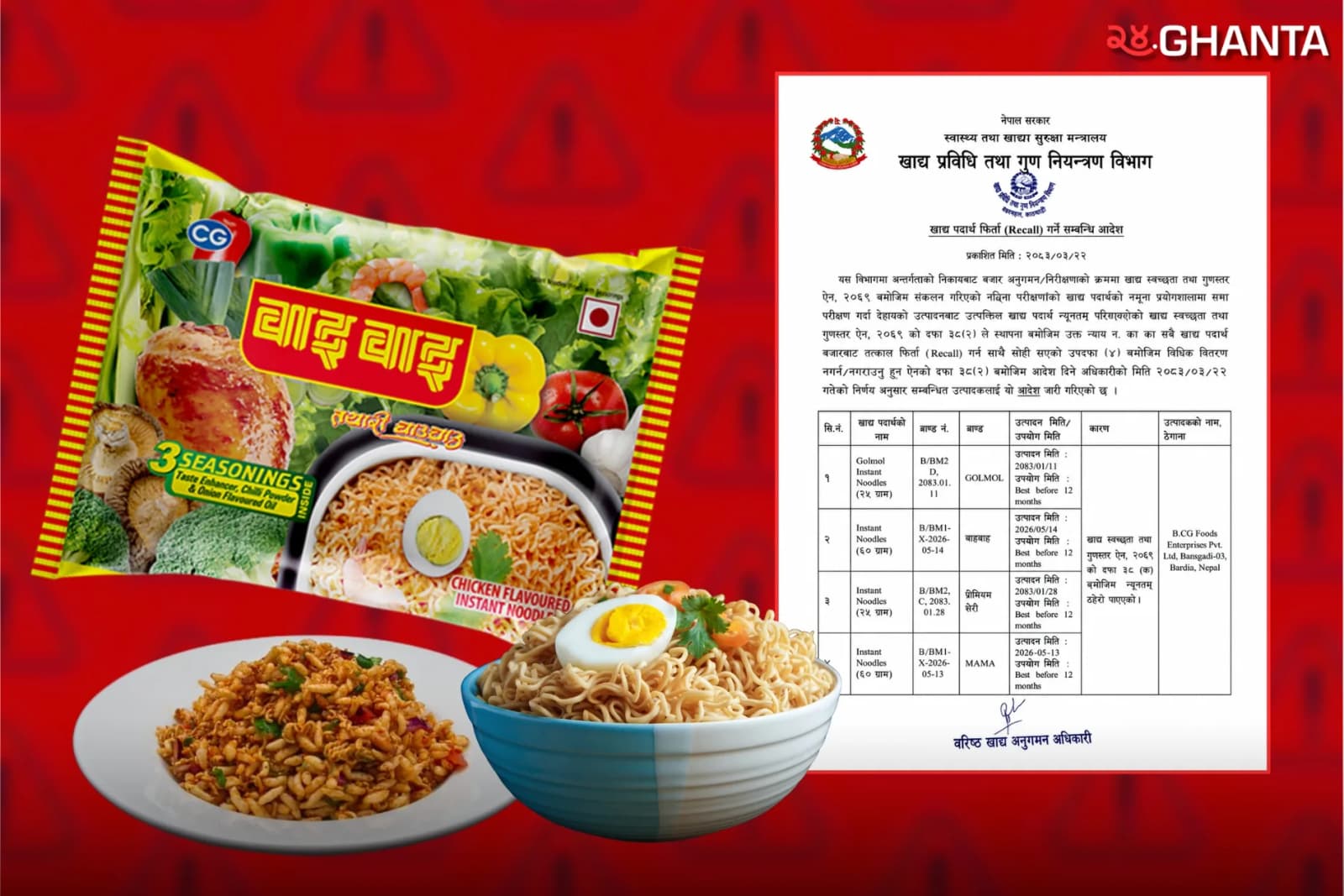
Food Department Orders Immediate Recall
The Department of Food Technology and Quality Control ordered CG Foods Enterprises Pvt. Ltd. to recall four specific batches of instant noodles from shops and distribution networks across Nepal after laboratory tests found that the products failed to meet prescribed quality standards. The recall notice, reported on July 19, 2026, covers noodles produced at the company’s facility in Bansgadhi Municipality–3, Bardiya, and was issued to prevent products that do not comply with Nepal’s food-quality requirements from remaining available to consumers.
Four Products Affected
The recall applies to the following products and batch details:

Golmol Instant Noodles: Batch B/BM2 D, dated 2083.01.11
Wai Wai Instant Noodles: Batch B/BM1-X-2026-05-14
Premium Piro Instant Noodles: Batch B/BM2 C, dated 2083.01.28
MAMA Instant Noodles: Batch B/BM1-X-2026-05-13
Consumers should check the batch number and production information printed on the packaging rather than assuming that every packet sold under these brand names is included in the recall.
Recall Limited to Listed Batches
The department’s order concerns the specified production batches, not every Golmol, Wai Wai, Premium Piro or MAMA product in the market.
This distinction is important because a product recall normally identifies the exact manufacturing run connected to the laboratory result. Packets carrying different batch numbers are not identified in the available notice as part of this particular recall.
Laboratory Tests Found Quality Failure
Samples collected for inspection were tested in a government laboratory and reportedly found to be below the required standard. The products were classified as substandard under Section 16(a) of the Food Hygiene and Quality Act, 2081.
However, the publicly available reports reviewed for this article do not clearly state which laboratory parameter each batch failed. They do not specify whether the issue involved moisture, acidity, fat quality, ingredients, labelling, contamination or another technical measurement.
No Specific Health Hazard Disclosed
The recall should be treated seriously, but the available notice does not provide enough evidence to describe the products as poisonous, contaminated or immediately dangerous.
“Substandard” means that the tested samples failed to satisfy one or more legally required standards. It does not automatically establish the presence of a particular harmful substance unless the department publishes further laboratory details.
Producer Must Remove Products
The manufacturer has been directed to immediately withdraw the affected stock from the market. This means the company is responsible for tracing the specified batches through wholesalers, distributors and retailers and arranging their removal.
Nepal’s food law allows regulators to order a producer to recall products when laboratory testing finds that they do not meet required standards.
Shops Told to Stop Sales
Retailers, wholesalers and distributors have also been instructed not to sell or distribute packets carrying the affected batch numbers.
Under the reported order, the sales and distribution restriction was issued using Section 38(4) of the Food Hygiene and Quality Act, 2081. Similar recall actions taken by the department against other food products have required businesses to immediately remove the identified batches and stop further sales.
What Consumers Should Do
Consumers who have any of the four products at home should first examine the batch information printed on the packet.
When the number matches the recall notice, the product should not be consumed or served. Consumers can return it to the shop where it was purchased or preserve the packet and purchase receipt while seeking instructions from the retailer, distributor or food department.
Do Not Rely Only on Brand Names
A packet should not be discarded solely because it carries the Wai Wai, Golmol, Premium Piro or MAMA name. The batch code is the key information that determines whether it is included in this recall.
Likewise, consumers should not assume that a packet is safe simply because its packaging looks normal. Quality failures identified through laboratory analysis may not always be visible from the outside.
Manufactured at Bardiya Facility
The listed products were manufactured by CG Foods Enterprises Pvt. Ltd. in Bansgadhi–3, Bardiya. CG Foods describes its Bardiya food park as a manufacturing centre established to supply instant noodles and snack products to Nepal’s western region.
The recall notice identifies the manufacturing facility to help authorities and the producer trace the affected production runs through the supply chain.
Why Batch Tracking Matters
Batch numbers allow regulators to connect a packet on a shop shelf with a specific production date, factory line and manufacturing run.
Accurate batch tracking makes it possible to conduct a targeted recall instead of withdrawing every product sold under the same brand. It also helps investigators determine how much affected stock was produced, where it was distributed and whether any packets remain in the market.
Further Details Still Needed
The department has not publicly disclosed, in the reports reviewed, the number of packets affected, the geographical areas where the batches were distributed or the exact test results behind the quality classification.
It is also unclear whether the company has completed the recall or issued a separate public response. Any future laboratory report, enforcement update or company statement may provide additional clarity.
Consumers Urged to Check Packets
The immediate priority is for consumers and sellers to examine the batch numbers carefully. Shops should isolate matching products from other stock and avoid selling them while the recall remains in effect.
The case also highlights the importance of regular market inspections, transparent publication of laboratory findings, and rapid communication when commonly consumed food products fail government standards.
Published Jul 21 in Health