
From Nepal To Dubai: DDC Sends Its Ghee Abroad For The First Time
Nepal's state-owned Dairy Development Corporation has started exporting DDC ghee to Dubai, marking its entry into the international market with an agreement to export at least 50,000 kg annually. DDC says it plans to expand exports across the Middle East and later reach markets including Japan, South Korea and Tibet, China, as it increases production and looks for new markets for Nepali dairy products.
· 4 min read
KATHMANDU, AUGUST 21, 2026
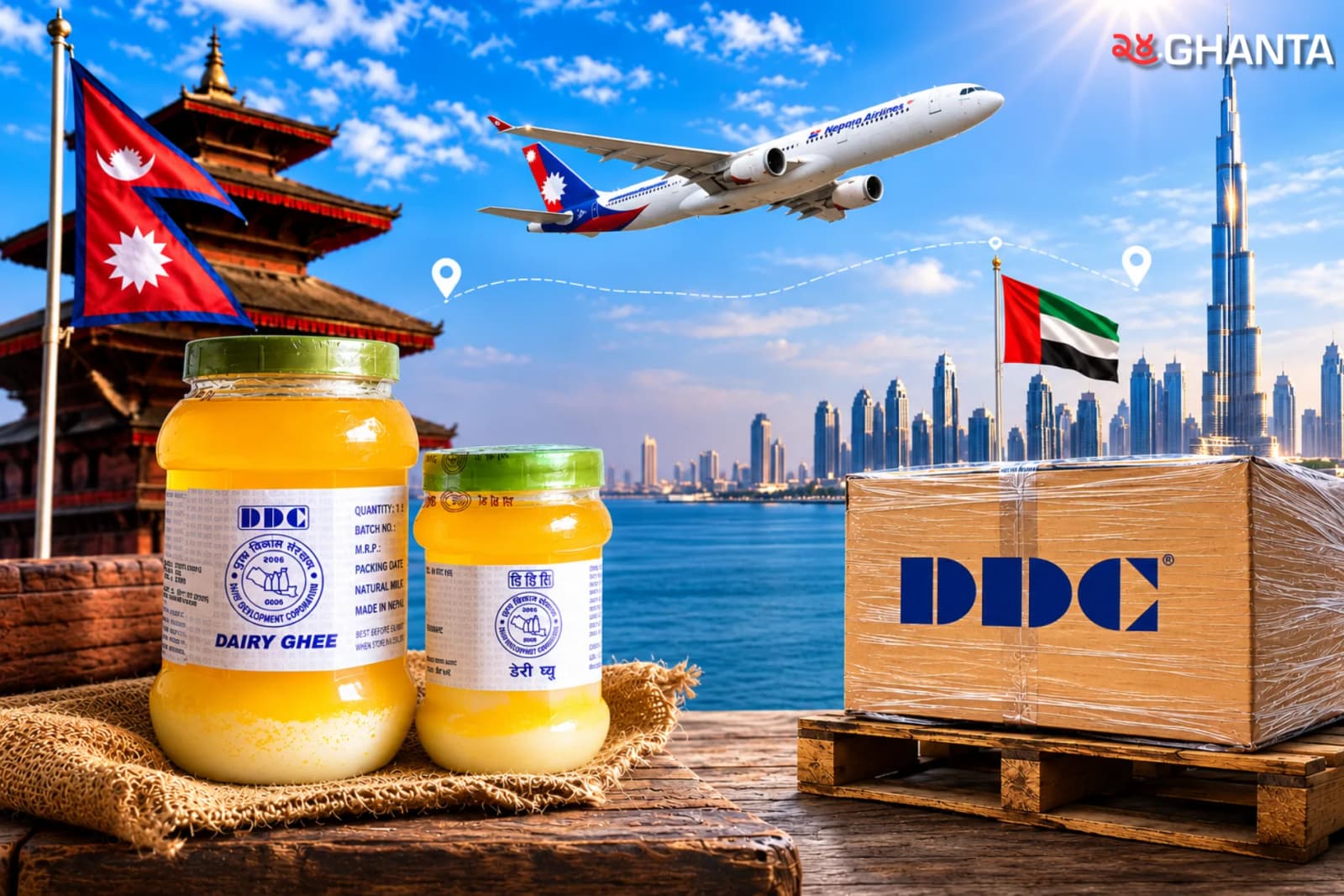
Nepal's state-owned Dairy Development Corporation (DDC) officially began exporting its ghee to Dubai, UAE, on Friday, opening a new international market for the government-owned dairy producer as part of efforts to expand sales, strengthen its finances and create overseas demand for Nepali dairy products. The first consignment was sent to Dubai through Nepal Airlines, while DDC has reached a commercial agreement with private company Rato Ra Chandra Surya International Pvt. Ltd. to export at least 50,000 kg, or 50 metric tonnes, of ghee annually.
DDC Ghee Reaches Dubai
The shipment marks the beginning of DDC's commercial ghee exports to the Middle East.

DDC General Manager Dr. Sharan Kumar Pandey said the corporation has started with Dubai and plans to gradually expand into other markets as production capacity allows.
Reports differ slightly on the size of Friday's initial shipment. Onlinekhabar reported 500 kg, while Setopati and Clickmandu reported 600 kg. However, the outlets consistently report that the shipment marks DDC's first ghee export and that a larger annual export agreement has been reached.
50 Tonnes A Year Planned
The bigger target goes well beyond Friday's first shipment.
DDC has reached an agreement to export at least 50,000 kg of ghee annually, equivalent to 50 metric tonnes.
Earlier government reporting on DDC's export preparations estimated that exporting 50 tonnes of ghee to Gulf markets could generate approximately Rs 5 crore in annual business.
Shipments could be made as frequently as every week depending on overseas demand.
Why Dubai Was Chosen First
Dubai provides DDC with an entry point into the wider Middle Eastern market, where the corporation is seeking to establish a market for Nepali ghee.
According to DDC management, its commercial agreement is aimed at exporting ghee across Middle Eastern countries rather than limiting sales to Dubai alone.
The first shipment therefore represents a starting point for a potentially broader Gulf export network.
Japan, South Korea And Tibet Next
DDC's international ambitions extend beyond the Middle East.
General Manager Pandey said the corporation is preparing to send its products to Japan and South Korea, while exports to Tibet in China are also planned.
According to the current plan, DDC expects its products to begin reaching Japan, South Korea and Tibet from around Kartik, provided production and raw-material availability support the expansion.
Production Is The Main Challenge
DDC says it deliberately limited its first-year export agreement to 50 tonnes because current ghee production is not high enough to immediately support significantly larger overseas orders.
Pandey said expansion will depend on having sufficient raw materials and increasing production.
Official DDC production data show the corporation produced 219,070 litres of ghee in fiscal year 2081/82, up from 188,874 litres the previous year and 139,982 litres in 2079/80.
That upward trend could become increasingly important if international demand grows.
Export Comes During DDC's Wider Recovery Push
The Dubai shipment comes as DDC works to improve its sales, finances and operations.
Agriculture Minister Geeta Chaudhary said earlier this week that sales of DDC dairy products had increased by around 35 percent. She also confirmed that preparations were underway to export ghee to Gulf countries and China.
Earlier government reporting also said DDC had been working to expand distribution, increase daily sales and improve the quality of the raw milk it purchases.
Farmers Are Still Waiting For Payments
Despite the export milestone, DDC continues to face major financial challenges.
According to Agriculture Minister Chaudhary, DDC still owed around Rs 35 crore to 235 dairy cooperatives as of this week.
The corporation has been trying to shorten the time farmers must wait for payment while simultaneously collecting outstanding money from the market and expanding product sales.
This makes the export strategy financially significant: overseas sales could provide DDC with another source of revenue while creating a larger market for dairy products made from milk supplied by Nepali farmers.
A Bigger Market For Nepali Dairy
DDC's international expansion could have implications beyond the corporation itself.
The government-owned dairy company operates as a major link between milk-producing farmers and consumers. Government and DDC officials have repeatedly argued that expanding markets for processed products is important for managing domestically collected milk and supporting farmers.
DDC's official production figures show that it already manufactures ghee, butter, yoghurt, paneer and several varieties of cheese alongside its core milk business.
From Domestic Shelves To International Markets
For decades, DDC has been primarily associated with Nepal's domestic dairy market. Friday's shipment represents an attempt to take one of its established products beyond that traditional customer base.
The first Dubai consignment is relatively small, but the 50-tonne annual agreement gives the move a larger commercial dimension.
If DDC can increase production and successfully enter Japan, South Korea, China and additional Middle Eastern markets as planned, Friday's first shipment could mark the beginning of a much wider international market for Nepal's state-owned dairy producer.
Published Aug 21 in Nepal