
Green Army Nepal Registration Reportedly Cancelled Amid Controversy Over Military-Style Uniforms and Activities
Green Army Nepal’s registration has reportedly been cancelled following controversy over its military-style name, uniforms, structure and disaster-response activities.
· 5 min read
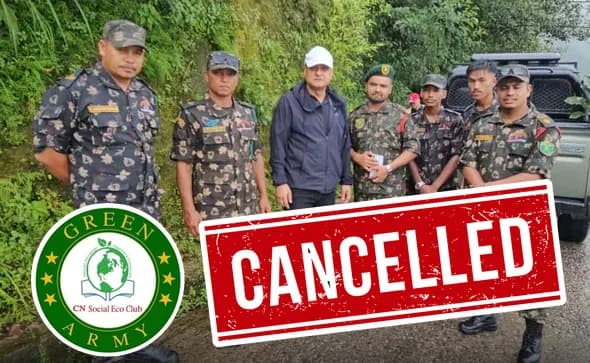
Green Army Nepal Registration Reportedly Cancelled
The controversy surrounding Green Army Nepal has taken a major turn after reports emerged that the organisation’s registration has been cancelled. The group came under intense public attention after its members were seen wearing military-style uniforms while working in flood-affected areas following the devastating Bhote Koshi–Trishuli floods. The appearance of the group alongside official rescue and security teams raised questions about its identity, authority and legal role during disaster-response operations.
According to a report published by Desh Sanchar on September 6, 2026, the registration of the Green Army has been revoked and its activities have consequently been banned. The report said the organisation was registered as a non-profit company with the Office of the Company Registrar and had faced growing scrutiny because its name, uniforms, insignia and organisational structure appeared similar to those associated with military organisations.
How Did the Green Army Controversy Begin?
The Green Army became widely known after photos and videos of its members working in flood-hit areas circulated on social media. Members wearing green military-style uniforms were seen assisting in affected areas of Rasuwa and Nuwakot, leading many people to ask whether the group was connected to the Nepal Army or another government security agency.

The confusion became stronger because some security officials initially said they were unaware of the organisation's presence and activities in the affected areas. Ratopati reported that senior Nepal Army and police officials had said they were looking into the matter.
The group, however, has maintained that it is not a military organisation. Earlier reports said Green Army described itself as an organisation focused on environmental conservation, disaster preparedness, humanitarian assistance and youth training. It reportedly worked with students and volunteers and conducted training in areas such as first aid, discipline, waste management and basic disaster response.
Why Was the Military-Style Uniform Controversial?
One of the biggest issues surrounding Green Army Nepal was its uniform.
The organisation's uniform looked similar to military clothing, which caused confusion among members of the public. Green Army founder Sabin Sharma previously said the organisation had received permission to use its uniform after consultations involving the Ministry of Home Affairs, Ministry of Defence, Nepal Army and Kathmandu District Administration Office.
According to Sharma's explanation reported by Ratopati, the organisation had sought approval for its uniform and received a response that the design did not resemble the official Nepal Army uniform. He said permission was subsequently granted in 2021.
OnlineKhabar also reported that Green Army said its uniform had received formal approval and that the organisation had been working in environmental conservation and disaster management rather than acting as a military force.
Green Army's Role in Disaster Response
The controversy became especially serious because the organisation appeared in areas affected by the recent floods.
Nepal has been dealing with a catastrophic disaster after the August 26 glacier collapse and subsequent flooding along the Trishuli corridor. The disaster has killed more than 1,200 people, left thousands missing and destroyed or damaged thousands of homes and other infrastructure. Thousands of Nepali Army personnel have been involved in search, rescue, medical assistance and recovery operations.
Against this background, the presence of a civilian organisation wearing military-style uniforms created concern about whether ordinary citizens could clearly distinguish between official security personnel and volunteers.
The issue was therefore not simply about clothing. It also raised broader questions about who can operate in disaster zones, who has authority to conduct rescue operations, how volunteers should coordinate with government agencies, and how military identity should be protected from confusion.
Was Green Army's Registration Actually Cancelled?
As of September 6, reports from Nepali media say the registration has been cancelled. Desh Sanchar reported that a high-ranking military source confirmed the cancellation, while also noting that its attempts to obtain clarification from officials at the Office of the Company Registrar were unsuccessful.
Another report published on September 6 also reported that the Green Army's registration had been cancelled following the controversy surrounding its uniform and military-style structure.
This means the cancellation should currently be described as reported rather than treated as fully confirmed by an official public statement from the Company Registrar. The distinction is important because the organisation's own website, which remains online, still describes Green Army Nepal as a recognised organisation and lists its registration and Social Welfare Council numbers.
There is also a separate issue concerning its affiliation with the Social Welfare Council. Desh Sanchar reported that the council's member secretary said the Green Army's affiliation had not yet been cancelled and that cancellation of such affiliation follows a separate process.
What Happens Next?
The Green Army controversy has now moved beyond social media debate and into questions of legal status, government oversight and disaster-response coordination.
If the registration cancellation is formally confirmed, authorities will need to clarify what happens to the organisation's existing activities, volunteers, assets and affiliation with other government bodies. They may also need to explain how an organisation using a military-style name and uniform was originally allowed to operate and whether similar organisations are subject to the same rules.
The case has also highlighted the importance of clear rules for civilian volunteer groups working during disasters. Volunteers can play an important role in helping communities during floods, landslides and other emergencies, but their identity, training, authority and coordination with official rescue agencies need to be clear.
For now, the Green Army Nepal controversy remains a developing story, with the reported registration cancellation adding another major chapter to questions that began after the group's appearance in Nepal's flood-hit areas.
Published Sep 6 in Nepal