
Hetauda Textile Industry Comes Back to Life After 25 Years as Looms Resume Production
After remaining shut since 2057 BS, Hetauda Textile Industry has restarted trial production, with 10 looms now producing fabric and three upgraded with automated technology.
· 4 min read
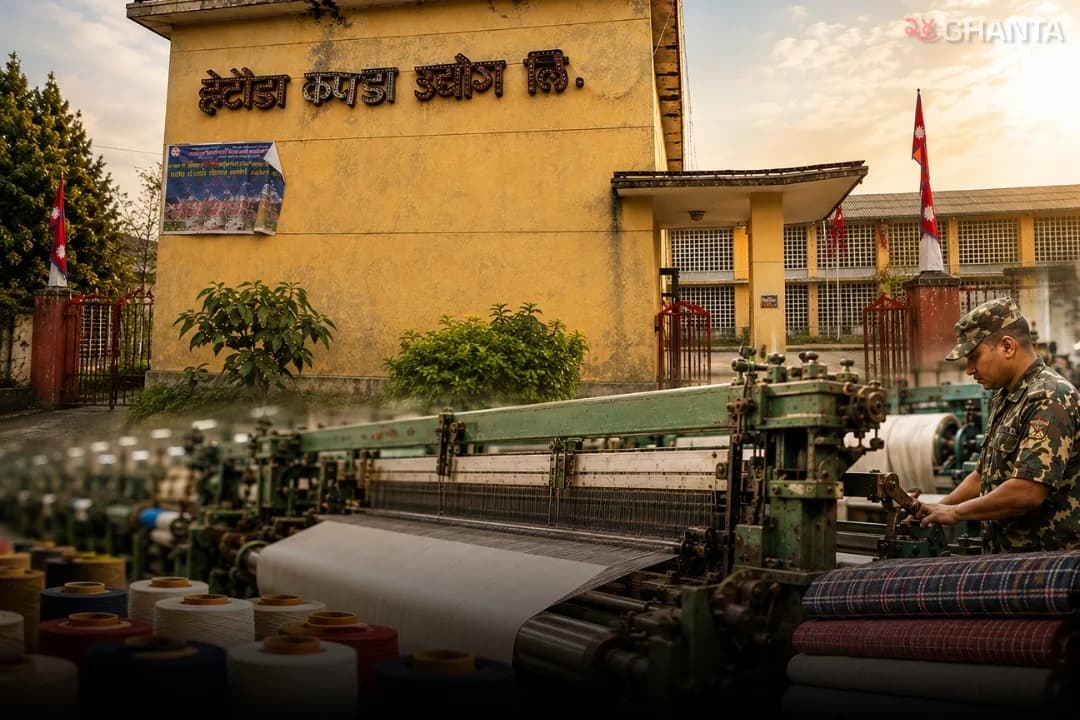
HETAUDA, AUGUST 23, 2026: The sound of weaving looms has returned to the Hetauda Textile Industry after more than two decades, marking a major step in the government's effort to revive the state-owned factory.
The industry, which had remained shut since 2057 BS, had spent years with abandoned machinery, dusty production halls and deteriorating infrastructure. It is now undergoing repairs and trial production, with 10 looms already operating.
Old Machines Get a New Lease of Life
Technical teams brought in to revive the factory have repaired and modified its old machinery instead of replacing everything with new equipment.

Three of the 10 operating looms have been converted to automated systems.
According to technicians, the upgrade has significantly increased production:
Traditional looms produced around 20–25 metres of fabric in eight hours.
Automated looms can now produce around 65–70 metres in the same period.
Automated systems can increase production while reducing the manpower required.
Technicians have replaced components including the dobby, sleward, brake and clutch systems to bring the old machines back into operation.
Looms Can Produce Different Types of Fabric
Technicians say the factory's machinery can be used to manufacture a wide range of products, including:
Sarees
Uniforms and clothing
Bedsheets
Plain and coloured fabrics
Patterned fabrics
Materials required by government employees and security agencies
Some of the original shuttle-loom parts are difficult to source because production of those older machines has already stopped.
Technicians are therefore exploring conversion to rapier technology, which allows weaving without the traditional shuttle system.
Government Provides Rs 3.3 Million for Trial Production
The government decided on June 18 to begin the process of reviving the factory and assigned the Nepal Army responsibility for cleaning the premises, repairing electrical systems and restoring machinery.
The government has provided Rs 3.3 million for trial production.
Around 40 technical personnel and soldiers from the Nepal Army's Production Directorate are currently involved in preparing the industry for operation.
The Industry Minister has said that 20 looms have been prepared for operation, with 10 already running. The remaining machines are expected to be brought into operation gradually.
Domestic Raw Materials Could Support Production
Raw materials for the current trial production are being sourced from Reliance Industries in Nepal.
The government is also looking beyond the factory itself by encouraging farmers to expand cotton cultivation in Nepal.
According to the minister, the government is prepared to purchase locally produced cotton and provide necessary support to farmers.
A stronger domestic cotton supply could eventually help reduce dependence on imported raw materials and support the textile industry from production to finished goods.
A Factory With a Long History
Hetauda Textile Industry was registered on Bhadra 30, 2032 BS with financial and technical assistance from the Chinese government.
Its foundation stone was laid in the same year, while trial production began in Kartik 2035 BS. The factory was formally inaugurated on Magh 5, 2035 BS.
At its full capacity, the factory once provided direct employment to around 1,200 people.
Why Did the Industry Shut Down?
The factory gradually fell into crisis because of several long-standing problems, including:
Political interference
Frequent strikes and disruptions
Management weaknesses
Outdated technology
Growing financial losses
The industry eventually stopped operating completely in 2057 BS.
Its long closure left machinery and infrastructure unused for years.
Revival Is Only the First Step
The return of production has raised hopes that Hetauda Textile Industry could once again become an important domestic manufacturing facility.
However, technicians and officials acknowledge that restarting the machines is only the beginning.
For sustainable full-capacity operation, the industry will still need:
Further investment
Reliable supplies of raw materials
Modernised machinery
A stable market for its products
Strong and professional management
Long-term financial planning
The factory's old machinery has shown that equipment can be repaired and modernised. The bigger question now is whether the government can provide the continuity, investment and management needed to keep the industry running.
Also Read: Nepal Moves to Revive Udayapur Cement and Gorkharkali Rubber Industries
Published Aug 23 in Business