
Indigenous Nationalities Commission Proposes Rhino As Nepal’s National Animal Instead Of Cow
The Indigenous Nationalities Commission has proposed replacing the cow with the rhino as Nepal’s national animal, saying the cow may not represent all religious and cultural communities.
· 3 min read
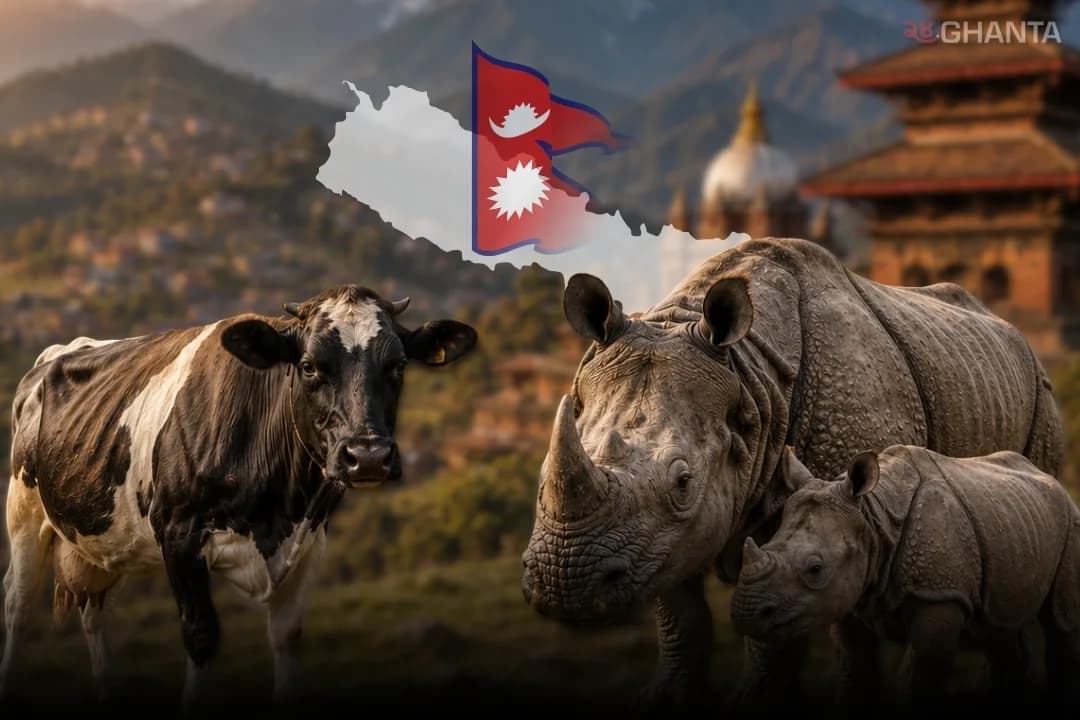
The Indigenous Nationalities Commission has proposed replacing the cow with the rhino as Nepal’s national animal, saying the cow may not represent all religious and cultural communities, in a 25-point constitution amendment report prepared after the Prime Minister and Council of Ministers’ Office sought suggestions in line with the spirit of the Gen Z Movement 2082.
The commission proposed in its “Constitution Amendment Proposal Report,” which was made public on Thursday. The report includes suggestions on national symbols, language rights, inclusion, federalism and the constitutional rights of Indigenous and marginalized communities.
Why The Rhino Was Proposed
The commission said the cow may not be a shared symbol for all communities, including Muslims and several Indigenous cultural groups such as Kirat and Rai communities.

Because of that, the commission suggested that the rhino would be a more suitable national animal in place of the cow.
The proposal has not changed Nepal’s national animal. It is only a recommendation for possible constitutional amendment.
Suggestion On National Anthem
The commission has also proposed allowing the national anthem to be sung in languages designated for official government work in different provinces.
It said such a provision would better reflect Nepal’s linguistic and cultural diversity.
Language Rights Proposal
The commission has recommended that all languages written in the scripts of Nepal’s Indigenous nationalities should be recognized as languages of official government work.
At present, the Constitution recognizes Nepali written in the Devanagari script as the official language of government work. The commission said recognizing mother tongues as Nepali languages while not recognizing their scripts could create discrimination.
Cultural Protection By The State
The commission has proposed revising the constitutional provision related to language and cultural rights.
It has suggested that the state should be responsible for protecting the language and culture of every community, while every citizen should also have a duty to preserve and promote their own language and culture.
The commission said every language and culture is a valuable national asset and should be protected by the government with support from the concerned communities.
Indigenous Rights In Constitution
The commission has also proposed that the rights guaranteed to Indigenous nationalities under the Constitution, laws, international treaties and United Nations declarations should be clearly written as the constitutional rights of Indigenous communities.
It said Indigenous nationalities have distinct knowledge, skills and traditional lands, and their rights should be secured through clear constitutional provisions.
The report also includes suggestions on proportional inclusion, state restructuring, federalism and the implementation of constitutional rights for Indigenous, marginalized and excluded communities.
Published Jul 10 in Nepal