
Jyoti Ranabhat Ends Hunger Strike After 19 Point Agreement With Government
Nurse Activist Jyoti Ranabhat Ends Hunger Strike After 19 Point Agreement With Government, Task Force To Set Pay And Benefits For Health Workers Within Six Months
· 6 min read
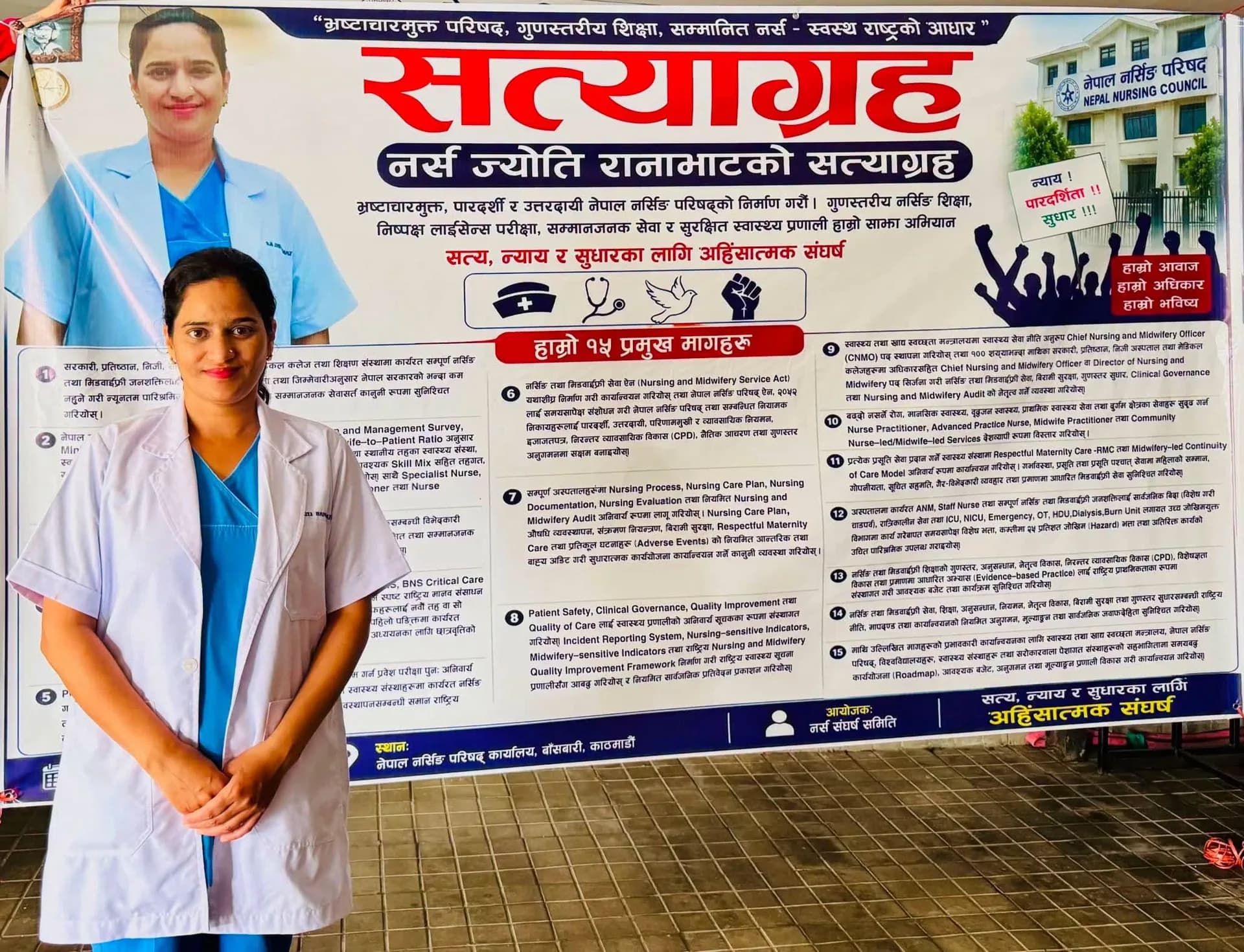
Nurse activist Jyoti Ranabhat has ended her hunger strike after reaching a 19 point agreement with the government on a wide range of issues affecting nurses, midwives and other health workers in Nepal.
Ranabhat had been on hunger strike since Shrawan 14, raising demands related to salaries, service benefits, staffing, professional development, nursing education, patient safety and long term reforms in the health sector. The agreement was reached during talks on Tuesday night and brought all of her hunger strike programs to an end.

The agreement was signed by Additional Secretary Dr. Shrikrishna Shrestha, Senior Medical Superintendent Dr. Hemant Chandra Ojha and Legal Officer Jay Prasad Subedi from the government side, along with Ranabhat.
What The 19 Point Agreement Covers
Available reports confirm that the agreement includes both measures that can be implemented quickly and wider legal and policy reforms that will require further government action.
The following 19 points provide a clear breakdown of the commitments reported under the agreement.
1. Task Force For Salaries And Service Benefits
The government will form a task force within seven days to determine appropriate salaries and service benefits for nurses, midwives and other health workers working in government, private and community health institutions. The work is expected to be completed within six months.
2. Minimum Service Standards In Hospitals
Hospitals will be required to implement Minimum Service Standards to improve the quality and basic level of services provided to patients.
3. Mandatory Patient Safety Measures
Patient Safety standards will be made compulsory in hospitals, with health institutions required to strengthen systems designed to protect patients during treatment and care.
4. Scholarship Health Worker Deployment Directive
The government has agreed to revise the directive related to the deployment of doctors and health workers who received government scholarships.
The revision is expected to address concerns over how scholarship health workers are assigned and used after completing their studies.
5. Responsibilities Based On Qualifications
Scholarship trained nurses and midwives are expected to receive responsibilities and positions that properly reflect their educational qualifications, training and areas of specialization.
6. Better Service Benefits And Leadership Opportunities
The agreement includes measures to improve professional opportunities for qualified nurses and midwives, including appropriate service benefits and opportunities to take leadership responsibilities.
7. Further Study Opportunities For ANMs
Arrangements will be made to provide scholarship opportunities for Auxiliary Nurse Midwives to continue their studies in Proficiency Certificate Level Nursing or Midwifery according to relevant national nursing and midwifery policies.
8. Nursing And Midwifery Entrance Exam Reform
The government has agreed to improve policies related to entrance examinations for certificate level nursing and midwifery education.
The changes are expected to apply from the coming academic session after coordination with the relevant education authorities.
9. Review Of One Health Worker One Health Institution Policy
The existing One Health Worker One Health Institution standard will be reviewed and revised.
The policy is intended to regulate how health professionals work across institutions while ensuring that public health services remain properly staffed.
10. Nursing Process And Care Plans
Hospitals will be required to properly use nursing processes and nursing care plans as part of routine patient treatment and care.
This is intended to create a more organized system for identifying patient needs, planning nursing care and monitoring progress.
11. Nursing Documentation And Assessment
Health institutions will be required to strengthen nursing documentation and patient assessment systems.
Accurate documentation is considered important for continuity of treatment, patient safety and accountability within hospitals.
12. Medication Management And Infection Control
Hospitals will have to strengthen medication management and infection control practices.
These measures are aimed at reducing preventable errors and protecting patients and health workers from infections inside health facilities.
13. Adverse Event Reporting And Patient Safety Monitoring
Health institutions will be expected to record and report adverse events affecting patients and take steps to improve safety based on those reports.
This will strengthen systems for identifying problems and preventing similar incidents in the future.
14. Regular Nursing And Midwifery Audits
Regular nursing and midwifery audits will be introduced or strengthened to measure the quality of services provided by health institutions.
Audit findings are expected to help hospitals identify weaknesses and improve nursing and midwifery services.
15. Respectful Maternity Care Audits
Health institutions will also strengthen audits of respectful maternity care in line with Nepal's legal provisions on safe motherhood and reproductive health rights.
The measure is intended to ensure that women receive safe, respectful and dignified treatment during pregnancy, childbirth and related health services.
16. Nursing Education, Research And Professional Development
The agreement gives importance to improving the quality of nursing and midwifery education, research and professional development.
It also covers continuous professional development, leadership development, evidence based nursing practices and stronger specialist knowledge within the profession.
17. More Nursing And Midwifery Positions
The government has agreed to work toward creating enough nursing and midwifery positions to maintain an appropriate ratio between health workers and patients.
Staff shortages have long been raised as a concern because too few nurses caring for too many patients can increase workloads and affect the quality of care.
18. Permanent Recruitment And At Least 25 Percent Risk Allowance
The agreement calls for contract based employment to be gradually reduced and necessary positions to be filled through permanent recruitment.
The government has also agreed to work toward revising the Health Service Act to ensure at least a 25 percent risk allowance for the nursing sector.
This is one of the most important financial commitments in the agreement because nurses and other frontline workers can face regular exposure to infectious diseases, medical emergencies and other workplace risks.
19. Specialist Nursing And Midwifery Posts
A task force will be formed to work on creating specialist positions for nurses and midwives.
The move is expected to provide clearer career paths for professionals with advanced qualifications and allow specialist nursing expertise to be used more effectively in hospitals and national health programs.
The 19 point understanding covers more than salaries alone. It includes hospital quality standards, patient safety, nursing documentation, education, staffing, scholarship policies, professional development, permanent recruitment and changes to health sector law.
Some commitments have specific implementation periods. The salary and service benefits task force is expected to be formed within seven days and complete its work within six months. Other measures will require changes to existing directives, standards, laws and government staffing systems.
The agreement also places greater attention on the nurse and patient ratio. Creating positions according to the actual number of patients and workload could become an important part of improving both working conditions for nurses and the quality of care patients receive.
Published Aug 5 in Health