
Nepal’s September 4–8 Calendar: Festivals, Weekend, Mourning and Remembrance
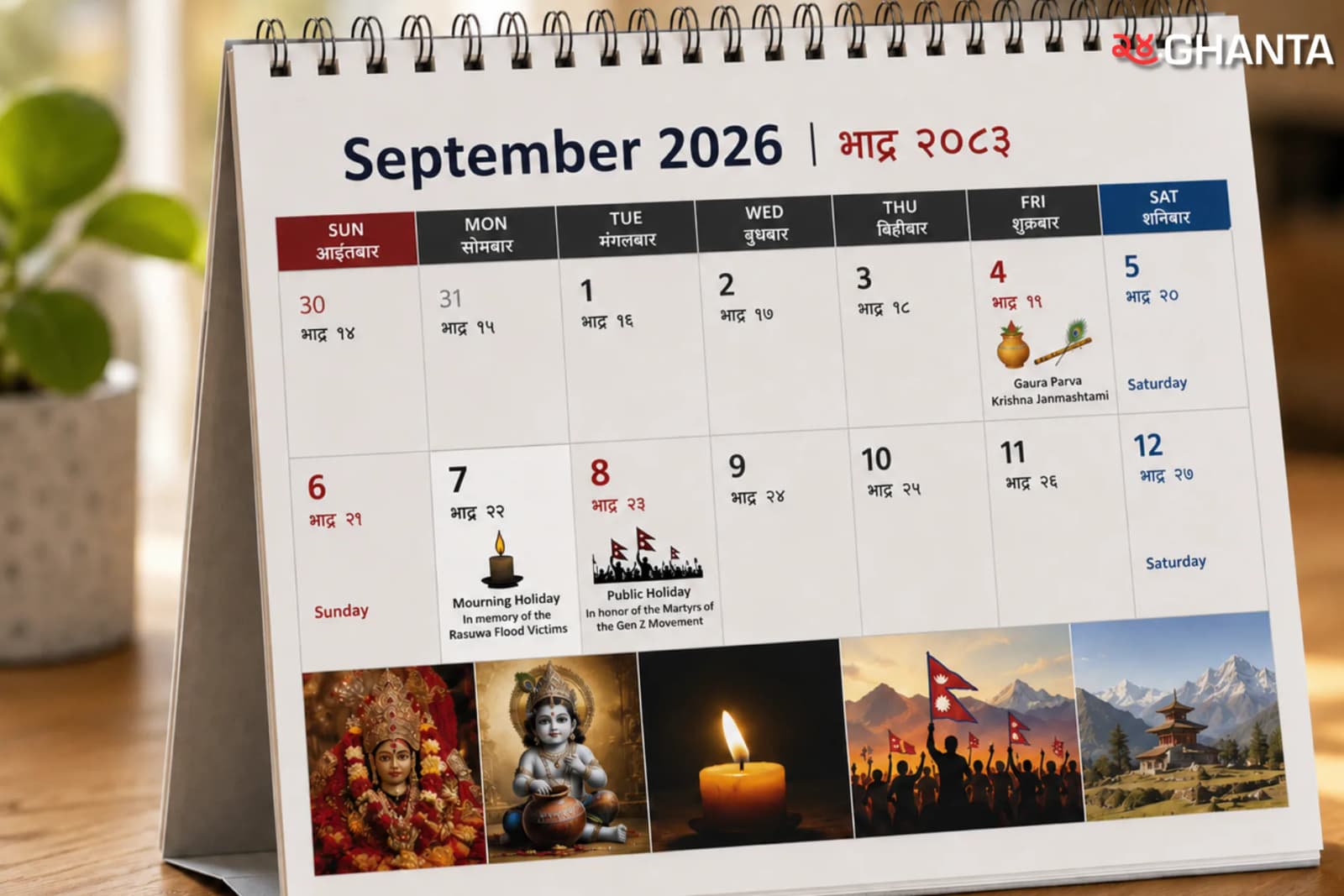
Nepal will observe five consecutive significant days from September 4 to 8, beginning with Krishna Janmashtami and Gaura Parva, followed by the regular weekend, a national mourning day for Rasuwa flood victims, and Gen Z Martyrs’ Day. September 7 is a national mourning day, not a public holiday, while September 8 has been declared a nationwide public holiday.
· 8 min read
KATHMANDU, NEPAL, September 3, 2026
Nepal is heading into an unusual five-day stretch from Friday, September 4, through Tuesday, September 8, bringing together religious festivals, the country’s current two-day weekend, national mourning and a newly announced public holiday commemorating the Gen Z martyrs.
Although these five significant days fall consecutively, they do not all have the same meaning or legal status. September 4 is associated with Krishna Janmashtami and Gaura Parva, September 5 and 6 form the regular Saturday-Sunday weekend, September 7 has been designated a national mourning day for victims of the devastating Rasuwa flood but is not a public holiday, and September 8 has been declared a nationwide public holiday for Gen Z Martyrs’ Day.

Together, the dates create a rare period in which Nepal moves from religious celebration and cultural tradition to national grief and remembrance.
September 4: Krishna Janmashtami and Gaura Parva
Friday, September 4, or Bhadra 19, brings Krishna Janmashtami and Gaura Parva together on the same date, marking a day of religious and cultural significance.
Why Is Krishna Janmashtami Celebrated?
Krishna Janmashtami commemorates the birth of Lord Krishna, revered in Hindu tradition as an incarnation of Lord Vishnu and a central figure in the Mahabharata and Bhagavad Gita.
According to Hindu tradition, Krishna was born to Devaki and Vasudeva in Mathura while they were imprisoned by Devaki’s brother, King Kansa. Kansa had been warned by a prophecy that Devaki’s eighth child would eventually cause his downfall.
Following Krishna’s birth, Vasudeva is believed to have carried the newborn across the Yamuna River to Gokul, where he was raised away from Kansa. Krishna later became associated with Kansa’s defeat and, in the Mahabharata, became Arjuna’s charioteer and spiritual guide.
Because Krishna is traditionally believed to have been born at midnight on Krishna Paksha Ashtami, midnight worship remains an important part of Janmashtami observances.
Across Nepal, devotees mark the occasion through fasting, prayers, bhajans, offerings and visits to Krishna temples. Some devotees remain awake until midnight to mark the traditional time of Krishna’s birth.
One of Nepal’s best-known centers for Janmashtami celebrations is Krishna Mandir at Patan Durbar Square in Lalitpur, where large numbers of devotees traditionally gather for worship. The historic stone temple dates to the reign of King Siddhi Narsingh Malla in the 17th century.
What Is Gaura Parva?
The same Friday carries particular cultural importance for Sudurpashchim and communities with roots in Nepal’s far-western region.
Gaura Parva is associated with Goddess Gaura or Gauri, a form of Parvati, and Lord Shiva. The festival is closely connected with family wellbeing, marital life, prosperity and community traditions.
Gaura is more than a single-day celebration. Traditional observances extend across several days and include the preparation of Biruda, a mixture of five types of grains or pulses.
Women traditionally soak and wash Biruda before using it during religious rituals. Married women also observe fasting and offer prayers for the health, wellbeing and prosperity of their families.
The festival is also closely associated with traditional songs, community gatherings and Deuda dancing, particularly in Nepal’s far west.
Over generations, Gaura Parva has become an important expression not only of religious faith but also of the music, language, dress, rituals and cultural identity of Sudurpashchim.
With Krishna Janmashtami and Gaura Parva falling together on September 4 this year, Friday opens the five-day period with faith, tradition and cultural celebration.
September 5: Saturday Weekly Holiday
Saturday, September 5, Bhadra 20, is Nepal’s regular weekly holiday.
Unlike the festival observances on Friday, Saturday does not depend on a special government announcement. It is already part of the country’s regular weekly closure.
Its position on the calendar, however, places it directly between Friday’s religious observances and Sunday’s weekly holiday.
September 6: Sunday Weekly Holiday
Sunday, September 6, Bhadra 21, falls under Nepal’s current two-day weekend arrangement for government offices and educational institutions.
The Saturday-Sunday weekend was introduced in 2026 as part of government measures that included efforts to reduce fuel consumption and operating costs. Under the arrangement, public offices operate for longer hours on working days while Saturday and Sunday remain weekly holidays.
There was later speculation that the government could withdraw the Sunday holiday, but authorities clarified that no such decision had been made.
Sunday therefore becomes the third consecutive day in this unusual five-day calendar sequence.
September 7: National Mourning for Rasuwa Flood Victims
The nature of the period changes significantly on Monday, September 7, Bhadra 22.
The government has designated the date as a national day of mourning for people who lost their lives in the devastating Rasuwa flood.
Importantly, September 7 is a national mourning day, not a nationwide public holiday. Government offices are therefore not automatically closed simply because the country is observing national mourning.
The disaster struck on August 26, Bhadra 10, when a massive flood entered the Bhote Koshi-Trishuli river system, causing extensive destruction and loss of life.
The impact extended beyond Rasuwa as floodwaters and debris travelled downstream through the river system, affecting communities and infrastructure in several districts and triggering a major search, rescue and recovery operation.
Security personnel, government workers, volunteers, local communities and rescue teams have since been involved in searching for missing people, rescuing survivors and providing assistance to affected communities.
Why Was September 7 Chosen?
The government selected Bhadra 22 because it falls on the 13th day following the disaster.
The thirteenth day carries particular importance in Hindu mourning traditions followed by many Nepali families. Rituals connected with the death of a family member are commonly performed during this mourning period.
Choosing the date therefore connects the government’s national remembrance with a mourning tradition familiar to many communities across Nepal.
What Happens During National Mourning?
As part of the observance, the national flag will be flown at half-mast at government offices across Nepal as well as Nepali embassies and diplomatic missions abroad.
The gesture represents the state’s official expression of mourning and respect for those who died.
However, the distinction remains important:
September 7 — National Mourning Day
September 7 — Not a Public Holiday
The day therefore should not be counted as another day off when describing the September 4–8 period.
Instead, Monday is intended as a day of grief, respect and national remembrance for people whose lives were lost in one of Nepal’s most devastating recent disasters.
September 8: Gen Z Martyrs’ Day
The five-day period concludes on Tuesday, September 8, Bhadra 23, with another nationally significant observance.
The Cabinet decided on September 3 to declare a nationwide public holiday on Bhadra 23 for Gen Z Martyrs’ Day.
The date commemorates people who lost their lives during the Gen Z movement of September 2025, a youth-led movement that became a major political event in Nepal.
What Happened During the Gen Z Movement?
The movement emerged in September 2025, with large numbers of young Nepalis raising demands related to governance, accountability and political reform.
Demonstrations intensified on September 8 and 9, with confrontations resulting in deaths and injuries.
The protests subsequently developed into a major national political crisis and contributed to significant political changes, including the fall of the government led by then-Prime Minister KP Sharma Oli.
People killed during the movement were later recognized as martyrs, while issues surrounding justice, compensation, medical treatment for injured protesters and commitments made to affected families remained part of the national discussion.
The government subsequently designated Bhadra 23 as Gen Z Martyrs’ Day.
The annual calendar had originally treated the occasion as a nationally observed day without necessarily closing government offices. However, the Cabinet made a separate decision on September 3, 2026, declaring September 8 a nationwide public holiday this year.
September 8 therefore carries a different legal status from the previous day: September 7 is a national mourning day, while September 8 is a nationwide public holiday.
The Five Days at a Glance
September 4, Friday — Bhadra 19: Krishna Janmashtami and Gaura Parva
September 5, Saturday — Bhadra 20: Regular weekly holiday
September 6, Sunday — Bhadra 21: Regular weekly holiday under the current two-day weekend arrangement
September 7, Monday — Bhadra 22: National mourning for victims of the Rasuwa flood; not a public holiday
September 8, Tuesday — Bhadra 23: Gen Z Martyrs’ Day and nationwide public holiday
Not Simply Five Days Off
Calling September 4 to 8 a “five-day holiday” or “five consecutive public holidays” would be misleading because Monday, September 7, has been designated for national mourning rather than declared a nationwide public holiday.
What Nepal actually faces is five consecutive significant days with very different meanings.
The period begins with two long-established religious and cultural traditions. Krishna Janmashtami celebrates the birth of Lord Krishna, while Gaura Parva carries generations of religious and cultural tradition, particularly for communities connected to Sudurpashchim.
Saturday and Sunday then form the regular weekend.
The final two days take on a much more solemn character.
September 7 asks the country to remember those who lost their lives in the Rasuwa flood. September 8 honors people recognized as martyrs of the Gen Z movement and is being observed as a nationwide public holiday.
In just five days, Nepal’s calendar therefore moves through faith, culture, rest, grief and national remembrance, making September 4–8 far more significant than an ordinary extended break.
Published Sep 3 in Nepal