
Nepal Police Requests DNA Samples To Identify Victims Of Rasuwa Bhote Koshi Flood
Nepal Police has requested DNA samples from first-degree relatives of people missing after the Rasuwa Bhote Koshi flood to help identify recovered bodies and body parts. Relatives in Nepal can provide fresh blood samples, while those abroad can send DNA profiles for comparison.
· 3 min read
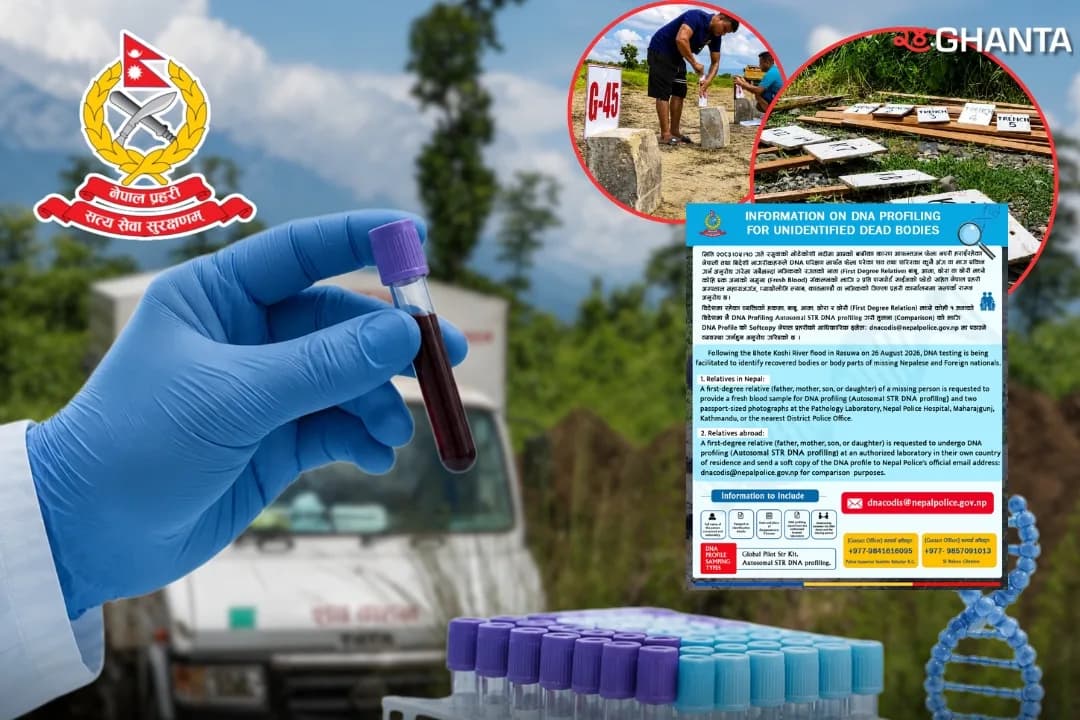
Nepal Police has started facilitating DNA profiling to identify unidentified bodies and body parts recovered following the devastating Bhote Koshi River flood in Rasuwa. Families of missing Nepali and foreign nationals can now provide DNA samples or profiles to help authorities confirm the identity of recovered victims.
The flood struck Rasuwa on August 26, 2026, leaving people missing and causing serious damage in the affected region. As search and recovery operations continue, DNA profiling is being used in cases where bodies or body parts cannot be identified through other methods.
Who Can Provide A DNA Sample?
According to the notice, Nepal Police is requesting DNA samples from a first-degree relative of a missing person.

The eligible relatives are:
Father
Mother
Son
Daughter
Only one of these first-degree relatives is required to provide a sample for DNA comparison.
What Should Families In Nepal Do?
For relatives currently in Nepal, a fresh blood sample will be collected for Autosomal STR DNA profiling.
The relative should also bring two passport-sized photographs when providing the sample.
Families can contact the Pathology Laboratory at Nepal Police Hospital in Maharajgunj, Kathmandu, or their nearest District Police Office for the DNA sample collection process.
The DNA profile from the relative can then be compared with DNA obtained from unidentified bodies or body parts recovered following the flood.
What Should Relatives Living Abroad Do?
Nepal Police has also provided a process for relatives of missing people who are currently outside Nepal.
A father, mother, son or daughter of the missing person can undergo Autosomal STR DNA profiling at an authorized laboratory in their country of residence.
A soft copy of the resulting DNA profile should then be sent to Nepal Police for comparison through its official email address:
This allows families living overseas, including relatives of missing foreign nationals, to participate in the identification process without travelling to Nepal solely to provide the DNA profile.
Why Is DNA Profiling Important?
DNA comparison can help authorities establish the identity of recovered victims when visual identification is difficult or impossible. By comparing DNA from unidentified remains with a close biological relative, forensic experts can help determine whether there is a family relationship.
The process is especially important following major disasters where victims may remain unidentified even after search and recovery teams locate bodies or body parts.
Families Of Missing People Asked To Contact Police
Families who have relatives missing following the Rasuwa Bhote Koshi flood and believe DNA identification may be required are requested to contact Nepal Police and follow the official procedure.
Those in Nepal can visit Nepal Police Hospital in Maharajgunj or their nearest District Police Office, while eligible first-degree relatives abroad can complete DNA profiling through an authorized laboratory and send the DNA profile electronically for comparison.
The measure is expected to support the continuing effort to identify victims and provide answers to families waiting for information about their missing relatives.
Photo gallery(1)
Tags
Published Sep 2 in Nepal