
Seven Days After Rasuwa Flood: What Did the Government Actually Do?
Prime Minister Balen Shah has presented Parliament with a detailed account of the government’s response following the August 26 Bhote Koshi flood, including helicopter rescues, free treatment, relief funding, evacuation, road restoration and emergency coordination. The government also allocated additional disaster funds, declared affected local levels crisis zones for three months and continued coordinating with provincial, local and international partners as rescue and recovery operations continued.
· 7 min read
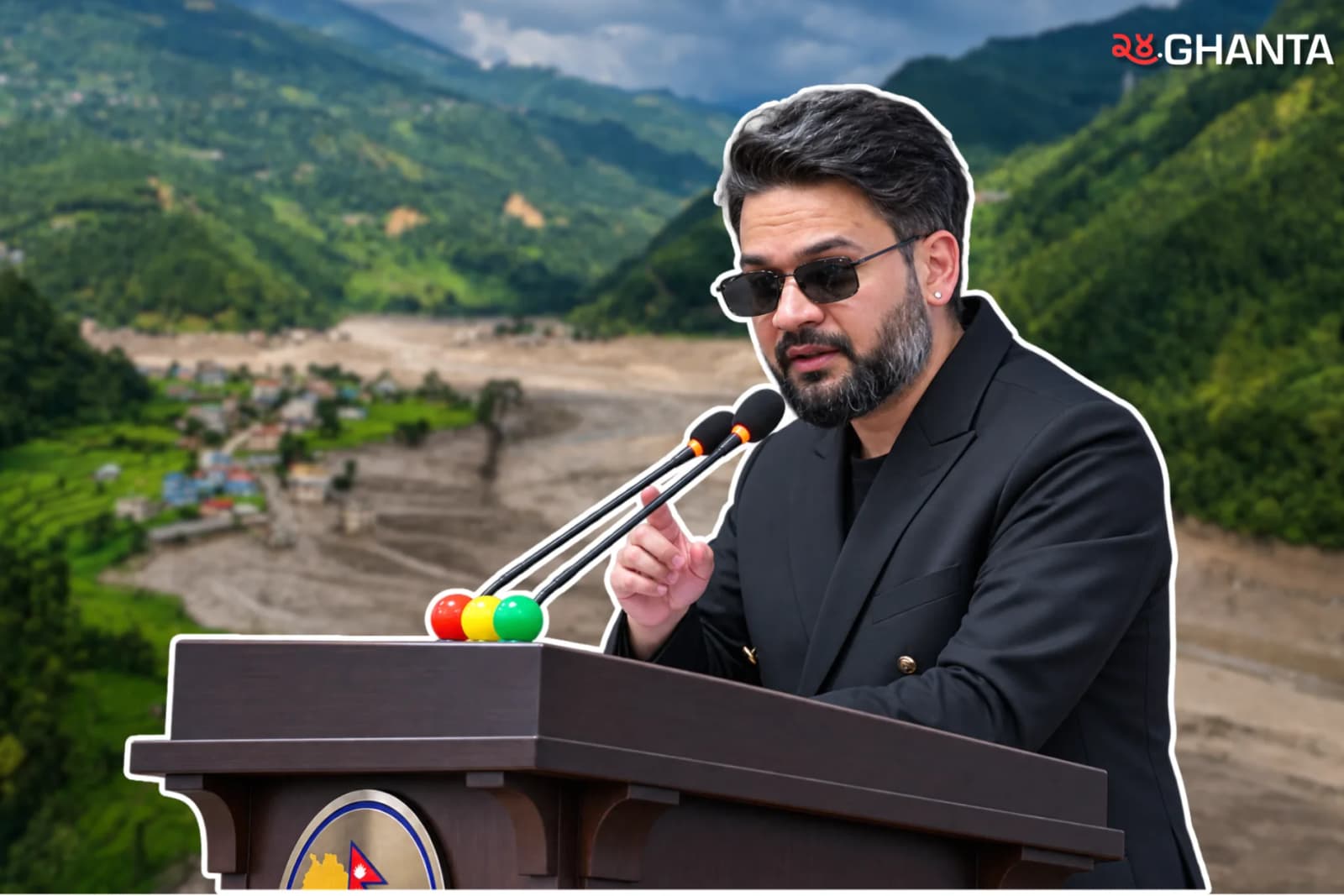
KATHMANDU, September 2, 2026
Prime Minister Balen Shah briefed the House of Representatives on Wednesday about the steps taken by the Nepal government after the devastating Bhote Koshi flood struck Rasuwa on August 26, 2026 (Bhadra 10, 2083). The government says its response focused on saving lives, finding missing people, rescuing stranded victims, providing free treatment and relief, restoring damaged infrastructure and coordinating federal, provincial and local authorities in Rasuwa, Nuwakot, Dhading and other affected areas.
August 26, 2026, Bhadra 10, 2083
The government said it became alert immediately after receiving information about the devastating Bhote Koshi flood in Rasuwa.
An emergency meeting of the Monsoon Response Command Post was held soon after the disaster.
The meeting coordinated the assessment of the disaster situation, search and rescue operations, security management, health services and relief mobilisation.
Authorities asked people not to travel unnecessarily along vulnerable road sections including Galchhi, Nuwakot, Syabrubesi and the Mugling–Narayangadh road.
Local administrations were instructed to completely restrict movement in high-risk areas wherever necessary.
Authorities were told to make the protection of human life the highest priority.
Nepal Army helicopters were deployed in Rasuwa and Nuwakot to speed up rescue operations.
Private-sector helicopters were also mobilised for rescue and evacuation.
Additional air and ground rescue resources were deployed depending on the situation and need.
The government said its immediate priorities were saving lives, searching for missing people, rescuing stranded victims, treating the injured, providing relief and relocating people to safer places.
A Cabinet meeting was held on the same day as the disaster.
The Cabinet expressed deep grief over the loss of lives and property caused by the flood in Rasuwagadhi, the Bhote Koshi area and downstream communities.
The government paid tribute to those who died and expressed condolences to bereaved families.
The Cabinet wished for the speedy recovery of those injured in the disaster.
The government decided that people injured in the flood would receive immediate free medical treatment.
Government hospitals, concerned health authorities and the Nepal Army were instructed to arrange treatment for injured victims.
According to subsequent reports, hospital capacity was also prepared for a possible rise in casualties, including beds designated for disaster victims at major government hospitals.
The Home Ministry and Defence Ministry were instructed to immediately rescue injured, stranded and displaced people.
Authorities were instructed to move vulnerable people from dangerous locations to safer areas.
The Home Minister was authorised to mobilise all necessary rescue resources, including helicopters.
Families whose houses or places of residence were destroyed were to be relocated to safer locations.
Food, shelter and accommodation were to be arranged for displaced families.
The Home Ministry, National Disaster Risk Reduction and Management Authority and relevant disaster management committees were given responsibility for coordinating shelter and basic support.
Authorities were instructed to reopen roads blocked or damaged by the flood as soon as possible.
The government ordered arrangements for drinking water in affected areas.
The concerned infrastructure authorities were instructed to restore damaged transport links and public services.
The Energy Ministry and Nepal Electricity Authority were instructed to restore disrupted electricity supplies as quickly as possible.
Concerned communication authorities were instructed to restore disrupted telecommunications immediately.
The Cabinet decided that the families of people killed in the disaster would receive financial assistance according to existing laws.
The Finance Minister was assigned responsibility for coordinating the financial resources required to restore damaged public structures and infrastructure.
Funding was also to be arranged for reconstruction of infrastructure destroyed or seriously damaged by the disaster.
Local levels in disaster-affected districts were to be declared disaster crisis areas for three months under Section 32 of the Disaster Risk Reduction and Management Act, 2074.
The Home Ministry was tasked with publishing the disaster crisis declaration in the Nepal Gazette.
Provincial governments were formally called on to assist in search, rescue, relief and treatment operations.
Local governments were also asked to support affected communities and coordinate rescue and relief activities.
Social organisations, institutions and other stakeholders were encouraged to support the disaster response.
The government began coordinating with neighbouring countries and international partners regarding possible humanitarian and emergency assistance.
After August 26, Additional Relief and Coordination
The government released an additional Rs 1 crore to the Rasuwa District Disaster Management Fund.
Another Rs 1 crore was released to the Nuwakot District Disaster Management Fund.
An additional Rs 50 lakh was provided to the Dhading District Disaster Management Fund.
The three districts therefore received a combined additional allocation of Rs 2.5 crore through the district disaster management funds.
Search and rescue operations continued in affected areas where people remained missing or stranded.
Helicopter rescue operations continued where damaged roads and difficult terrain prevented normal access.
Ground rescue teams continued operating in areas accessible by road or on foot.
The government continued coordinating with security agencies including the Nepal Army, Nepal Police and Armed Police Force.
Relief materials, food, shelter support and medical assistance continued to be mobilised for affected communities.
Government agencies continued efforts to reconnect damaged roads and restore access to isolated areas.
Electricity and telecommunications restoration remained part of the recovery effort.
The federal government remained in regular communication with provincial governments.
Coordination also continued with affected local governments and elected representatives.
During visits to affected areas, the federal government held discussions with provincial officials, including representatives from Bagmati Province.
Prime Minister Shah said the government had remained in dialogue with local representatives since the beginning of the disaster.
The National Disaster Risk Reduction and Management Authority held further discussions on how responsibilities should be divided between federal, provincial and local governments.
Provincial and local governments were assigned responsibilities according to their areas of authority and capacity.
International assistance and humanitarian cooperation were also sought as the scale of the disaster became clearer.
September 2, 2026, Bhadra 17, 2083
Prime Minister Balen Shah addressed the House of Representatives and presented a detailed briefing on what the government had done since the Rasuwa disaster.
He told lawmakers that the government had focused on search, rescue, treatment, relief and safe relocation from the beginning of the emergency.
Shah said the government had maintained coordination with provincial governments, local governments, security agencies, disaster authorities and other stakeholders.
A meeting of the National Council for Disaster Risk Reduction and Management was held under the Prime Minister’s chairmanship.
The meeting directed all concerned government agencies to continue giving the highest priority to the search for missing people.
Agencies were instructed to continue rescue operations wherever people could still be stranded.
Relief distribution to disaster-affected communities was also placed among the government’s main priorities.
Authorities were instructed to take immediate additional measures wherever the situation required them.
Shah said difficult geography and damaged infrastructure had made some rescue operations challenging.
Despite those difficulties, the government said rescue teams and security personnel were continuing operations in affected areas.
The Prime Minister said the government remained focused on protecting affected citizens and supporting displaced families.
Restoration of roads, electricity, telecommunications and other essential infrastructure continued to be part of the government’s recovery plan.
Reconstruction of damaged public infrastructure was identified as a longer-term priority after immediate rescue and relief operations.
The government said coordination among federal, provincial and local authorities would continue throughout the recovery process.
Why These Measures Matter
The response to the Rasuwa disaster is not limited to the first days of helicopter rescues and emergency relief. The longer challenge is restoring transport, electricity, communications and public infrastructure while ensuring displaced families receive shelter, food, healthcare and financial support.

The government’s September 2 briefing provides a detailed account of the measures it says have been taken since August 26. The effectiveness of those decisions will ultimately depend on how quickly assistance reaches affected communities, missing people are accounted for, and damaged areas move from emergency response toward recovery and reconstruction.
Published Sep 2 in Nepal